Before Linkin Park filled arenas, the band went looking for listeners in chat rooms. The recordings came from inexpensive home equipment. The pitch was refreshingly unceremonious: here is a thing we made; tell us what you think. A street team, eventually about a thousand people strong, carried tapes and flyers toward record stores, clubs and radio stations. The machinery of fame was not yet humming. It was closer to a photocopier with a paper jam.
There were roughly 42 label showcases and a dispiriting quantity of rejection. Yet the group had already learned the habit that would outlast fashion: put unlike materials in one room and make the friction useful. Mike Shinoda and Brad Delson had imagined heavy guitars, hip-hop and electronics functioning as one language. Rob Bourdon, Dave “Phoenix” Farrell and Joe Hahn brought rhythm, low end and visual mischief. Chester Bennington brought a voice that could move from restraint to full force inside a bar. The parts did not agree politely. They completed one another.
The cheap domain that became a global address
The group began in Agoura Hills in 1996 as Xero. After Bennington joined, it became Hybrid Theory, a good description of the method but a legally inconvenient band name. Lincoln Park, borrowed from a place in Santa Monica, came next. Then the practical snag: the obvious web address was too expensive. Dropping a vowel made linkinpark.com affordable and made the band easier to find.
The joke arrived later. American cities had Lincoln Parks everywhere, so radio stations occasionally introduced Linkin Park as hometown talent. Phoenix remembered that “everybody thought we were local.” It was a happy accident with a deeper truth inside it. The band's songs felt locally owned because they translated private pressure into public sound. A person could enter through the piano figure, the riff, the beat, the rap or the scream. There were several doors, and none required an explanation of genre.
Hybrid Theory, released in October 2000, sold slowly for approximately five minutes. It finished as the top-selling album in the United States in 2001 and later became Diamond-certified. “In the End,” the song Bennington initially doubted belonged on the record, became the band's defining single. “Crawling” earned the first Grammy. The debut's title was the old band name, repurposed as a thesis.
“We'd like to think that our music will always be bigger than any one of our individual personalities.”Chester Bennington02 / Six opinions, one fingerprint
Collaboration with the seams left showing
Linkin Park's cleverest achievement was not mixing rock and rap. Plenty of musicians had done that. Shinoda said as much in 2002: the band took pride in writing songs, not in claiming a recipe. What distinguished the records was arrangement. Hahn's turntables and samples behaved like lead instruments. Shinoda's measured delivery created space for Bennington's melodic force. Delson's guitar often chose one exact texture over a display of virtuosity. Silence, programming and visual design belonged to the same composition.
Shinoda had trained in graphic design and worked on the Hybrid Theory artwork. Hahn studied illustration and special effects, then directed videos. This was not merchandise applied after the music. The soldier with dragonfly wings, the scratched typography and the grainy films were extensions of the sound: handmade and technological at once. Long before every musician was expected to be a content studio, Linkin Park operated as one.
The Linkin Park signal path
The band kept changing the frame. Meteora sharpened the debut's architecture. The Jay-Z collaboration Collision Course turned a mash-up into a proper meeting and produced the Grammy-winning “Numb/Encore.” Minutes to Midnight loosened the formula. A Thousand Suns behaved like an electronic concept record with geopolitical static in its wiring. Later albums made room for folk textures, pop economy and a return to heavier guitars. Fans argued. The band moved anyway.
That movement looked unusually relaxed at the 2006 Grammys. Linkin Park and Jay-Z began “Numb/Encore,” then Paul McCartney walked on and the song opened into “Yesterday.” Three generations of popular music occupied one arrangement without needing a panel discussion about crossover. The moment was playful, technically strange and completely legible. It also offered a compact version of the band's career: a familiar piece placed beside an unlikely partner until each made the other sound newly available.
A different kind of collaboration appeared beyond records. Linkin Park founded Music for Relief in 2005 after the Indian Ocean tsunami. The fund has since responded to more than 35 natural disasters across six continents. The impulse resembled the early street team, scaled for consequence: gather a music community, give it a practical route to help, and let many small acts become infrastructure.
03 / The room before the announcementA return that did not begin as a comeback
After Bennington's death in 2017, Linkin Park stopped. There was no neat transition and no public timetable. The pause lasted seven years onstage. When Shinoda, Delson, Farrell and Hahn eventually began making music together, the activity was deliberately smaller than the band's name. Friends met. Sessions happened. Emily Armstrong, known for fronting Dead Sara, entered the room. Producer and songwriter Colin Brittain did too. Jams became songs before the participants decided they had become Linkin Park.
This order mattered. A press strategy could not manufacture chemistry, and nostalgia could too easily flatten it. Armstrong's job was especially peculiar: sing songs embedded in millions of memories while remaining recognizably herself. Her voice has its own grain and attack. Beside Shinoda, it creates a new contrast rather than a replica of the old one. Brittain, replacing Bourdon as the group's drummer, brought a producer's sense of structure. Delson remained in the studio lineup while Alex Feder took the touring guitar position.
The public announcement compressed years of private work into one afternoon: a livestream, a new single, an album title and tour dates. Onstage, though, the change could not be compressed. Every old chorus had to be learned in bodies as well as rehearsed in rooms. Audiences supplied another voice, sometimes loudly enough to overwhelm the monitors. The arrangement was no longer six musicians delivering a fixed object. It became six musicians and thousands of custodians testing what the songs could hold.
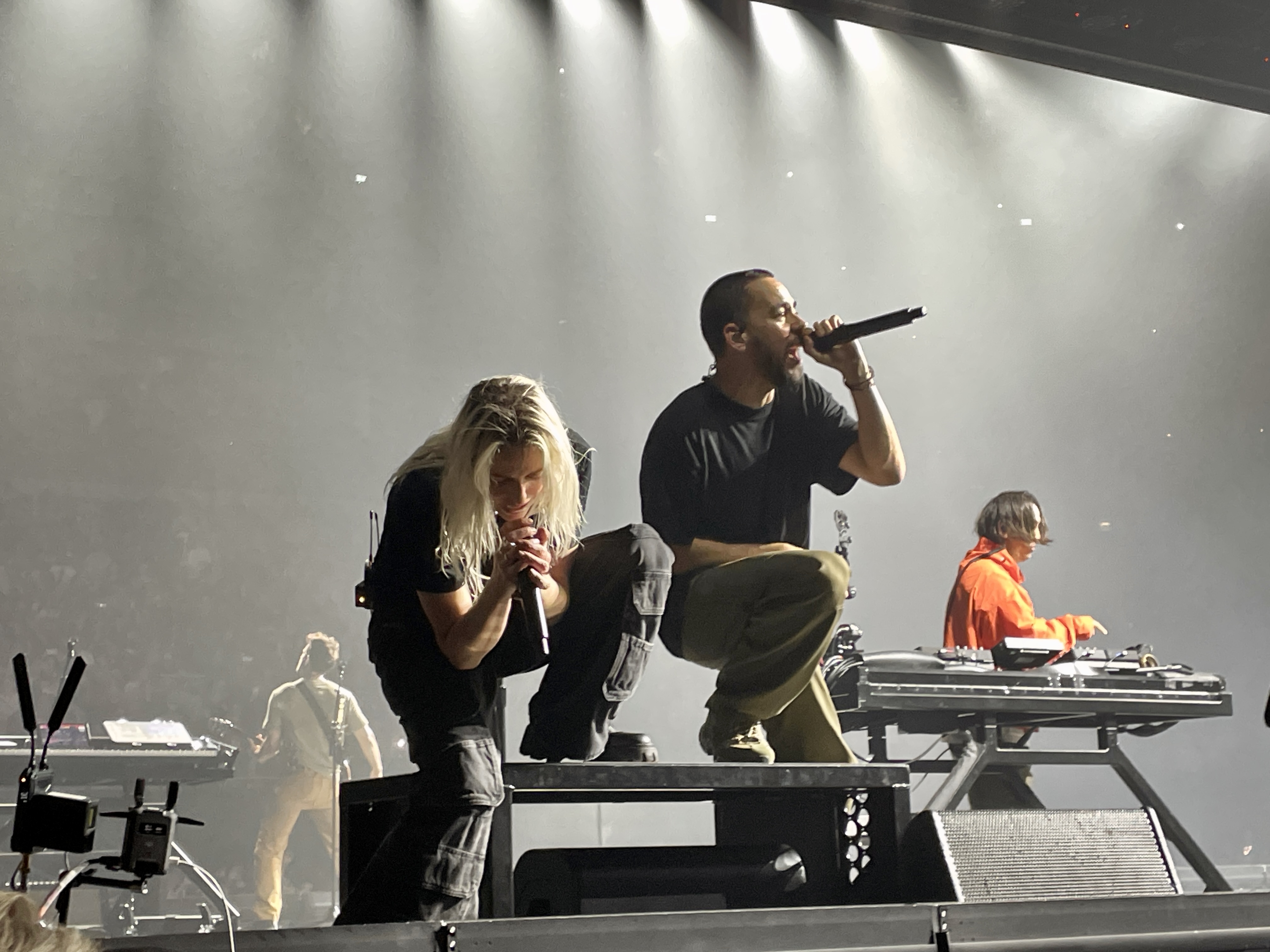
On September 5, 2024, the band stepped onto a stage for the first time in seven years. The album title, From Zero, carried two meanings without laboring either. It pointed to Xero, the original name, and to the awkward arithmetic of beginning again. The record reached No. 1 in 14 countries. “The Emptiness Machine” held the top of Billboard's Rock & Alternative Airplay chart for 15 weeks. At the 2024 Billboard Music Awards, the group won Top Rock Duo/Group and Top Hard Rock Artist, then performed to 55,000 people in São Paulo.
“When we can't hear ourselves on stage because the audience is louder than the P.A., we know we're experiencing something transcendent.”Emily Armstrong
The scale can obscure the tenderness of the maneuver. Linkin Park did not return by declaring the past settled. It made a present tense sturdy enough to stand beside it. Old songs remained in the set, altered by the people now playing them. New songs used familiar mechanics without dressing as antiques. The resulting concerts became less an audition than a negotiation between memory and immediacy, conducted at arena volume.
Xero forms in Agoura Hills.
Hybrid Theory turns a rejected demo history into a mass audience.
Music for Relief begins organizing disaster response.
The band enters a seven-year stage absence.
From Zero introduces Armstrong and Brittain to the lineup.
Unshatter turns the uncertain middle into a film.
The next record is a documentary of not knowing
The latest artifact is not another reinvention speech. It is Unshatter, a documentary co-directed by Hahn and Mark Ritchie. The film begins with private studio sessions in 2022, follows the making of From Zero, and reaches the São Paulo album-release concert. It uses archive footage, candid conversations and fan interviews to show the path while it was still a path, not a case study.
Its live soundtrack arrives September 25, 2026, and the film begins a limited worldwide theatrical run five days later. The timing is apt. A band once named by an available URL is now using cinema to preserve uncertainty. For all the numbers - more than 100 million records, five No. 1 Billboard 200 debuts, two Grammys - Linkin Park's durable subject has remained the distance between the interior voice and the shared room.
That room began in chat windows and on four-track demos. It expanded through headphones, festival fields and relief networks. It went quiet. Then a few people entered a studio without promising anyone a comeback. The useful thing about zero is not that it erases what came before. Zero is a place from which another count can begin.