The Duke Spinout Teaching Billion-Dollar Drugs to Fit Inside a Needle
Deborah Bitterfield raised about $8 million over seven years to prove that a protein could be dried into microbeads and shot through a needle. Then Novartis signed a deal worth up to nearly $1 billion.
There is a boring physics reason that some of the most valuable medicines on earth still have to be dripped into your arm through an IV line, in a clinic, over an hour or more. Concentrate an antibody drug enough to fit a full dose into the small volume a needle can push under the skin, and the liquid turns thick - too viscous to inject, and often too unstable to sit on a shelf. That single obstacle keeps millions of patients tethered to infusion chairs. Lindy Biosciences, a small company in North Carolina's Research Triangle, exists to remove it.
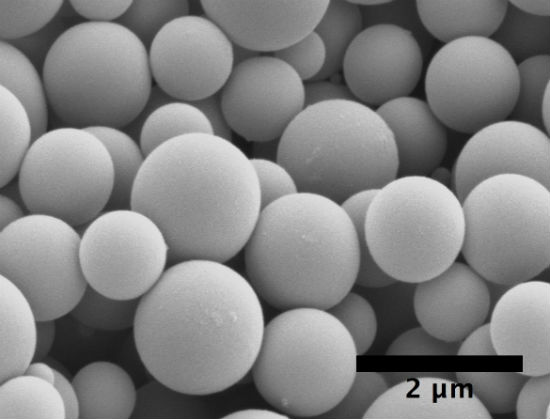
Its answer is a process with an unglamorous, oddly literal name: Microglassification. Take a solution of a protein or monoclonal antibody, break it into tiny droplets, and use common organic solvents to pull the water out - fast, in a matter of seconds. What is left behind are solid, spherical, amorphous microbeads, glassy little spheres of nearly pure protein. They are denser than water, they are stable, and - the whole point - they can be poured back into a carrier fluid to make a thick suspension that still flows through a needle. An IV infusion becomes a shot you give yourself on the couch.
01 / What it doesDrying a drug without breaking it
The trick is speed. Proteins are fussy, folded things; dehydrate them too slowly or too roughly and they unfold, clump, and lose their function. The standard way to dry a biologic for storage is lyophilization - freeze-drying - a process that has ruled protein stabilization for the better part of a century and takes hours. Microglassification does its dehydration in seconds, and it does it while the protein is suspended in a droplet, so the molecule gets locked into a glassy solid before it has time to misbehave. The result is a bead with a protein density above 1 gram per milliliter, which is why so much drug can be crammed into so little injectable volume.
02 / The founderFrom the lab bench that invented it
Lindy Biosciences did not stumble onto Microglassification. Its founder helped translate it. Deborah Bitterfield earned her PhD in materials science at Duke University, doing her research in the lab of Professor Emeritus David Needham - the group that invented the underlying dehydration technique. Where an academic discovery often stalls in the gap between a promising paper and a product nobody has the appetite to build, Bitterfield recognized what the method was worth and founded a company around it in 2017. She had spent time at a university-tech commercialization outfit beforehand, which is a useful thing to have done when your whole business is turning a licensed lab technique into something a drugmaker will pay for.

She built out a bench of veterans around her rather than a swarm of juniors: a COO with two decades in pharma chemistry, manufacturing and quality; a CFO who had founded biotech companies himself; a board seat for the tech-commercialization world she came from. For a company of roughly two dozen people, the resumes read heavy. Bitterfield has said plainly that the Research Triangle made that possible - the region is thick with people who have shipped drugs before. "Being able to tap into the experience of others," she put it, "is probably easier to do here than elsewhere."
03 / The customersThree winners from one shot
Lindy does not sell a drug. It sells a conversion. Its customers are the pharmaceutical and biotech companies that already own an approved or in-development biologic delivered by IV, and would very much like it to be a subcutaneous shot instead. The pitch works because a single reformulation creates three separate winners. Patients get their time back - no infusion appointment, no clinic. Payers save money, because a self-administered shot at home is far cheaper than an hour of monitored infusion. And the drugmaker gets a fresher, more convenient product, which can extend a franchise's commercial life. Lindy has said its pipeline of collaborations has included several of the top-ten pharmaceutical companies.
04 / The dealThe $8 million company that signed a near-billion
In August 2024, Novartis signed an exclusive, global, multi-target licensing and collaboration agreement to convert certain of its medicines into self-administered subcutaneous injections using Microglassification. The structure: $20 million paid upfront, up to $934 million in additional milestone payments, and tiered single-digit royalties on top - a headline value approaching a billion dollars. The number that makes it remarkable is the one next to it. Bitterfield has said the company had raised only a little over $8 million across its entire life to that point. Much of that early money came in unglamorous chunks: small Small Business Research loans from the North Carolina Biotechnology Center, angel checks, a modest Series A of around $1.6 million, a Series B tranche above $3.2 million.
Bars are illustrative and not to exact scale. Deal ceiling combines upfront and maximum milestones.
05 / The moatNot the molecule - the drying step
Most biotech chases a new molecule. Lindy's competitive position rests on something quieter: it does not touch the drug at all, only the way the drug is prepared. That reframes the entire competitive set. The direct incumbent it challenges is lyophilization, the freeze-drying standard. The nearer commercial rivals take different routes to the same goal of higher-dose subcutaneous delivery - excipient specialists like Arecor and Comera Life Sciences tune formulations to cut viscosity, while enzyme-based approaches such as Halozyme's ENHANZE and Alteogen's ALT-B4 let a larger volume go under the skin. Further afield, companies like Rani Therapeutics skip the needle entirely with an oral biologic capsule. Lindy's wager is that a dense, dry, room-temperature-stable microbead beats all of them on the specific axis of cramming a big dose into a small, injectable, shelf-stable package.
To move that wager from bench data toward the clinic, the company published a peer-reviewed stability comparison of Microglassification against lyophilization using a monoclonal antibody in 2023, and in October 2024 named Lifecore Biomedical as its contract manufacturer for process development and commercial scale-up. Peer-reviewed evidence and a named CDMO are the two things a big pharma partner wants to see before it bets a franchise on your drying step.
Where it fits in the market
- Category
- Biotherapeutic drug-delivery / formulation platform
- Core IP
- Microglassification (Duke-licensed dehydration)
- Model
- Licensing + collaboration; upfront, milestones, royalties
- Displaces
- Lyophilization for high-dose subcutaneous biologics
- Anchor partner
- Novartis Pharma AG (2024)
06 / What you can copyThe lessons hiding in the microbead
Strip away the chemistry and Lindy's story is a compact set of transferable moves. Build the moat around a process nobody wants to reinvent rather than a molecule everybody is racing toward. Stay violently capital-efficient - roughly $8 million, much of it non-dilutive state loans, kept the company alive long enough for the big deal to arrive. Anchor the business in a place where you can borrow expertise instead of hiring it all at once. And when you license academic IP, it helps enormously to be the person who understands it best. The obvious caveat sits right alongside: this only works when the underlying science genuinely holds, when a large partner is willing to run the clinical risk you cannot fund yourself, and when the problem you solve - viscosity, in this case - is expensive enough that someone will pay a near-billion-dollar ceiling to make it disappear. Not every drying step is worth that. This one, so far, appears to be.