A syringe has a curious relationship with time. It may take years to design, test, register, manufacture and distribute, then spend only seconds in a hand. Liang Lin has built a career around those seconds. He launched the Sol-Millennium medical-device project in Shanghai in 2007 and gradually attached to it a chain of acquisitions, laboratories, offices, factories and sales operations. The objects at the center remained modest in scale: a needle, a shield, a tube, a spring, a cartridge. The organization around them became continental.
Lin is a low-volume public figure. His LinkedIn activity is mostly reposts from colleagues and company accounts. There is no practiced founder folklore about a garage, a napkin or a thunderclap. The available story instead lives in the decisions: buy a route into the Americas, put researchers in Switzerland, establish a base in Poland, move the headquarters to Chicago, invest in a public needle-free company. If personality can be read through corporate verbs, Lin's preferred verb is connect.
A colleague once relayed his phrase for the whole design: a “Global Medical Device Superhighway.” It sounds like the sort of language that might require a hard hat. Yet it is surprisingly exact. A highway matters because separate places become a system. Sol-Millennium's map joins product design to precision molding, manufacturing to regulation, and regional distribution to clinical routines. One clever safety mechanism is useful. A repeatable way to move many such mechanisms from an engineer's desk to a hospital storeroom is a business.
A family tree made of molds
Sol-Millennium dates its industrial prehistory to 1982, when Lin Zuoqian worked in precision plastic-mold manufacturing. The company does not publicly spell out a family relationship, and there is no need to embroider one. The practical inheritance is plain enough: disposable medical products begin with the ability to reproduce small plastic parts with almost comic consistency. A flaw measured in fractions can become a failure measured in people.
When Liang Lin launched the medical project a quarter-century later, he started on top of that manufacturing logic. In 2009, Sol-Millennium entered North America and Brazil by acquiring Inviro Medical and Medica Brazil. It also established an office in Poland to cover Europe and the Middle East. By 2015, the company had added a dedicated R&D center in Switzerland. An employee later remembered that center's beginning as a modest room with two people. Nine years on, it occupied 300 square meters and included research, quality and regulatory functions.
The operating circuit
Lin's education includes Royal Holloway, University of London, though his public profile supplies neither a degree nor dates. By 2016 he was representing Sol-Millennium at a World Health Organization gathering in Geneva devoted to injection safety. The participant list is an unshowy artifact, which is precisely why it matters. It places him in the room where manufacturers, device specialists and safety organizations were trying to convert policy into objects that could survive everyday use.
Three years later, Sol-Millennium shifted its global headquarters to Chicago. The move gave the group an American center while its manufacturing and research network remained distributed. During the pandemic response, the company says it supplied more than two billion syringes and needles for global vaccination programs in 2021. The number belongs to the company rather than to Lin alone, but it reveals the scale of the machine he had assembled. In medical supplies, capacity is an argument made in pallets.
“Global Medical Device Superhighway”Liang Lin's description of the Sol-Millennium platform
The needle maker crosses the aisle
The most interesting turn arrived from the other side of the product category. In 2022, Sol-Millennium became a distributor for NuGen Medical Devices, a Canadian-listed developer of needle-free drug-delivery systems. The relationship deepened. In September 2024, Sol-Millennium and Nature Health closed a C$10 million secured convertible-debenture financing for NuGen. Lin joined its board and became executive chairman. Four months later, he added the chief executive role.
The apparent contradiction is neat enough to tempt a slogan: a needle executive takes charge of a needle-free company. The operating connection is more useful. Sol-Millennium knows the last inch of medication delivery, including manufacturing, distribution, training and regulation. NuGen brings a system designed to deliver medicine with a high-pressure jet rather than a conventional needle. The technologies differ; the choreography around adoption is familiar.
Make contact safer
Safety syringes, needles, blood-collection devices and the infrastructure to manufacture and distribute them.
Rethink contact
Transfer, refill and prefilled platforms intended to simplify needle-free drug delivery.
On taking the NuGen job, Lin said his goal was to use his experience to grow sales worldwide. His later language became more product-specific. In 2026, as NuGen filed patents around spring charging, dose setting, refill systems and prefilled nozzles, he set a simple usability test: someone able to use an insulin pen should be able to adopt needle-free technology with comparable confidence and ease.
That sentence contains the practical restraint often missing from innovation talk. Newness does not exempt a device from being learnable. A mechanism can be ingenious and still lose to the familiar object in the drawer. Lin's companies operate in a field where the winning feature may be a one-handed activation, a transparent housing or tubing that refuses to kink. Progress frequently arrives wearing sensible shoes.
Quality has a paper trail
Medical-device stories are usually told through launches and patents. The less photogenic chapters concern correction. In March 2024, the FDA sent Sol-Millennium a warning letter after an inspection. A December 2025 closeout said the company appeared to have addressed the cited violations. The agency also made clear that later inspections would determine whether the fixes endured. Lin was the named recipient in both his capacity as chief executive and the responsible officer at the Chicago address.
That episode belongs in the profile because regulation is part of the operating system, not scenery around it. Sol-Millennium sells devices whose credibility depends on routine, documented compliance. The closeout marked completed corrective work; the continuing scrutiny is the price of staying in the business. Lin's public persona may be quiet, but the chief executive's signature on a regulatory file is louder than a conference-stage anecdote.
His role at NuGen also makes governance visible. In August 2026, NuGen signed a non-binding letter of intent to acquire Sol-Millennium Canada. The proposed share transaction would leave Sol-Millennium Medical HK with roughly 65 percent of NuGen after closing. In September, the Lin-controlled Hong Kong entity agreed to lend NuGen up to C$1.3 million. Lin declared his conflict and abstained from the NuGen board's deliberations. The deal remained proposed, with due diligence and approvals still required.
A founder drawn in negative space
What is Lin like? The honest answer is bounded. Public evidence supports a few strokes. He thanks teams. In one comment he wrote that he was “super proud” of what colleagues had built together and thanked them for their support during his first three years in the United States. He travels: a 2025 visit to Brazil included meetings with staff and partners and business-review sessions. He favors systems language over personal revelation. The rest should remain blank rather than become legend by adjective.
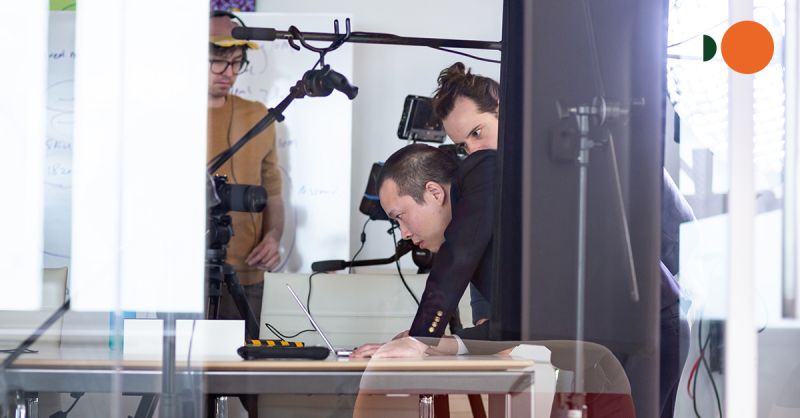
The photographs offer a small, fair anecdote. During a 2023 filming day for a Reuters campaign, the camera crew captured Lin leaning over a laptop, tie slightly loose, apparently studying the screen while the production gathered around him. Two years later, a Brazil team photograph put him in the front row in a pink T-shirt, hands in pockets, colleagues clustered behind. Both images are relaxed. Neither pretends that a chief executive must look like a monument.
His ambition is easier to document than his temperament. At Sol-Millennium, it is the connected highway. At NuGen, it is a family of needle-free platforms broad enough to serve multiple drug formats and simple enough to compete with familiar delivery tools. The 2026 patent program sketched three lanes: transfer systems that work with existing containers, reusable refill systems for chronic therapies, and prefilled systems intended for fixed-dose use.
The career has a satisfying circularity. Lin began by making an old clinical object safer. He now leads a company trying to remove that object from some procedures altogether. One path refines the needle; the other designs around it. Both depend on the same unromantic disciplines: tolerances, pressure curves, quality systems, training, inventory and trust.
That may be the clearest explanation of Liang Lin's work. He does not sell a single future. He builds routes between several workable ones. The point of risk remains small enough to disappear between two fingers. The enterprise required to manage it is anything but.