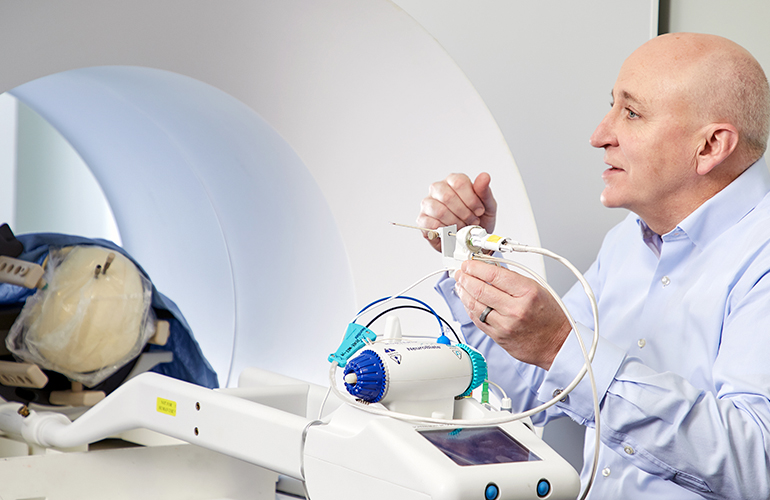
One month into Marty Emerson's new job, the machine presented him with a riddle. It was August 2016. Emerson had just become chief executive of Monteris Medical, the Minnesota company behind NeuroBlate, a robotically controlled laser system used by neurosurgeons inside an MRI scanner. Then came a report that the tip of a laser probe had heated when it was not supposed to. For a young technology company, this was not the sort of welcome basket one puts in the lobby.
Emerson had spent roughly three decades in medical devices without facing a recall like the one that followed. He had run a public company with more than $500 million in sales. He had led a private cryotherapy business through an acquisition. He had managed abroad, sold products, read balance sheets and learned the peculiar tempo of regulated businesses. None of that made the probe problem small. It did, however, give him a way to behave while it was large.
The company made the investigation its first priority. Its people tested more than 20 permutations of MRI equipment and scan types. They narrowed the problem to a coated metal thermocouple and the way energy could travel down the probe under particular conditions. Executives and regulatory specialists spent late nights editing responses to the Food and Drug Administration. The work consumed Emerson and dozens of colleagues for two years.
“I'm not an FDA expert. I relied heavily on the scientists and the technologists and the engineers and the experts on my team.”Marty Emerson, reflecting on the NeuroBlate recall
It is an arresting sentence because chief executives are usually paid to make uncertainty look house-trained. Emerson did something more useful. He named the edge of his knowledge, then put the right people near the problem. A redesigned probe with fiberoptic-controlled cooling won FDA clearance in October 2018. The metallic component was gone from the patient-contacting assembly, and the restrictions imposed on MRI scans could be lifted.
There is no neat morality play here. A regulatory consultant questioned why the FDA was not alerted sooner; Emerson said the company had been conducting extensive testing and that the agency never suggested Monteris had moved too slowly. The point is not that every decision came gift-wrapped in hindsight. The point is that the response became visible: test, report, revise, redesign. Innovation, once it leaves the slide deck, is mostly verbs.
The accountant who kept changing rooms
Emerson's first professional room was finance. He graduated from Marquette University in 1985 with a bachelor's degree in accounting, joined Baxter International and passed the CPA examination the following year. That beginning explains part of his style, but only part. A ledger can teach discipline; it cannot teach you how to sell, manage across cultures or decide which engineer to trust at midnight.
So he moved. His early career included management posts at Baxter and Boston Scientific, with domestic and international responsibilities. In the late 1990s, he worked as a Boston Scientific general manager in Singapore. By 2000 he was at American Medical Systems, first overseeing international business, then global sales and marketing, then operations. He became president and chief operating officer in 2004 and chief executive in January 2005.
A career built across functions
Doug Kohrs, the American Medical Systems chief who promoted him, noticed the unlikely mixture. Emerson's sales experience and communication skills helped bring him into the company; his level-headed, numbers-oriented manner marked him for broader responsibility. Kohrs remembered a leader who did not declare the sky was falling. He looked at the situation, found the resources and fixed it.
In 2008 Emerson left AMS to run Galil Medical, a cryoablation company. The technology changed from one business to the next, but the operating problem rhymed: take a specialized clinical tool and build the organization that can carry it. He stayed eight years and led Galil through its 2016 acquisition by BTG, a deal valued at up to $110 million.
Then came Monteris. On paper, the role checked familiar boxes: complex technology, minimally invasive procedures, a global market and room to grow. In practice, it put Emerson closer to neurosurgery, where millimeters are geography and optimism must submit its paperwork.
From repair to proof
Once the redesigned probe cleared the regulator, Monteris still had to do the less cinematic work of creating a category. A new device is not adopted merely because it exists. Surgeons need training. Hospitals need a workflow. Payers need evidence. Patients and families need language that makes an unfamiliar procedure comprehensible. Each constituency holds a different key, and none opens the whole door.
The company's answer has been accumulation. NeuroBlate had been used for more than 2,000 patients by late 2018 and passed 3,000 in 2020. By 2022 it was installed at more than 100 hospitals in the United States and Canada. In 2026 Monteris said the system was in nearly 130 North American health systems.
Adoption is a long verb
NeuroBlate presence in North America
More important to Emerson's stated philosophy is the evidence beneath that expansion. Monteris sponsored LAANTERN, a prospective, multicenter registry designed to follow real-world use for as long as five years. It enrolled more than 1,000 people. In August 2026, the ninth manuscript from the effort appeared in the Journal of Clinical Oncology, analyzing 787 tumor patients treated across 25 American centers. The company had turned a commercial product into an ongoing question that many institutions could help answer.
The distinction matters. A company can market a device on the charm of possibility for only so long. A registry forces it into a longer conversation, one in which outcomes, complications and quality of life have the last word. Emerson has repeatedly described sustained clinical research as a shared investment by employees, physicians and financial backers. It is both a scientific undertaking and an operating model.
“Almost every emerging technology at some point or another in its maturation process has to go through one of those trials by fire.”Marty Emerson
The company after the hard chapter
By 2026, Monteris was preparing for another kind of test: scale. In March it closed $28 million in Series E equity and replaced an earlier credit arrangement with a $35 million facility from Trinity Capital. The announced uses were plain rather than poetic - a larger American commercial footprint, technology development, clinical research and geographic expansion. A Twin Cities business report said Emerson believed the infrastructure was in place to hire and pursue $100 million in revenue.
The board work around his day job also widened. Emerson has chaired SubioMed since 2019 and served as a Contraline director since 2021. In February 2026, Nuwellis appointed him as an independent director and placed him on its audit, compensation, and nominating and governance committees. The designation that jumps out is “financial expert.” Four decades after Baxter hired the young accountant, the first language of his career remains useful.
None of this makes Emerson a laboratory scientist or a neurological surgeon, and he has never claimed those roles. His craft is translation across groups that can otherwise glide past one another: engineers and regulators, clinicians and sales teams, investors and researchers. Medical devices require all of them to be right at once. The CEO's task is to keep the table intact long enough for that to happen.
Even his public enthusiasm tends to arrive with a supporting noun. Evidence. Data. Access. Partners. When he speaks about changing lives, he quickly returns to prospective studies or reimbursement or the physicians who decide how a tool should be used. The rhetoric has bolts in it.
That may be why the recall remains the most illuminating episode in his record. Success can disguise the machinery that produced it. Trouble removes the casing. Under pressure, Emerson's method became legible: no theatrical panic, no claim to omniscience, no retreat from the uncomfortable detail. Just a long sequence of experts, tests, revised components and conversations.
A career like his invites the usual summary - Baxter, Boston Scientific, AMS, Galil, Monteris - as if a collection of company names explains a person. The better clue is the movement between them and within them: finance to sales, Singapore to Minnesota, public markets to private capital, freezing technology to laser heat. Emerson has repeatedly entered rooms where he was not the deepest specialist and learned enough to organize the specialists who were.
Now Monteris wants its technology to become a routine option rather than an exotic one. Routine is an unromantic aspiration for a robotics company, but it is the right one. In medicine, routine means that evidence has traveled, training has worked, payment has been settled and trust no longer needs an introduction. It is innovation after the adjectives have worn off.
The laser may do its work in minutes. Building the system around it takes years. Marty Emerson, accountant and operator, appears perfectly content to stay in the room.