Consider the catered lunch. On LEXA’s feature list, it appears beside pre-camp and post-camp care as an “Add-On Class.” That is a wonderfully revealing classification. Lunch has no syllabus. Nobody earns a certificate in Tuesday’s sandwich. But a camp operator needs to know who ordered it, which child receives it, and what the family owes. In the business of running classes, the edges of the lesson have a way of becoming the job.
- Enrollment, family accounts, billing, and attendance share one platform.
- Camps, studios, and after-school operators are the intended buyers.
- Plans start at $95 monthly; daily-operation features vary by tier.
LEXA Class Management, also branded LexaClass, builds around those edges. Its online software serves businesses that organize people into scheduled activities: a dance lesson, a summer camp, a martial-arts session, a birthday party. The interesting question is how much administration can travel with the enrollment, so staff can follow what happens next.
The family is the unit
A ticket usually belongs to one person at one event. A family’s relationship with a class business is messier. One child may attend camp while another takes an ongoing class. The payer and the participant are different people. An emergency contact is someone else again. Treating each signup as an isolated transaction creates work for whoever has to join the pieces later.
LEXA offers a parent portal, family registrations, and bundled class packs. Its public IDEA Lab Kids registration forms make the distinction tangible: they ask for the adult’s contact type and include emergency-contact information. The form is building a relationship record before anyone reaches the classroom. That matters to a business whose customers return, change schedules, and bring siblings.

Follow the enrollment past checkout
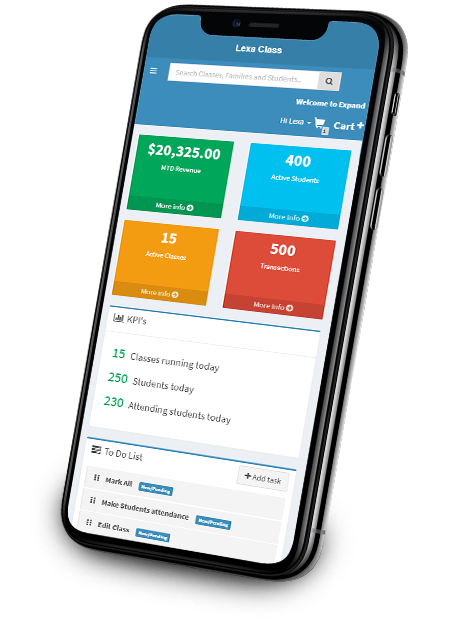
The product pairs online availability with subscriptions, payment options, staff assignments, attendance, and reports. It also accommodates parties and add-on purchases. The practical appeal is continuity: the person managing a roster needs information related to the person managing billing, even when they are different employees looking at different parts of the day.
Here is a useful way to evaluate that promise. Imagine enrolling two siblings, adding care before camp, and arranging recurring tuition. Then follow the records into the attendance workflow. This is an illustrative buying test, not a report of a customer outcome. It asks whether the software understands the ordinary combinations that make a simple signup complicated.
- 01Family
account - 02Class +
extras - 03Payment
schedule - 04Daily
attendance
The $35 question
LEXA sells monthly subscriptions. Silver costs $95 and lists up to 100 students, ten instructor accounts, and one school. Gold costs $130 for 101-250 students, 30 instructor accounts, and up to four schools. Platinum costs $180 for 251-1,000 students, unlimited instructor accounts, and up to eight schools. Larger and franchise requirements receive custom quotes.
The $35 step from Silver to Gold deserves attention. Gold and Platinum list check-in/check-out, parties, an online store, advanced reports, email notifications, e-gift cards, and ACH/eCheck. Silver’s list omits those features. A small operator should therefore read past the student allowance: fitting below a capacity limit does not settle which plan fits the working day.
The company advertises no-contract plans and a process to request a full refund within 90 days. That creates an opportunity to test a real workflow. A sensible trial has a concrete finish line: a family can enroll, staff can find the right record, and the payment schedule matches what was promised.
A product with a place to go
Public enrollment pages identify IDEA Lab Kids locations including Ballantyne, Aliana, Spring Branch, and Stouffville. The Ontario location’s LEXA portal lists camps at 2 Park Drive. These are useful examples because they put a setting around an otherwise broad software description. A location with recurring families and changing programs has plenty of reasons to want a common administrative record.
The customer policies add another wrinkle. Stouffville’s registration terms distinguish an enrollment acknowledgment from confirmation that a class will run. Accepting a form and delivering a program are separate events. Software can carry the information between them; an operator still has to decide the rules and explain them clearly.
That distinction is worth carrying into any purchase decision. A registration system can record a policy without making it a good policy. The operator must still choose cancellation deadlines, decide how to communicate changes, and make sure staff know what a status means. Connected records are useful only when the people reading them understand the same rules.
The work before the first signup
ITVibes lists LexaClass among its products and describes a setup sequence: understand the programs, configure classes and pricing, prepare registration and communication, then launch. It also offers integration, interface customization, and support. That sequence gives the product an implementation dimension. The organization’s actual schedules and payment rules have to become settings somebody can use.
For a reader considering similar software, this is the part to copy. Map the day before booking the demo. Write down who registers, who pays, which extras are sold, and who records attendance. Bring those examples to the demonstration. A polished dashboard tells you less than watching your own awkward registration handled from beginning to end.
“Make life easier for your staff, teachers, parents & students.”
LEXA’s stated product aim
Also test the handoff between employees. Ask an instructor to find a roster while an administrator checks the family’s payment arrangement. Watch where either person needs to ask a colleague for an explanation. Those pauses offer a practical way to judge whether the setup matches the organization, even before there is a full season of enrollments to examine.
Choose it by the day you run
LEXA occupies a familiar class-management market. Jackrabbit Class documents family registration and parent enrollment; iClassPro documents class setup and billing. A parent portal alone cannot distinguish a vendor. LEXA’s specific proposition is the combination of family registration, recurring programs, parties, add-ons, and daily administration, offered through published subscription tiers.
The fit becomes weaker when those are not the jobs a buyer needs done. Someone primarily purchasing lesson content or a system for delivering online instruction should evaluate those requirements separately. For an operator juggling enrollment and the details around it, the catered lunch is a good place to begin. Follow that order to the right child, the right day, and the right bill. There is your demo.
Take a closer look
Explore LEXA’s website, product features, subscription plans, or request a live demo.
More from ITVibes on LexaClass, its website-launch blog, and LEXA on LinkedIn.