A milk carton is a funny place to begin a story about artificial intelligence. Lewis Polansky would probably allow the joke. His Y Combinator biography says he “randomly co-invented” one, a description with the cheerful untidiness of a founder who has shipped enough odd projects to stop arranging them into a grand prophecy. The actual project was SoyBox, a soy-based packaging board for liquids. Polansky and Laurian Lien wanted to turn a seven-layer manufacturing process into one. Their entry placed second in an Indiana soybean innovation competition and earned a $10,000 prize.
Years later, the material has changed but the gesture remains familiar. Captain, the San Francisco company Polansky runs with co-founder and CTO Edgar Babajanyan, takes the many-layered business of file retrieval - parsing, chunking, embeddings, storage, search, reranking, permissions and citations - and places it behind an API. The customer connects files. The agent gets searchable evidence. Somewhere beneath the deck, a great many moving parts keep moving.
Polansky is Captain's CEO, an engineer and a designer with finance studies at Purdue University. Captain was founded in 2025 and entered Y Combinator's Winter 2026 batch. Its current description is plain by startup standards: self-tuning file search for AI agents. It syncs complex, multimodal files and cloud storage, then adjusts retrieval to the shape of a customer's data and workload. Captain reports that its benchmark accuracy moves from roughly 78 percent for standard retrieval-augmented generation to more than 97 percent. Benchmark claims deserve the sober attention one gives any number wearing a nice suit. The more durable idea is the interface.
The evidence problem
In 2024, before Captain, Polansky launched aiCode.fail. The product reviewed AI-generated code with a separate, server-side model. The reviewer arrived without the original chat's context, like a second engineer entering the room after the first has become too fond of the answer. Polansky said the tool helped him deploy three times faster. More amusingly, he used it to help code itself.
The recursive stunt contained a serious product observation. Generation is cheap enough to create a new verification problem. A model can produce code in seconds, but confidence arrives more slowly. aiCode.fail tried to inspect the output after it was made. Captain moves closer to the source, improving the evidence available before an agent answers. One checks the sentence; the other checks whether the right books were open on the desk.
Today’s LLMs are held back not by intelligence, but by access.Lewis Polansky, announcing Captain
That line became Polansky's concise diagnosis. Company knowledge is scattered across PDFs, drives, object stores and SaaS products. Some of it is text; some arrives as tables, diagrams, video or images. Some belongs to everyone; some emphatically does not. A useful agent must find the relevant piece, respect access controls and show where the answer came from. Intelligence without retrieval becomes an eloquent colleague who has lost the filing cabinet key.
A habit of translation
The early record is not a straight line toward enterprise search. It is more interesting than that. In 2020, Polansky worked with Devin Shih and Nicholas Parra on Hourly, which received the Best Technical award in the Congressional App Challenge for California's 27th District. Two years later, he and Evi Shih created Lexi, a chat application designed to help speakers of different languages communicate. Lexi placed third in the district. Judges for the competition included technical volunteers from Caltech and JPL.
Lexi made language cross an interface. SoyBox tried to make a layered industrial process less layered. aiCode.fail translated a model's plausible code into a more trustworthy shipping decision. Captain translates the shifting machinery of retrieval into a stable endpoint. The projects are different enough to resist a tidy origin myth, yet they share a taste for reducing distance between a complicated system and the person trying to use it.
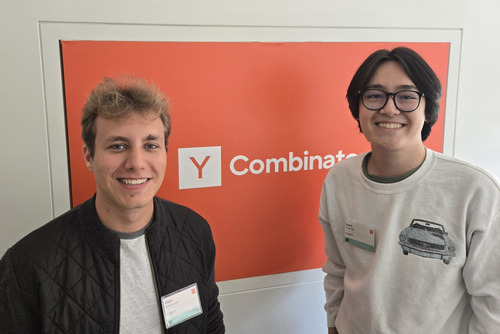
There are other details in the collection. Polansky earned Eagle Scout rank in 2023. His public profile lists advanced French fluency and an early cybersecurity education organization. Captain describes the founders as engineers who encountered the limits of enterprise data work firsthand. Polansky brings product design and finance; Babajanyan brings NLP research and years spent building production retrieval systems. Their division of labor reads less like business founder plus technical founder than two builders approaching the same filing cabinet from different doors.
The stack keeps moving
Captain's March 2026 Hacker News launch made the machinery unusually visible. The founders described an ingestion engine that converts source material to Markdown, contextual embeddings, second-stage reranking and hybrid search. They explained page-number citations for PDFs, metadata filters for access control and integrations with cloud storage. They also answered the inevitable question: why not build it yourself?
Polansky's answer was not that every internal system is impossible. It was that production file search requires a chain of decisions, and the chain changes. Embedding models improve. Parsers specialize. Retrieval techniques trade accuracy against latency. Structured data behaves differently from prose. Captain's proposed advantage is to maintain that chain while preserving one interface for the developer. “The stack is constantly changing,” Polansky wrote, “but the Captain API creates a standard interface for this.”
The exchange also showed his temperament in miniature. A commenter said the nautical homepage initially looked like a ship-tracking service. Polansky did not deliver a lecture on brand strategy. He said they might tweak the hero and thanked the person. Elsewhere, he gave specific answers about competitors, bounding-box citations and the limits of parsing large tables. Precision when it helps; brevity when the customer has already made the point.
The stack is constantly changing but the Captain API creates a standard interface for this.Lewis Polansky, on Hacker News
The product has kept changing too. In January 2026, Captain announced its v2 API and said it had migrated non-textual knowledge away from vector storage and into object storage, reporting a threefold latency reduction and better recall in its experiments. It described work on long-context document embeddings and domain detection. By March, Captain had announced Connected Search, Cloudflare R2 indexing and Odyssey, an agent-ready private-market dataset with more than 155 normalized attributes. The company was broadening from a retrieval pipeline into a larger answer to a pointed question: what data should an agent be allowed to know, and how quickly can it know it?
Hourly wins a Best Technical award in the Congressional App Challenge.
Lexi places third with a chat interface across languages.
SoyBox wins a $10,000 second-place innovation prize.
aiCode.fail launches as a second set of eyes for generated code.
Captain is founded, joins YC W26 and launches its file-search API.
Build the interface, then listen
Captain operates in a busy neighborhood. Developers can choose lower-level search engines, vector databases, cloud file-search products and application-layer knowledge assistants. Polansky positions Captain between those categories. It is infrastructure for developers who control their own agents but do not want to rebuild ingestion and retrieval whenever the underlying tools change. The wager is that a managed layer can earn its keep through accuracy, scale, integrations and the profoundly unglamorous work of maintenance.
There is a practical lesson here for builders. New technology invites spectacle, yet useful products often emerge from shrinking the distance between input and evidence. Polansky's work repeatedly chooses a seam where complexity leaks onto the user: a language boundary, a manufacturing stack, unreliable generated code, a brittle retrieval pipeline. He builds at the seam, then gives the result a button, an API or, once, a carton.
His aspiration for Captain is visible in the product's direction rather than in a personal declaration. Make complex files searchable. Keep data fresh. Carry permissions forward. Return citations. Let the agent use the knowledge without requiring every company to become a retrieval laboratory. It is an infrastructure ambition with a designer's preference for disappearance: when the machinery works, the user notices the answer.
The pattern also explains why Polansky's finance background belongs in the story. Search quality is an engineering problem, but buying infrastructure is an organizational decision. In one public account of learning enterprise sales during YC, the Captain founders divided purchasing motives into revenue, cost and risk, then distinguished the fast conversion of an individual user from a longer enterprise pilot. Their takeaway was to pursue customers who adopt quickly instead of collecting impressive names. The formulation is tidy, perhaps because it treats sales as another retrieval task: locate the urgent problem, test whether the product answers it and preserve the evidence of return on investment.
That combination of design, engineering and commercial attention matters because a retrieval system can fail in several registers at once. It may be accurate but too slow, broad but careless with permissions, technically elegant but miserable to integrate. Captain's roadmap - fresher connections, faster object search, SDKs and more capable handling of non-text material - amounts to a list of those frictions. Polansky's public work suggests he prefers addressing them in artifacts. The translation app demonstrated communication. The code checker demonstrated review. The API demonstrates an abstraction. Even the soy board had to demonstrate a manufacturing reduction, not merely announce one.
And if the metaphor gets in the way, change the homepage. The best founders are rarely precious about the wrong layer.