The first store was supposed to be in Malibu. For Frankies Bikinis, the swimwear brand founded by Francesca Aiello, the choice had a pleasing logic: hometown roots, sunshine, beach culture. Then Leap compared markets. SoHo, with its younger shoppers and tourist traffic, offered another kind of opportunity. A California bikini business began its retail journey in New York.
That small geographic surprise explains much of Leap. Opening a shop feels like an act of taste. Running one requires an organization. Leap sells brands access to that organization, from choosing the address to training the person who unlocks the door.
- The job: launch and operate stores under a client’s brand.
- The customer: growing consumer businesses with demand, but limited retail infrastructure.
- The bargain: pay for shared expertise, operations and, in many agreements, relief from holding the property lease.
01 Malibu was the idea. SoHo was the test.
Frankies had already learned to sell online. Physical retail introduced different questions: how long would construction take, who would manage the staff, and did a desirable address justify a long lease? Leap’s January 2025 case study describes a team facing commitments that could stretch to a decade in Malibu.
Comparing markets changed the sequence. SoHo came first; Malibu remained part of the expansion. New York also complicated an easy merchandising assumption. Winter called for more knitwear, but tourists and locals heading somewhere warm still wanted swimwear. The store became a place to learn what shoppers actually needed.
The transferable lesson is specific: compare customer behavior across locations before letting the founder’s preferred neighborhood settle the decision. Geography is part of the product.
02 A store comes with people attached
Amish Tolia and Jared Golden founded Leap in 2018. They had met at Indiana University and built businesses together before. Their insight concerned a mismatch: the skills that make someone good at building a consumer brand do not automatically make that person good at developing and operating real estate.
Leap’s answer spans the physical and digital messiness. It evaluates locations, designs stores, coordinates development, recruits and trains employees, and manages daily operations. Technology connects sales, inventory and customer information. Merchandising and marketing turn those records into decisions about what to stock and whom to invite back.
For shoppers, the result is a store bearing the brand’s own name. For the brand, it means an operating partner with responsibilities that continue after opening day. That ongoing work distinguishes Leap from a broker who finds a space or a software vendor who supplies the checkout system.
- 01ConnectRead the demand
- 02LocateChoose the market
- 03BuildMake it the brand
- 04OperateStaff, sell, learn
03 Someone still signs the lease
The commercial arrangement matters. Leap’s public platform page lists a one-time build contribution, inventory and marketing supplied by the brand, a monthly operating fee and a percentage of sales. The economics depend on the agreement and the store. Lower initial investment still leaves the brand needing enough margin to support the service.
In Leap’s lease-backed model, Leap takes the property commitment. In a 2024 interview, Tolia described leases often lasting five to ten years, paired with shorter brand contracts. If a store underperforms, Leap can seek another brand for the space. A network of possible tenants makes that proposition more plausible than it would be for a single retailer.
“We sign the lease, not you.”
Leap’s platform pitch, in seven words
The risk therefore has an owner. Vacancy, a poor location or a weak replacement pipeline can still hurt Leap. A brand also trades some operating autonomy for the convenience of a partner. An experienced retailer with its own infrastructure may prefer to retain those functions and their economics.
Before choosing an operator, a brand can map the work it already does well and price the missing functions separately. Compare the full arrangement with an internal team, including management time, rather than comparing the fee with rent alone. Then ask how a weak store would be handled: who can change the assortment, replace staff, approve spending or end the agreement? Those decisions shape the practical value of outsourcing.
04 Three stores. Then thirteen.
Grown Brilliance illustrates why a capable online business might welcome the trade. The jewelry company had opened three stores itself. Its team then confronted long commitments, development delays and operating work that pulled people away from their existing jobs.
Leap’s case study reports that the brand reached thirteen locations in ten months, with twelve operated by Leap. The arrangement also evolved: Grown Brilliance handed over operations at its original stores while retaining their leases. Store management could be separated from ownership of the property obligation.
Company-published case study, January 2025. Twelve of the thirteen locations were Leap-operated.
These are selected customer results published by Leap, rather than a forecast for every brand. Their useful detail is the change in organizational capacity. Expansion no longer depended entirely on how many construction and staffing problems the brand’s own team could absorb.

05 The neighborhood is part of the machinery
Density is central to the model. Leap says clusters of nearby stores allow shared labor and operating efficiencies. Experience with one location can inform another. Its 2023 funding announcement emphasized investing in density within existing markets, a more practical ambition than simply collecting pins on a map.
By January 2025, Leap announced $20 million in financing, reported profitability and added former Neiman Marcus Group CEO Karen Katz to its board. Today its website advertises more than 115 leased spaces and separately lists 100 active stores. Available space and an operating shop are different measures.
There is also evidence of the model’s vulnerability. Investor Equal Ventures reported that platform merchandise sales were down effectively 100% entering April 2020. Shared infrastructure could not stop shoppers disappearing during the pandemic. It makes execution easier; it cannot manufacture foot traffic under every condition.
06 Four companies, one storefront
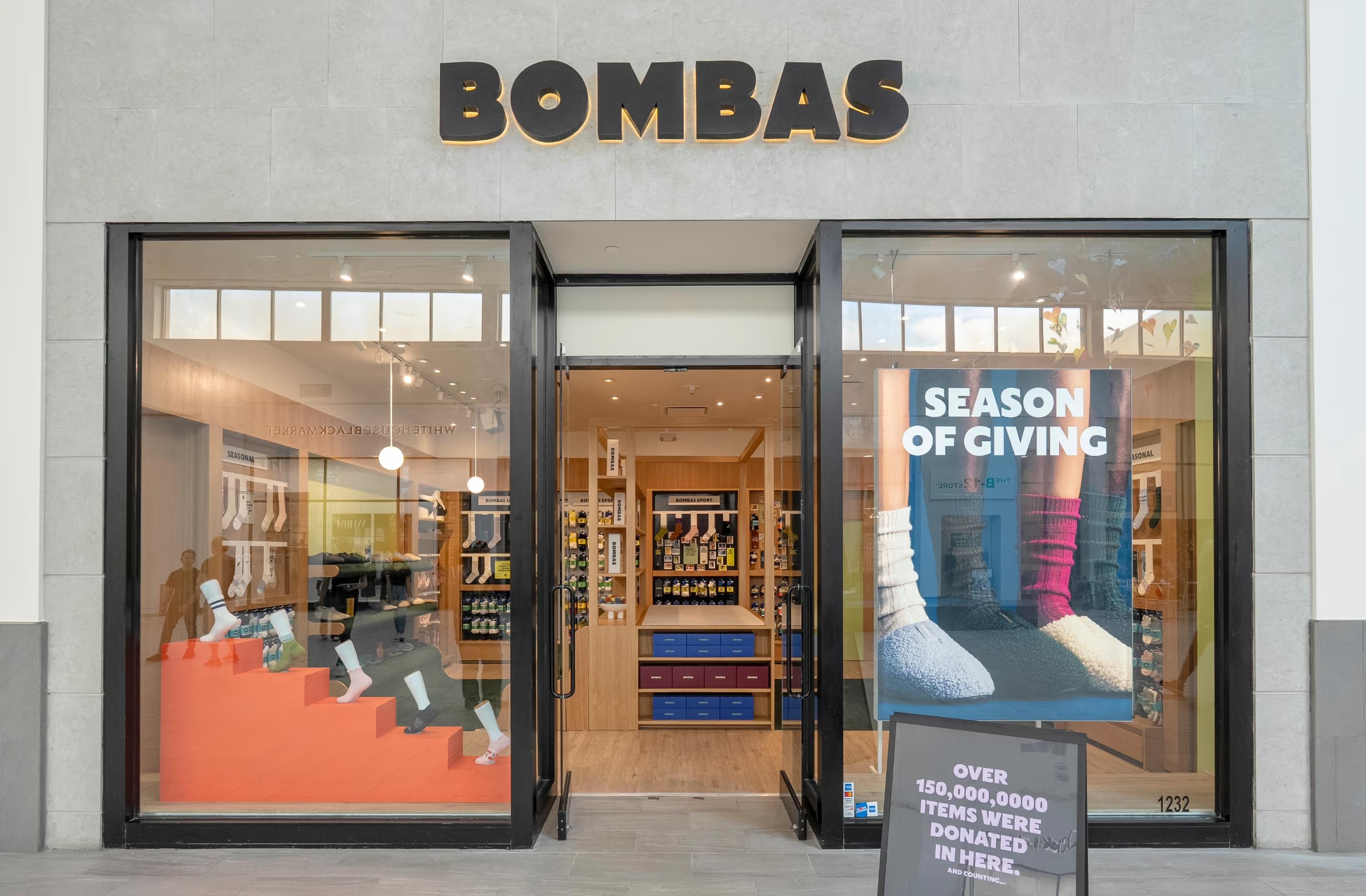
The partnership with Shopify and Simon makes Leap’s market position especially clear. Shopify supplies unified commerce technology, Simon contributes shopping-center access, and Leap handles store execution. Bombas is a featured example of the combination. No single piece substitutes for the others.
For a growing brand, the question becomes whether outsourcing retail leaves more attention for products and customers while producing sound store economics. Demand, margin and willingness to share control still matter. Leap’s proposition is that a company can get its name above the door without first building an entire retail department behind it.