The blue plastic folder was the sort of object good intentions produce: tidy, portable and very sure of itself. Lauren Schmidt was 19 on her first trip to Tanzania. She had watched a documentary about Jane Goodall, imagined a future among chimpanzees, survived exactly enough biology to reconsider, and arrived wearing an overpriced safari hat. In the folder were printed pages she had grandly labeled as solutions for women in Africa. She was ready to help.
Then a Tanzanian program director told the visitors to sit back and listen. Schmidt watched women hold space for one another, trade business strategies, laugh and solve their own problems. The pages in her folder became embarrassing in real time. Her summary of the moment, years later, was wonderfully brief: “God, I know nothing.”
Many careers begin with a show of competence. Schmidt’s began, by her own telling, with the collapse of it. The lesson did not send her home in defeat. It gave her a better reason to return.
The country that refused to become a backdrop
Schmidt completed a bachelor’s degree in sociology at Bates College and a master’s in social work at Columbia University, concentrating on social enterprise administration and international social welfare. Then Tanzania became more than the location of an earnest teenage awakening. It became home.
She spent ten years there as a social worker and dean of students, working with international students and development projects. Her public record includes early work with Living Waters Primary School and the Foundation for the New Life of Street Children, leadership of the Tupo Pamoja Foundation, and teaching social work at Kampala International University in Tanzania. Grants and partnerships brought her into projects connected with Oxfam and Hivos. Columbia later invited her back into its orbit as a practicum instructor.
The biography can be made to look linear. Life was less obliging. Tanzania was also where she formed her family. Schmidt is an adoptive mother of three. On her organization’s team page, she names solo parenting those children for a year in Tanzania as the achievement that makes her proudest. Her declared allegiance in a less consequential contest is just as firm: mint chocolate chip.
Those details matter because Schmidt’s argument about service is not an abstraction polished in a seminar room. It came from staying long enough to be supported by the people she had once imagined helping. During the pandemic, when international volunteers left Tanzania and their projects stopped, she watched the fragility of programs built around outsiders’ presence. Meanwhile, local friends helped her manage the unromantic mechanics of daily family life. The heroic story had nowhere sensible to stand.
A fire pit and one difficult question
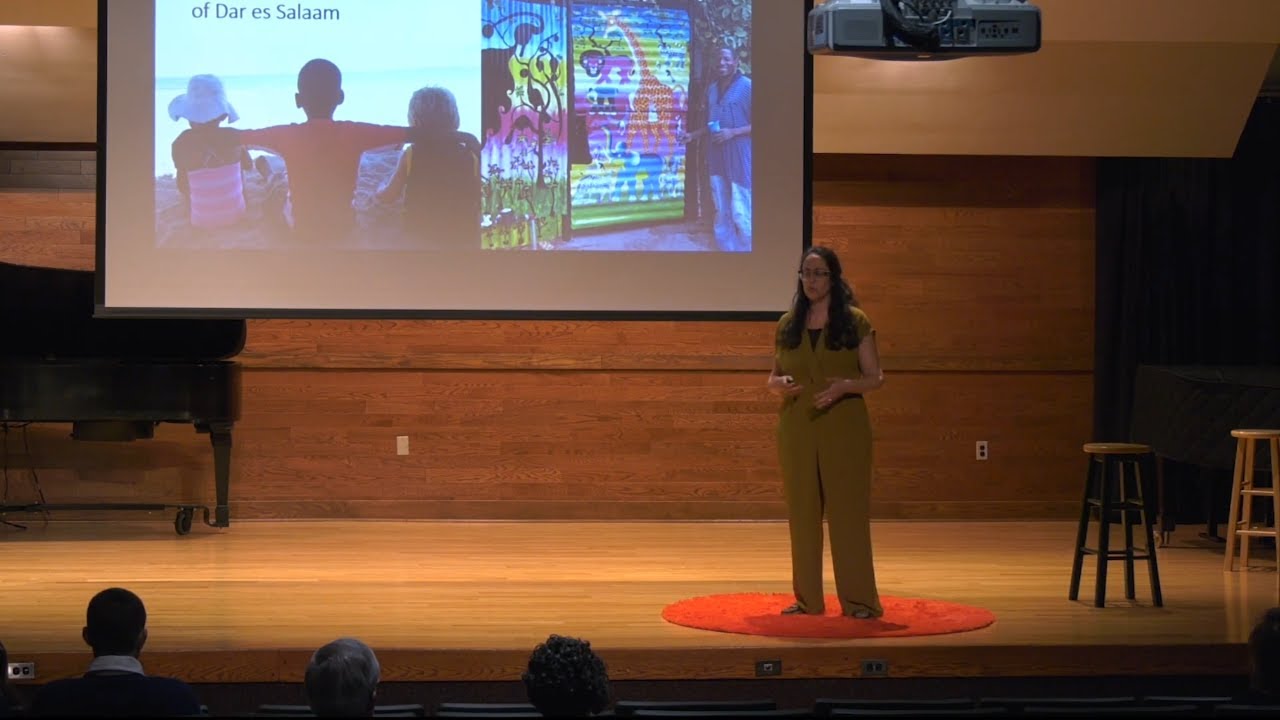
Schmidt began her 2023 TEDx talk not with a credential but with a scene. Students from India, Kenya, Brazil and the United Kingdom had gathered at a global impact conference in Tanzania. Around a fire pit she asked, “What challenges are you still facing?” The answers carried more force than a showcase of completed projects. Young people spoke about what their work had not solved and what they themselves did not yet know.
The title of the talk, Stop Helping & Start Sharing, sounds at first like a clever provocation. Schmidt uses it as a practical design rule. Meet people before arriving with a toolkit. Share uncertainty instead of disguising it as expertise. Put resources into the hands of those doing the work locally. Treat service as the beginning of a relationship, not a vivid week abroad to be converted later into an essay.
Three edits to the volunteer script
This philosophy eventually found an institutional home in A Tree That Grows, the venture Schmidt founded to help teenagers develop purpose-led projects. Its programs have connected students with community partners, fellowships and opportunities to present their work. The point is not to turn every adolescent into a nonprofit chief executive before prom. It is to let them discover what they care about, test an idea in company with others and learn that impact is a practice rather than an accessory.
The name is almost suspiciously apt. A tree cannot be hectored upward. Its growth depends on soil, water, climate and time. The educator can shape conditions and remain unable to claim sole authorship. Schmidt’s own favorite quotation, from poet Toi Derricotte, is “Joy is an act of resistance.” In her work, joy is less confetti than permission: families and students are allowed to build lives around connection and purpose, not merely struggle and repair.
The admissions paradox
Alongside her founder’s work, Schmidt has served as an application mentor for Crimson Education. The pairing is revealing. Selective admissions encourages young people to compress themselves into evidence: grades, prizes, leadership, service, a personal statement with an immaculate hinge. Community work, done honestly, has a bad habit of making the protagonist smaller.
Schmidt works in that tension. Crimson features a student who credited her with sorting essay ideas, identifying what strengthened the narrative and cutting what distracted from it. Other education profiles say students she mentored went on to universities including Harvard, Yale, MIT, Stanford and Columbia. The acceptances are outcomes, not a philosophy. The philosophy is closer to editorial archaeology: notice the experience beneath the accomplishment, then ask what changed in the student’s way of seeing.
A conventional admissions story puts the applicant in the center and arranges everyone else as proof of character. Schmidt’s account of Tanzania does something more interesting. The local director, the women in the group, her colleagues and her students keep their agency. They interrupt her plans. They teach her. The story becomes stronger precisely because she gives up the starring role.
This may explain why her work crosses categories so easily. She is a trained social worker who became an educator, a founder who still mentors individual students, and a speaker whose central claim is that she once arrived knowing far less than she believed. In May 2023, she joined a New York City Bar Association discussion on women’s rights in the Middle East and North Africa, speaking from experience that included work with refugees from Afghanistan and Pakistan in Tanzania. The panel also included Nobel Peace Prize laureate Tawakkol Karman. Schmidt’s part of the conversation rested on the same habit: proximity is not permission to generalize, and experience is valuable when it sharpens listening.
Ambition after the hero exits
There is plenty of ambition here. Schmidt wants teenagers to create projects, speak publicly and pursue selective universities. She has built programs, trained mentors and stood on a red circular stage to argue for a change in an industry measured in billions. She is not proposing smaller lives.
She is proposing a different shape for ambition. The old version is vertical: rise, distinguish yourself, become the person with the answer. Her version spreads sideways. Learn enough about other people to be altered by them. Build something that can continue without your heroic presence. Ask for help. Stay around for the unphotogenic middle.
That vision has an amusing enemy in the blue folder. Every profession manufactures one: the strategic plan, the pitch deck, the application checklist, the page of clever solutions prepared before anybody has asked a local question. Folders are useful. The trouble begins when neatness is mistaken for knowledge.
Schmidt’s career keeps returning to the instant she recognized the distinction. It is there in the teenager who arrived ready to fix things, in the dean who stayed long enough to belong, in the founder asking students to build with communities, and in the essay mentor helping applicants decide which details illuminate and which merely decorate.
Her public bio lists her biggest fear as “Not living life for me.” It is an unexpectedly personal line from someone whose work lives in the language of service. Yet it completes the argument. Mutuality requires a self, not a martyr. Sharing asks people to bring something honest rather than perform goodness. A life built entirely for an audience is only another folder full of approved answers.
At 19, Schmidt thought expertise meant arriving prepared. The more durable preparation turned out to be attention. She put down the pages, watched the room and let other people complicate the story. Then she spent the next decade learning what could grow in the space left behind.
Watch, read, keep going
Schmidt’s talk and public profiles trace the journey from that first visit to her current work with students and community partners.