In March 2021, Lachlan Donald announced that he was leaving Buildkite. He had been an early investor, a co-founder and its chief executive. He would remain a shareholder and an enthusiastic spectator. The next stage, he explained, needed “someone differently shaped”. It was a wonderfully physical description of an organisational problem: sometimes a person and a job stop fitting, even when the company still matters to them.
In January 2026, he announced that he was coming back. This time the title was CTO. Between the two announcements lay engineering work at Block, Cash App and Groq, and a chance to experience the problems of large engineering organisations from inside them. The returning founder had spent time among the people who have to live with the tools.
Careers are usually drawn as ladders. Donald’s is more interesting as a route map. There are crossings between Australia and America, between customer and supplier, between writing software and running the business that sells it. His return gives those crossings a destination: the machinery that helps other people ship their work.
A design every seven seconds
Long before the return ticket, there was 99designs. Donald was its founding CTO, helping build an online marketplace connecting people who needed design with people who could provide it. A business like that has a conspicuous front room: the logos, illustrations and portfolios. Behind it sit the servers and storage that must keep the whole exchange moving.
By April 2010, an AWS account of the company described a new design arriving every seven seconds. Its applications, databases and proxy servers ran on EC2; S3 stored the design work. That cadence gives the infrastructure an almost audible rhythm. While someone deliberates over a logo, another file arrives. Then another. The system must accommodate human indecision without developing any of its own.
Donald described the benefit of AWS in practical terms: fewer infrastructure concerns and more attention available for the business. The point was what the team could get back to doing. It is an early glimpse of the subject that recurs through his career: how much work gets consumed by the apparatus surrounding the work?
The apparatus included geography. By October 2013, Donald had returned to Melbourne after three years in Silicon Valley with 99designs’ American team. His purpose there had been to connect the technical and product group in Melbourne with executives and marketing colleagues in San Francisco. A CTO’s remit, in that account, extended well beyond choosing a database.
Two teams can be working on the same product and encounter it through different demands. One sees the implementation; another sees what a customer expects. A person who can move between them does valuable translation. Donald’s description of that assignment makes the human organisation part of the technical job, rather than an administrative interruption to it.
Twenty-four hours, one useful website
There is a less corporate snapshot from the same period. In 2010, Donald was part of the Codaroos, the six-person Australian team that won FullCodePress. Teams had 24 hours to build a website for a nonprofit organisation. Fellow participants included user-experience specialist James Mansfield and former 99designs colleague Adam Schilling.
The Australians took the trophy. Three nonprofit organisations came away with websites. A coding competition is an agreeable corrective to an executive biography: the clock is visible, the team has to make decisions, and someone outside the room needs the result. A slide about future potential would have been a rather disappointing delivery.
The episode also puts collaboration back into a career that can otherwise disappear behind company names. The result belonged to six people working together. The trophy is the amusing detail; the useful websites are the reason to remember it.
The customer who helped build the machinery
Donald’s relationship with Buildkite began before his executive roles. He backed the business early. He also contributed from the customer side. In July 2016, Buildkite introduced the Elastic CI Stack for AWS and thanked Donald and the 99designs engineering team for open-sourcing its initial version.
The stack addressed a straightforward mismatch. A team’s demand for build machines changes, but a fixed supply of machines does not politely change with it. The release provided an autoscaling cluster inside a customer’s own AWS network. More capacity could meet a busy queue; capacity could retreat when demand fell. Customers could also configure separate stacks for different requirements.
This is a particularly revealing entry in Donald’s record because the contribution was already useful before there was a co-founder biography to explain it. Engineers at a customer company had lived with a problem, made something to address it, and shared the work. Buildkite could then make that work available to other teams.
A separate community update credited Donald, then identified with 99designs, for improvements to Buildkite’s CloudWatch metrics publisher. Queue monitoring fed into decisions about adding build servers. Even the plumbing needed plumbing. His name appears beside the small mechanisms that help a larger system behave sensibly.
Same work. More lanes.
By April 2018, he was writing the announcement for Buildkite Agent v3. The release introduced plugins for sharing workflows, annotations for adding useful information to builds, and environment-variable substitution in pipeline uploads. Underneath, the job runner moved from Bash to Go, with better Windows support among the benefits.
These are modest-sounding improvements until you have needed one of them. A summary where a failure happened. A reusable piece of workflow. A runner that behaves on the operating system your team actually uses. The same release added multipart uploads for large artifacts and a hook for running commands after a job, whatever its exit status. Those details concern the untidy edges of real work: oversized files and the things that still need doing after something fails. Donald ended by thanking 41 open-source contributors. The release made room for their names alongside its new features.
The confidence to name a price
At Buildkite, Donald’s contribution also became commercial. Keith Pitt later recalled that Donald helped the founders gain confidence in charging enterprise customers more. Pitt described being uncomfortable asking for $30,000; Donald could have that conversation. Their product had acquired a colleague willing to discuss its value without blushing at the proposal.
There is an awkward intimacy to pricing software you have made. You know its compromises and unfinished corners. A customer, meanwhile, may be buying relief from a costly operational problem. Pitt’s recollection suggests Donald helped close the distance between those two views. Technical knowledge and commercial confidence could occupy the same chair.
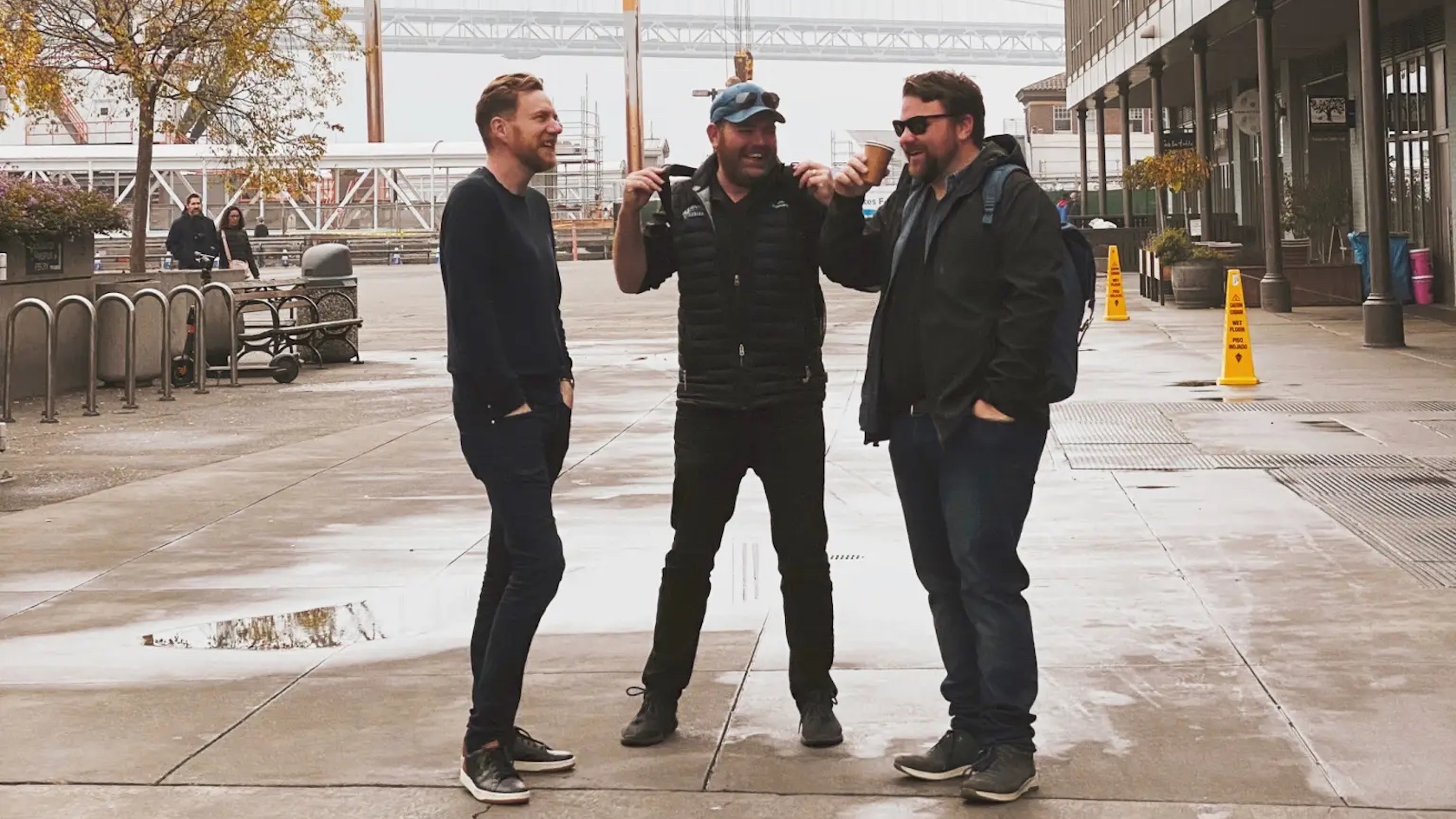
In September 2020, Donald appeared on The Startup Playbook as Buildkite’s co-founder and CEO. The conversation covered focus, product craftsmanship, shared leadership and the company’s A$28 million Series A, led by OpenView with General Catalyst. Buildkite had spent years concentrating on profitability after an initial A$200,000 seed investment.
The episode’s organising phrase was equity over ego. That is a demanding proposition inside a founding team. Money can be divided on paper; authority has to be negotiated through actual decisions. The discussion placed craftsmanship and company structure beside fundraising, where they belong. Raising capital did not remove the question of how the founders should work together.
“Someone differently shaped.”
Donald’s explanation for making way for a new CEO in 2021
Making room, then coming back
When Donald announced his departure in March 2021, he explicitly linked it to the company’s next stage. He had spent four years there. He would continue to have a financial interest and a personal attachment, while giving someone else room to lead. His explanation treated the role as a job with changing requirements.
Other businesses sought his experience. In July that year, research-technology company Glow announced that he had joined its advisory board, with a focus on CTO leadership and scaling. The assignment drew on his work building teams and helping businesses expand internationally. Another organisation needed help seeing what would become difficult next.
The interval also took him into senior engineering roles at Block and Groq, working on cloud platforms and CI/CD infrastructure. Those positions put him inside organisations whose software development depended on such systems. By the time he returned, the supplier’s concerns and the customer’s daily experience had become parts of the same career.
The queue after the code
His return announcement connected that experience to AI. More code being written, tested and deployed increases the demand on the systems downstream. A faster start can leave a longer queue. Donald’s stated priorities were reliability, execution and continuing to move quickly. The useful measure would be whether other engineering teams could depend on the result.
One current expression of that work is Buildkite’s open-source GitHub Actions compatibility project, which he has publicly promoted. It translates supported workflows into native Buildkite jobs. The repository describes an experimental preview, with explicit compatibility limits. Existing habits and configuration become something a team can carry with it, within those boundaries.
Donald’s personal site places him in Victoria’s Alpine Region with his wife and two children. His public developer biography leaves room for llamas and whisky alongside Go and CI/CD. It is a welcome amount of ordinary specificity in a career spent around systems that most people encounter only when they stop working.
He has been an investor, operator, chief executive and engineer. The new job title gives that accumulated experience a particular place to go. There are build queues to shorten, failures to understand and teams waiting to get on with something else. For a returning founder, that seems a sufficiently substantial welcome-back present.
Follow the work
- Personal website
- X / @lox
- GitHub / lox
- Buildkite company profile
- Watch: Startup Playbook interview
- Read: Keith Pitt on Buildkite’s early years
- Read: the 2016 Elastic CI Stack release
- Read: Agent v3, by Donald
- Read: Glow advisory appointment
- Explore: GitHub Actions compatibility project
- Read: 99designs CTO on Melbourne and San Francisco