On a November day in 2003, Matt DeBergalis moved through Harvard’s Mather House with a clipboard, campaign leaflets and the equipment of an earnest outsider: cargo pants, a bike messenger bag and a low-key pitch salted with “cool” and “sweet.” He was 26, a software writer with an MIT degree, running for Cambridge City Council. His platform included better late-night buses and restaurants that stayed open long enough to feed students. He finished tenth. There were nine seats.
The narrow loss was less an ending than a diagnostic. DeBergalis wanted younger residents to participate in the life of the city, but the machinery of politics was awkward, top-heavy and discouraging. A year later, with physicist Ben Rahn, he co-founded ActBlue. The new site let supporters make online donations and create fundraising pages for Democratic candidates. It did not require everyone to wait for instructions from a national campaign. Friends could persuade friends. Bloggers could direct communities toward a slate. The totals were visible, so a lonely contribution could be seen joining a crowd.
“Our feeling is that everyone has some sphere of influence,” DeBergalis explained in 2007. People, he thought, respond more actively to someone they know than to a distant advertising campaign. ActBlue was infrastructure with a social theory tucked inside it: lower the friction, make the collective action legible, then let the network move.
The engineer as organizer
DeBergalis had been building connective machinery long before electoral politics caught his attention. As an MIT undergraduate, he constructed a telephone system for his fraternity, fabricating circuit boards and writing the operating system. The story is almost suspiciously tidy in retrospect. Hardware, code, a community of users and a shared need all met in one homemade object.
His early professional work lived close to the metal. He contributed to NetBSD, including work associated with its NeXT port and the port of SMB filesystem components. At Network Appliance, he worked on network file storage and the NFSv4 and DAFS specifications. These were systems where protocol mattered because different machines needed dependable rules for acting together. A filesystem is not romantic. It becomes fascinating the moment it fails.
ActBlue pulled him into another kind of distributed system. In its first election cycle, it processed a little under $1 million. The important idea was already visible: independent fundraisers could choose candidates, write their own appeal and rally their own circles while a common platform handled the dull but essential mechanics underneath. The central organization supplied rails, records and feedback. The edge supplied energy.
A kernel hacker had discovered that politics also had an interface problem. He had not become less technical. He had enlarged his definition of a system.
Meteor, and the cost of every new screen
In 2011, DeBergalis joined Geoff Schmidt and Nick Martin in the company that created Meteor, an open-source JavaScript framework designed to make real-time web applications dramatically easier to build. The web was changing character. Applications behaved less like a sequence of documents and more like living interfaces. Data had to travel continuously between cloud services and browsers. The old arrangements produced thickets of repetitive code.
Meteor pursued a seductive promise: write in one language across the stack and let the framework handle more of the synchronization. Developers noticed. So did the team’s own experience. Beneath the framework’s speed lay a harder question about data. Every new screen seemed to demand another backend shaped especially for it. An iOS application might call three endpoints in sequence. Android repeated the transaction differently. The web team wrote a third version. Logic wandered outward and multiplied.
GraphQL offered a more principled arrangement. A client could describe the data it needed. A graph between the application and the underlying services could resolve that request. Product teams no longer had to encode the particular shape of every backend into every interface. When the Meteor Development Group turned its attention toward Apollo in 2016, it was following the problem down to its architectural root.
DeBergalis became Apollo’s co-founder and chief technology officer. The company built clients, a TypeScript server, federation technology and services for managing schemas and operations. Its commercial work grew around open-source foundations, a familiar but delicate arrangement. The community needed room to create; large organizations needed governance, reliability and a way to understand what changed before a change broke production.
A graph is also an org chart
The useful trick in Apollo’s vocabulary is “federation.” A large company rarely has one team that can own every piece of customer, product, inventory and account data. Federation lets separate groups maintain their parts of a graph while presenting one composed interface to application developers. Ownership stays distributed. The experience can still feel unified.
This is software architecture doing diplomatic work. Each team keeps authority over its domain, but it agrees to common contracts. Schema checks and registries make proposed changes visible. Query planning decides how a request travels across services. Observability exposes slow or expensive paths. The graph becomes a treaty that is executable.
The DeBergalis pattern: Preserve local agency, establish common rules, and make the result visible enough that participants can coordinate without a constant meeting.
In 2022, DeBergalis introduced GraphOS, Apollo’s cloud platform for building and operating a “supergraph.” The name carried a whiff of comic-book excess, but the underlying proposition was practical. Enterprises already had a landscape of services and APIs. Replacing everything was implausible. A graph could compose what existed, then evolve incrementally. DeBergalis often recommended beginning with the first application, screen or component and allowing the graph to grow from actual demand.
That preference for incremental adoption suits someone whose grandest projects began as answers to inconvenient particulars. Late-night pizza. A fundraising page. A screen that required three endpoint calls. The abstraction arrived after the obstruction had made itself annoying.
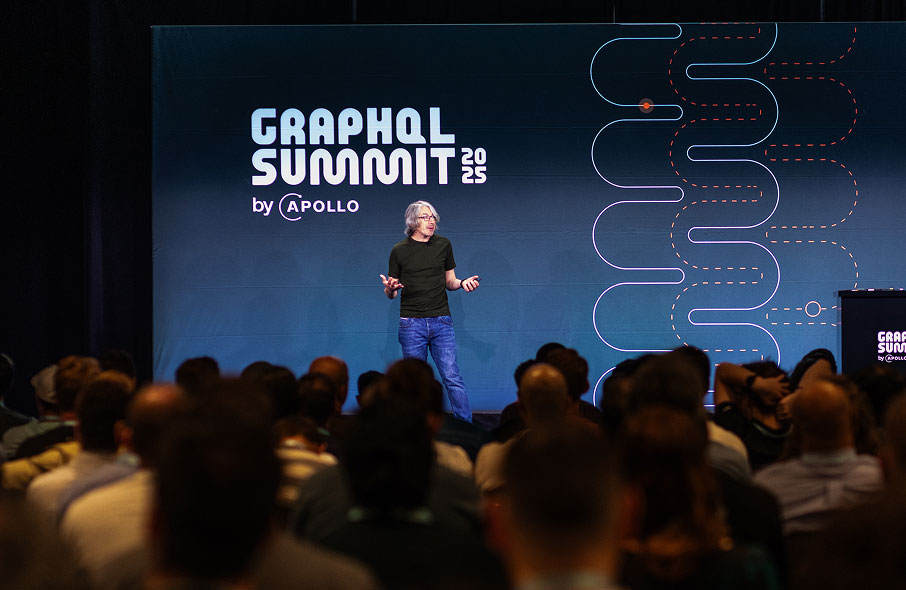
Watch: GraphQL Summit 2019 keynoteDeBergalis on the data graph, adoption and Apollo’s platformThe newest client has no screen
In July 2025, DeBergalis announced that he would become Apollo’s CEO. Schmidt, the outgoing chief executive and his longtime co-founder, moved into a role focused on technology and the wider GraphQL ecosystem. For DeBergalis, the timing was tied to a new kind of application consumer: the AI agent.
Agents need to retrieve information, modify systems and take actions. A fluent chat box is little help if the machinery behind it is a maze of undocumented endpoints, inconsistent permissions and business rules copied into a dozen clients. The current enthusiasm for agents had rediscovered the old integration problem at greater speed and with less tolerance for ambiguity.
DeBergalis’s argument is that GraphQL already contains useful answers. Its schema describes the available world. Its queries are declarative, allowing a client to specify a result instead of scripting each procedural step. Its field-level model can support fine-grained policy. Its orchestration layer can connect an agent to many underlying services without handing that agent a ring of unlabelled keys.
There is commercial ambition in this thesis, naturally. Apollo sells the managed platform that promises to make these graphs governable. There is also continuity. DeBergalis keeps finding networks full of actors who need to move independently without losing a shared view of what is happening. Donors and campaigns. Frontend and backend teams. Services and clients. Agents and enterprises.
Outside work, he has described a life divided among family, coding and flying his own airplane. Private piloting may be the perfect hobby for an engineer attentive to interfaces. A cockpit converts a complicated machine and an invisible atmosphere into instruments, procedures and choices. Freedom depends on respecting the protocol.
The younger candidate with the messenger bag did eventually get a larger constituency, though no city council seat. It includes open-source maintainers, enterprise architects and developers who would prefer to build the product instead of another adapter. DeBergalis’s career suggests that infrastructure is never merely underneath the interesting action. It determines who can join, what they can change and whether the whole arrangement can move without coming apart.
A graph, in that sense, is more than a technical map. It is a proposal for coexistence. Every participant gets a place, every connection gets a name, and one well-formed query can cross boundaries that once required a small expedition. DeBergalis has been making versions of that proposal for most of his working life. AI has simply supplied the latest traveler.