A detective story can survive an uncooperative witness. A conversation has a harder time surviving a loading screen. Somewhere between those two inconveniences sits the work of Kylan Gibbs, co-founder and CEO of Inworld AI. He has spent years trying to give digital characters enough freedom to surprise a person, and enough discipline to remain useful. The freedom attracts attention. The discipline increasingly occupies the company.
In 2023, Inworld released Origins, a playable demonstration set around an explosion in a fictional city. Players questioned characters using their own words. A journalist trying the demo coaxed a confession from a suspect in a fedora, then found the characters less accommodating when asked about their height. It was a useful little absurdity: a fictional person might discuss a crime more readily than a tape measure.
The point was to let developers try a different relationship between a player and a story. Instead of selecting a sentence someone else had written, you could attempt your own approach. That opened a delicious possibility for games, and an awkward assignment for their makers. If the audience can talk back, somebody has to decide how far the conversation may wander.
Before the characters, the people
Gibbs arrived at that problem by a route that began in social sciences. His early startup experience included a winning pitch at a business competition in Singapore and co-founding FlowX. The sequence matters because his public account of AI often begins with people: what holds their attention, how they interact, what they want to make. The technology enters as a means of changing those experiences.
His education took him through a bachelor's degree at McGill University and a master's at the University of Cambridge. He later worked at Bain & Company in London and Google DeepMind. In May 2024, he returned to an academic setting as a Stanford guest speaker, discussing AI for human-centered industrial activities. The subject neatly joined the human questions and the industrial machinery that recur in his career.
At Bain, he helped establish the firm's machine learning practice. At DeepMind, his work involved generative language models and bringing AI research toward products. Those are different kinds of translation: helping a consulting organization use a technical discipline, then helping research become something people can use. Neither task ends when a model produces an impressive answer. Somebody still has to make the answer fit a real situation.
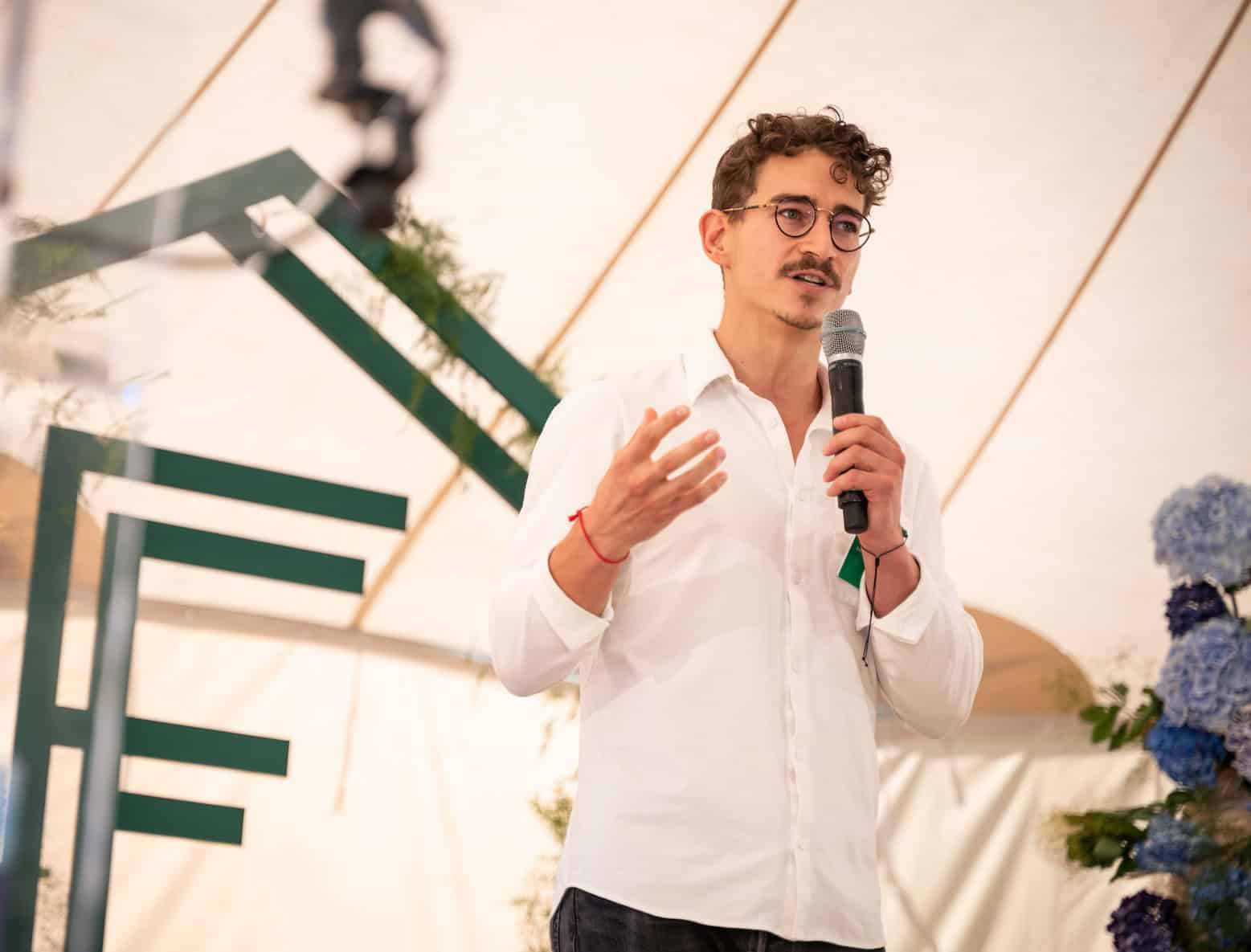
An audience that could interrupt
Inworld was founded in 2021 by Gibbs, Ilya Gelfenbeyn, and Michael Ermolenko. His co-founders brought conversational AI experience from API.AI, which Google acquired and renamed Dialogflow. Gibbs initially appeared publicly as chief product officer; by the Stanford lecture in May 2024, he was identified as CEO. The founding team joined experience in language technology with a distinctly entertainment-minded application.
The company's early characters offered personalities, memory, and responses shaped by a fictional setting. Gibbs wanted people to participate in media with more agency. A writer could devise a world and its narrative, while a visitor could approach it from an angle of their own. That ambition leaves plenty of room for authorship. Someone must still invent a world worth visiting and give its inhabitants something worth saying.
“We want to make media and entertainment a co-creative experience,” he said in 2023. The phrase expresses a specific wish: an audience with some influence over what happens. A character who merely recites an answer in a pleasant voice would be a modest version of that idea. A character whose response changes the player's next decision would begin to make it consequential.
“We want to make media and entertainment a co-creative experience.”
Kylan Gibbs, 2023
Santa, droids, and the problem with cleverness
The early experiments had a sense of occasion. In late 2022, Inworld showed a conversational Santa and announced a program offering up to $1 million in grants for creative experiments. The judging group included novelist Neal Stephenson, Oculus co-founder Nate Mitchell, producer Kiri Hart, and Inworld creative director John Gaeta. Fiction, virtual reality, film, and AI were being invited to the same table.
Participation in Disney's accelerator also led to a Star Wars Droid Maker project with ILMxLAB. Gibbs described a lesson from working in that orbit: an entertaining character need not be the most intelligent presence in a scene. Personality, story, and engagement have their own demands. A machine can be impressively knowledgeable and still be dreadful company. Anyone who has attended a long dinner recognizes the distinction.
That observation makes his product work more interesting than a race to add conversation everywhere. In an April 2023 interview, he emphasized iteration, market feedback, and discovering what makes content good. A creative tool needs creators using it. Its capabilities acquire meaning through actual scenes, actual players, and the moments when somebody tries a question the designer never considered.
The developers wanted the keys
By the 2025 Game Developers Conference, Gibbs was describing a change in the product's architecture. Inworld's initial character engine had hidden much of AI's complexity behind a server-side application. Developers wanted more control, including logic running locally. The company responded by turning parts of its own engine into libraries and a C++ runtime that developers could use more directly.
He also discussed telemetry: the unglamorous ability to see what happened when an interaction went wrong. A good demo can survive a host smoothing over an awkward moment. A released game has to cope while its makers are asleep. Knowing where the system failed becomes part of the creative process, because a writer or developer cannot repair behavior they cannot inspect.
Inworld's collaborations spread across different kinds of interactive work. Xbox's partnership concerned narrative and character creation; Ubisoft explored characters in its NEO prototype; NVIDIA worked with Inworld on Covert Protocol. Niantic brought AI characters into spatial experiences. These projects should be understood individually, with their own formats and stages of development. Taken together, they show why one neat character demo could lead to a much broader collection of tools.
- 2021Characters
Give the world a voice - 2025Runtime
Give developers control - 2026Voice + inference
Make the conversation run
The conversation acquires a bill
Gibbs's argument for consumer AI has become increasingly concerned with what happens after a prototype works. In his discussion with Microsoft's venture fund M12, he described the challenge as scaling applications and improving them through use. His advice to founders included a clear user problem and rapid experimentation. There is a practical humility in that approach: a product's first clever idea does not settle what its users will value.
Inworld's June 2025 essay A Return to the User laid out an ambition for software that adapts through experience. It described the work of building, scaling, and maintaining applications as a drain on time that could otherwise go toward users. The proposed destination was software whose infrastructure and configurations improve as needs change. That remains a vision to assess through shipped behavior, rather than a description of everything software already does.
The company's January 2026 argument made three requirements explicit: consumer applications need to respond in real time, scale economically, and suit different people. A language learner practicing for fun and an executive practicing for work may need different voices or configurations. Personalization in that account reaches beneath the interface. The same product may need to make different technical choices for different situations.
A voice needs timing
Speech makes those choices audible. In January 2026, Inworld released TTS-1.5, with Max and Mini variants aimed at different latency requirements. The announcement reported faster time to first audio and improvements in expressiveness and word error rates. These are company-reported results, but the measurements reveal the assignment: a voice must begin promptly, deliver the intended words, and make the delivery fit the moment.
Realtime TTS-2 followed in August 2026 with natural-language control over delivery. Developers could direct pace, tone, and emotion through instructions. The attraction is easy to understand in theatrical terms. Giving a performer a direction is a familiar creative act. Turning that direction into dependable synthetic speech, repeatedly and at scale, is an engineering problem hiding inside a rehearsal.
On September 30, Inworld announced its acquisition of Ultravox, a platform for real-time voice agents. Members of the Ultravox team joined Inworld to continue developing it. Their experience included speech understanding, reasoning, turn-taking, and interruptions. Existing built-in Inworld voices on Ultravox moved to TTS-2. A conversation requires all of these pieces to cooperate; an eloquent reply delivered over someone's unfinished sentence has already missed its cue.
What happens after hello
The next announcement reached further underneath the experience. On October 14, 2026, Inworld opened its Inference offering to developers. The launch described work on serving open models, caching repeated conversation context, and routing requests. Its performance comparisons were tied to specified models and measurements. The underlying commercial argument was simple enough: a consumer's repeated conversations have to fit inside what the application can afford.
For Gibbs, this is a considerable distance from the visible charm of a talking character, but it follows a recognizable line. Give people a world they can answer back to, and they will ask unpredictable questions. Let them keep talking, and response time, memory, control, and cost become part of the experience. The machinery underneath eventually determines how much freedom the person above it can enjoy.
His work now sits at that junction of invitation and constraint. The original aspiration, to give audiences more agency, still provides a useful test. Does the technology let someone explore, improvise, or learn in a way they could not before? Does it keep working after the introduction? Gibbs began by helping characters find a voice. The longer assignment is giving people a reason to stay for the conversation.