When the lights go out, a second problem arrives almost immediately: nobody knows how long the first problem will last. A refrigerator becomes a countdown. A phone battery becomes a budget. The useful question is suddenly very small. What is happening on my street?
During the Texas winter storm of February 2021, KUBRA’s outage maps recorded nearly 14.8 million interactions in a week. Its storm infographic reports that 83% of map views came from mobile devices. Somewhere inside those numbers is an explanation of the company: ordinary software becomes consequential when ordinary routines stop working.
- KUBRA connects bills, payments, alerts and outage information.
- Utilities and public agencies buy the systems; households use them.
- Its opportunity lives in the handoff between a customer’s question and a useful answer.
The business behind the question
A utility has two kinds of infrastructure. One delivers electricity or water. The other delivers explanations: what you owe, where to pay, why service stopped, when it might return. KUBRA works on that second network. The distinction matters. A perfect payment screen cannot compensate for an unexplained charge, and a beautiful outage map cannot repair a line.
Consider the company’s position as an interpreter. The utility holds operational and account information. The customer needs a much smaller piece of it, at the right moment, in a usable form. Moving between those worlds requires software, integration and a certain appreciation for people who would rather be doing something else.
KUBRA’s public market is recurring, necessary services. Utilities anchor the story, alongside government and insurance clients. These are relationships that continue after the first transaction. Next month brings another bill. The next storm brings another question. A useful answer today creates an expectation for tomorrow.
The interesting unit of design is the question a customer would otherwise have to call to ask.
An envelope is a surprisingly good starting point
KUBRA began in Mississauga in 1992 with outsourced printing and mailing. Its first task was tangible: take an organization’s billing work and get the documents delivered. That origin gives the later software business an unusual continuity. The envelope, the portal and the text message all carry information somebody needs to act on.
The company’s slogan is “Experience Better.” Read against its history, the phrase suggests incremental work: remove a confusing step, make an explanation legible, let someone finish a payment. The editorial lesson is less glamorous than reinvention. Follow the task beyond the boundary of the product you already sell.
Paper remains part of that task. Audited 2025 accounts show $59.4 million in print-and-mail revenue out of $246.6 million overall. That is roughly one dollar in four. Calling KUBRA a digital business is reasonable; assuming its customers have all abandoned envelopes would miss a substantial part of the economics.
One customer, several doors
The product names describe different entrances. EZ-PAY+ handles on-demand payments. MyHQ+ provides the account portal. Notifi manages alerts and preferences. Storm Center turns outage information into a map. Print production and remittance processing keep the less fashionable parts of the transaction moving too.
The useful distinction is breadth across the customer’s chores. Paymentus also sells billing, payments and engagement to utilities, so an attractive portal alone is hardly a unique position. KUBRA’s case rests on the combination of document delivery, payment operations and utility communications. Buyers must judge how that combination fits their existing systems.
- 01 Understand
the bill - 02 Choose
a channel - 03 Make
the payment - 04 Get
confirmation
In February 2026, KUBRA expanded EZ-PAY+ to more payment types, including fixed invoices, predefined orders and open amounts. A municipality collecting utility charges, permit fees and donations illustrates the appeal. Similar payment mechanics can support different public services without asking residents to learn an entirely new routine each time.
The map has to survive the weather
A storm reverses the usual software bargain. Demand rises precisely when the customer has the least patience and the fewest alternatives. The Texas figures make that pressure visible. Mobile use was overwhelming. Testing a map on a comfortable desktop connection would answer only part of the design problem.
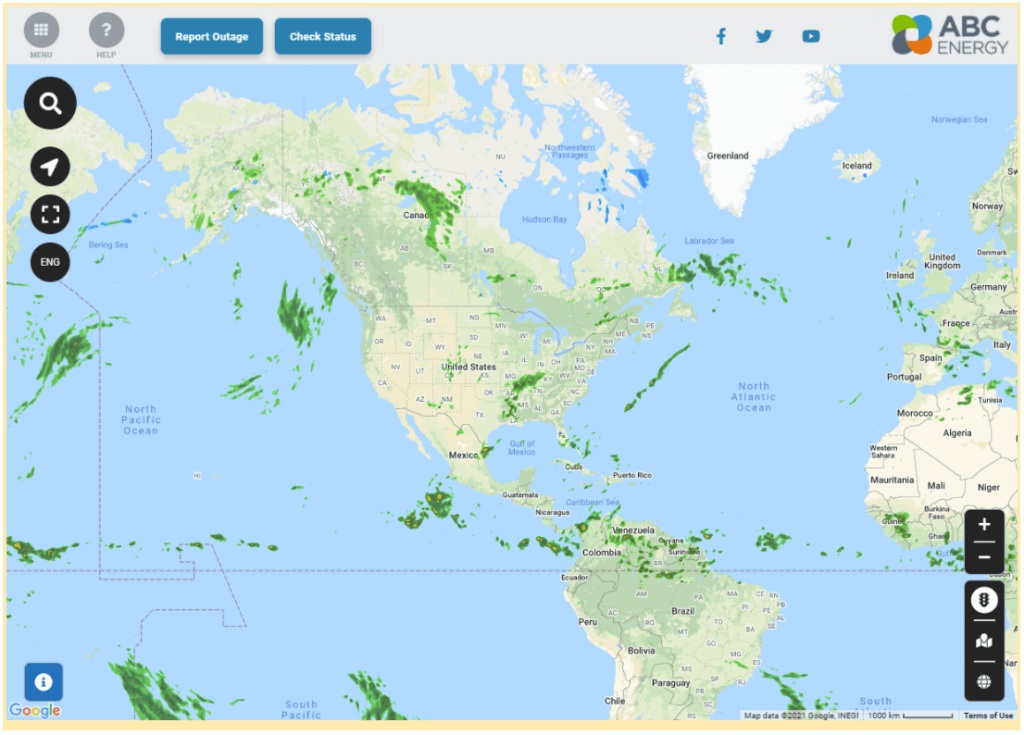
The weather layer also exposes a dependency. KUBRA’s account of its Xweather partnership describes joint load testing and data inspection. The company changed weather providers to broaden coverage and improve the presentation. This was a practical constraint to address, rather than evidence that its entire system had failed.
There is a useful recipe here: test the external feeds, test sudden demand, and test the phone. But the map still depends on information coming from the utility. As an inference, stale restoration estimates remain stale even when displayed elegantly. Better communication requires both a delivery system and something reliable to deliver.
For teams copying the approach, ownership matters too. Somebody must decide which messages get sent, how often an estimate changes, and what a customer sees when a feed is unavailable. Those are operating decisions as much as interface decisions. A portal rollout gives an organization an opportunity to settle them; the software purchase alone cannot settle them.
What the ordinary work costs
The financial structure is similarly practical. KUBRA earns through transaction services, subscriptions and implementation work. Its audited accounts record $50.6 million of research and development expense in 2025. Keeping the experience simple for the customer requires substantial work behind the screen.
Ownership changed in June 2026, when REPAY completed its acquisition from Hearst. The announced deal was $372 million; a later filing records approximately $354.1 million in closing cash consideration, subject to adjustments. Those describe the purchase of the business, rather than the price of installing a customer portal.
For a buyer, the sensible exercise is to price the whole journey: integration, transaction volume, support and the channels customers actually use. For a product team, the lesson is easier to borrow. Start with the question that interrupts somebody’s day. Then make answering it require less of their day.