A birthday is a peculiar way to organize a company. It ignores the reporting structure. It puts people together who may have little in common beyond the month on their driving licences. For Kristin Dolan, that is part of the point. At AMC, she has used monthly birthday lunches to bring colleagues together across departments and ranks. An organizational chart can tell you who reports to whom. It cannot tell you who has never had a conversation.
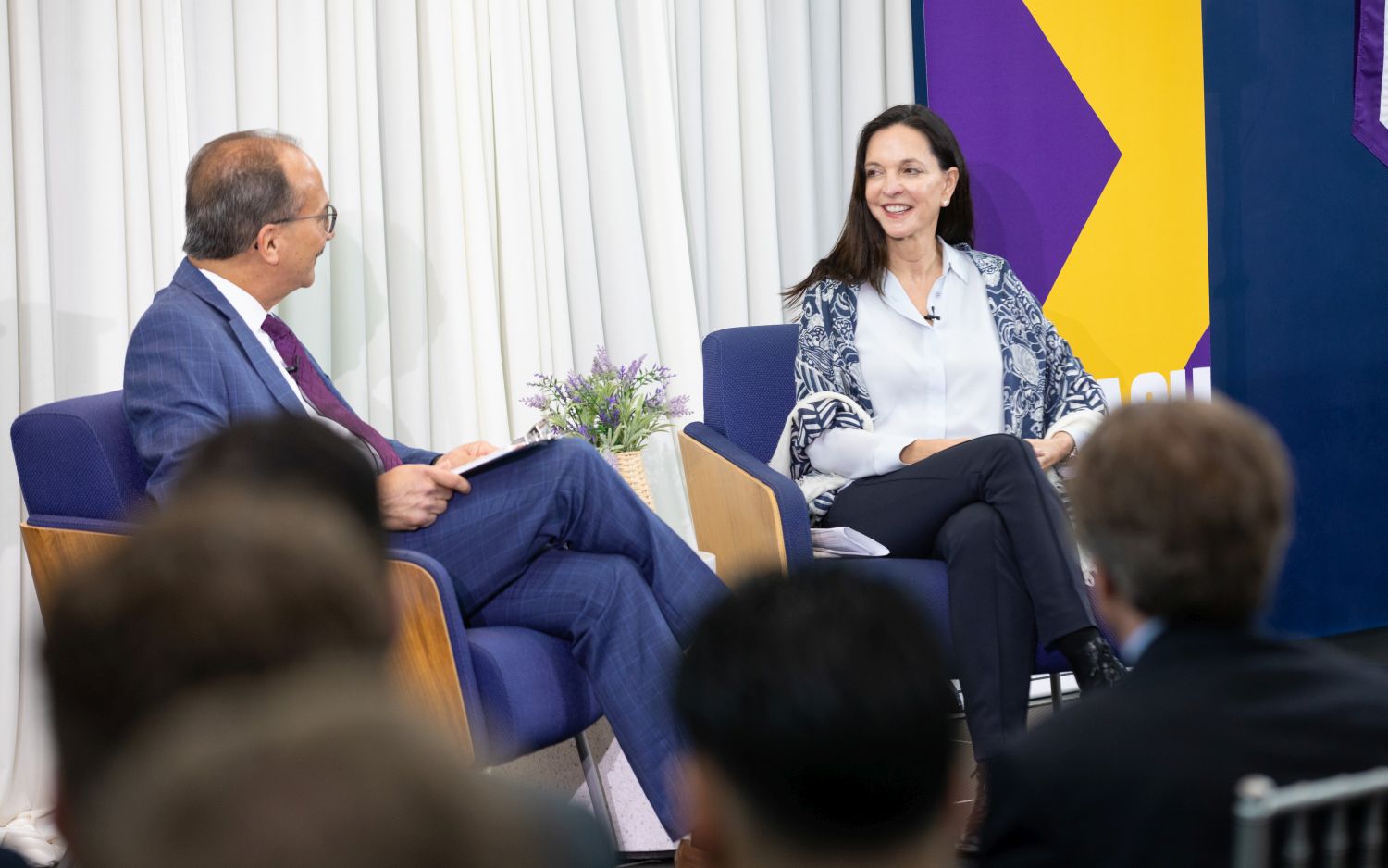
When she returned to the University at Albany in 2024, the television executive offered students a management lesson with refreshingly little furniture: talk to people. In the elevator. Across departments. Where they actually work. “Treat everyone respectfully by treating everyone the same,” she said. The woman responsible for a company full of elaborate fictional worlds was describing the usefulness of noticing the real people in the room.
A reader takes a wrong turn
Her route into television began with books. At Albany, she tried accounting, economics and computer science before settling on English with a business minor. Writing teacher Mark Nepo left an impression on her: give the activity in front of you your attention. For someone whose later work would involve the industrial measurement of attention, it was a rather good place to start.
She graduated in 1988 and pursued a publishing master’s at Pace. An early magazine internship disappointed her. A subsequent opportunity at American Movie Classics opened a different door. Her publishing thesis would concern cable television; the supposed detour had begun taking over the itinerary. She later added a master’s in literature from Long Island University.
There is an appealing awkwardness to that education. An English degree does not arrive with instructions for running a cable system. Equally, a business cannot sell stories for very long without thinking about the person receiving them. Her training put those two concerns in the same room, where they would have plenty to discuss.
The audience had a doorbell
Born in Norristown, Pennsylvania, and raised on Long Island, Dolan entered the Rainbow Media business in 1989. She briefly left for Random House, then returned when the AMC marketing job she wanted became available. Her territory covered New York and New England. Getting a channel into a home involved local cable businesses, service technicians and customer representatives, each needing to understand what they were offering.
Later, a field-communications assignment presented a wonderfully unglamorous problem: thousands of frontline employees had to understand changing products and promotions without the everyday digital tools office workers took for granted. Information had to reach the people answering questions and doing installations.
This is television viewed from the doorstep. A programme can be exquisite and a promotion ingenious; someone still has to explain the bill. For an executive learning the business, the distance between headquarters and a customer’s living room was an education in itself. It made the practical work visible.
Ten thousand people, one customer experience
In April 2014, Dolan became Cablevision’s chief operating officer. Her responsibilities reached across sales, service, programming, marketing, product management and human resources, with oversight of more than 10,000 employees. She also oversaw the advertising-sales operation. It was a job in which the customer experience could rarely be assigned to a single department and forgotten.
A 2015 snapshot of her working life supplies a useful small detail: her favourite screen was a Kindle Paperwhite. The executive selling television still wanted a good device for reading. In that same questionnaire, she picked Wi-Fi as the technology likely to benefit cable in the coming year. The book reader and the distribution executive were getting along perfectly well.
She was part of the leadership team overseeing Cablevision’s $17.7 billion sale to Altice in 2016. A transaction that size is easy to reduce to a number. Her contribution came from the operating side of a business whose product had to keep working in actual homes throughout the change of ownership.
Four people around a table
After Cablevision, Dolan founded 605 in 2016. Its early team gathered around a Manhattan living-room table. By the time she discussed the business in a 2023 university magazine interview, it employed more than 150 people, including 17 PhDs. An English graduate had become the boss of an enterprise concerned with large quantities of television data.
Her explanation of the consumer problem was less technical. People should encounter fewer irrelevant advertisements. For advertisers, the questions went beyond how many people watched: did a campaign produce a result, and what could the evidence say about the next one? The business worked on attribution, prediction and measuring audiences across different screens.
That last problem has an everyday illustration. Someone can watch television, open a laptop and pick up a phone without becoming three different people. Measuring the screens separately is simpler than understanding the person moving among them. The difficulty helped give 605 its reason to exist.
is seen→Audience
takes action→Analysts ask
what worked?
A simplified view of the question behind advertising attribution. It is harder to establish than this diagram makes it look.
A number with a backstory
The name was a small piece of cable-industry wordplay. DCV, the initials of an earlier Cablevision project, also work as Roman numerals. Written as an ordinary number, they become 605. The startup carried a trace of the old business into a different one.
At its launch, 605 brought together the acquisition of Analytics Media Group, expertise from Cablevision and co-founder Ben Tatta. Dolan described an opportunity to help programmers and distributors make use of information that their systems already generated. Smaller networks, too, could benefit from a clearer account of what their audiences and advertising were worth.
In September 2023, iSpot acquired 605. The buyer emphasized its attribution capabilities, engineering and data-science teams. For Dolan’s career, that chapter matters because she had operated on both sides of a familiar television argument: making and distributing the product, then asking how to establish what the audience actually did with it.
The French-fries proposition
Dolan took over as AMC Networks CEO on February 27, 2023, returning to the business where she had begun. The appointment brought an operator of subscription businesses back into a company increasingly obliged to manage direct relationships with streaming customers. Making a show and maintaining a subscription are related activities, but they require different daily work.
Her description of AMC’s place in the streaming market was unusually edible. Discussing partnerships in 2024, she used the phrase “French Fries to anyone’s Happy Meal.” It is an image with very little corporate vanity. A smaller entertainment company can make itself useful alongside a larger offering.
The argument gave distribution a central role. A viewer needs to find a programme, understand how to get it and decide whether to keep paying. Dolan’s interest in simpler interfaces and bundles fits her cable background. A customer should not need a professional interest in television economics to get through an evening’s viewing.
“French Fries to anyone’s Happy Meal.”Kristin Dolan on AMC’s place alongside larger platforms, 2024
The deal behind the metaphor
By April 2026, AMC Networks had become AMC Global Media. The legal name changed on April 8, while its Nasdaq symbol remained AMCX. Under Dolan, the portfolio spans AMC+, genre services such as Shudder and HIDIVE, Acorn TV, cable channels, film distribution and AMC Studios. Horror fans, anime viewers and devotees of British mysteries need not be imagined as one interchangeable audience.
On July 30, the company announced a global Netflix agreement covering The Walking Dead and its six spin-off series: seven series and 371 episodes. The agreement provided for $500 million in licence fees over the applicable five-year licensing periods. AMC retained the ability to show the programmes on its own streaming services. Rights begin at different times as existing arrangements expire.
Here the partnership thesis acquired a set of contractual terms. A franchise could help another platform attract viewers while continuing to serve its owner’s streaming business. The distinction matters: distribution through a partner can generate income without requiring the owner to surrender the underlying property.
The surrounding business remained difficult. Second-quarter 2026 revenue fell about 9 percent, even as streaming revenue grew 6 percent to $180 million. Those figures belong beside the deal announcement. A promising agreement does not erase the pressure on the rest of the business.
What arrives on Monday
There is a less expensive example of Dolan bringing something useful into an organization. She enjoys tackling complicated recipes on weekends, cooking or baking when the working week leaves little time. The results sometimes accompany her to the office on Monday. Colleagues are a fairly persuasive audience for that particular kind of production.
Asked about a formative challenge, she has pointed to restoring Cablevision service after Hurricane Sandy in 2012, when more than two million customer households were without it. What stayed with her was the work of teams alongside utility companies. It is consistent with her interest in the people who make a system function when a plan alone is insufficient.
The story resists the usual separation of creative work from operations. She reads literature, runs entertainment businesses, asks technical questions and remembers the frontline workforce. Her own compact description of her working instinct, offered years earlier, was “I like to fix things.” That leaves room for both the spreadsheet and the cake tin.
The next person watching
In February 2026, NATPE recognized Dolan with its North Star Award for career achievement. She was also named to the 2026 Cable Hall of Fame class. Such honours collect a career into a moment; her actual work continues in the less ceremonial business of programmes, partnerships and customers.
In October, AMC announced that all seasons of the original Walking Dead would reach AMC+ on January 7, 2027. For someone watching at home, that is the useful outcome: a series becomes available in another place. The deal, the rights and the distribution machinery sit behind the play button.
Dolan’s career has repeatedly brought her to that junction. A story needs an audience. An audience needs a way in. And somewhere between the two, a person has to notice what is making the journey harder than it needs to be. She has spent much of her working life asking that person’s questions.