Before there was a billion-dollar valuation, there were quizzes about history, music, geography and Indian scams. Krishna Depura and his friends had made an online place where people willingly spent hours learning things. This was an awkward discovery for anyone who had ever tried to hold a room’s attention with a corporate presentation. The audience could concentrate perfectly well. It simply preferred a treasure hunt.
The group was called TeraMeraIdea. Depura ran it as a hobby with Deepak Diwakar, Mohit Garg and Nishant Mungali, working with friends and like-minded people around the world. Their experiments concerned media, the internet and social businesses. Quizzes and knowledge-based hunts became a way of watching curiosity at work. People came back because participation itself was enjoyable.
Depura brought an engineer’s background to this small laboratory. He had studied at IIT Roorkee, then earned an MBA in finance and marketing at the Indian School of Business. At ISB, he received its Young Leader Award. His working life included Tejas Networks, Infinera and Microsoft; immediately before Mindtickle, he was director of product management at PubMatic. He had experience of getting technology into people’s hands.
In 2011, the four founders began the venture that became Mindtickle. Its name contained a compact statement of intent. Depura later explained that “Mind” stood for making something meaningful and consequential. “Tickle” meant the journey should have smiles in it, for founders, employees, customers and partners alike. A company could have ambition without requiring everyone to put on a solemn face.
The applause was encouraging. The budget was another matter.
There was an obvious market for engaging learning. The difficult part was deciding which learning mattered enough to build a business around. Early discussions with Accel included an education-oriented treasure hunt. The founders reconsidered: they knew the corporate world through their own careers, and that was where they felt better equipped to work.
New employee onboarding supplied a practical opening. Yahoo and InMobi tried the idea. A newcomer could explore a company through an online treasure hunt rather than spend the introduction sitting through presentations. The playful delivery brought attention to information that people actually needed. Mindtickle attracted customers in India and abroad, and recognition for its use of gamification followed.
By 2014, the company’s work extended across more than 60,000 learners, from smaller businesses to Fortune 500 corporations. The early premise was precise: give learners control, let them see progress, and make the purpose of a course clear. Knowing why something matters is a useful antidote to the ancient corporate ritual of clicking “next” until freedom arrives.
Still, enthusiasm left Depura with a commercial problem. Enjoyable onboarding was valuable, but he found it difficult to persuade a chief executive or chief revenue officer that the product was indispensable. Positive feedback had taken the company some distance. He wanted its work to reach further into the customer’s business.
“We are tech experts who are passionate about teaching”Krishna Depura, 2014
A treasure hunt finds the sales floor
The next direction was sales readiness. Depura was watching buyers acquire more choice and more information. Sellers needed to stay current, explain differences between products and respond to questions with confidence. An engaging induction could help someone join a company. Continuous preparation could help that person handle the work afterward.
Mindtickle rebuilt around sales representatives, and in 2015 made the US its central market focus. Depura’s account names AppDynamics, Nutanix and Cloudera among the fast-growing companies it targeted. Within six months, he said, it had signed 20 companies from its target group of 100. That was a more convincing answer to the question of whether anyone needed the product.
The vocabulary shifted with the job. Readiness meant assessing knowledge, practicing a pitch, receiving coaching and finding out where someone needed help. Instead of asking only whether a representative had completed a course, a manager could examine whether the representative could use what the course taught. A checked box is wonderfully obedient. A buyer tends to ask supplementary questions.
The idea became more explicit with Mindtickle’s 2021 Ideal Rep Profiles and Readiness Index. Sales leaders could define the capabilities they wanted, establish benchmarks and personalize development. Depura was moving toward a system in which preparation had a relationship to performance, rather than existing as an administrative ceremony on a separate calendar.
The furniture stayed cheap. The decisions did not.
Depura has said the team worked on plastic tables and chairs for four years. The detail is more revealing than a photograph of an expensive office would be. Early recruits joined on a limited budget, and he credits the first 10 to 20 people, their sense of purpose and the founders’ transparency with helping the business endure its changes.
Changing direction had an emotional cost. The founders described the difficulty of abandoning an idea after spending a year developing it. Their advice was to keep attention on the problem customers faced, so a particular product did not become too precious to revise. This is easy advice to admire and rather harder advice to take when your own work is the thing being retired.
Capital arrived in stages. A $40 million Series C in July 2019 brought Norwest Venture Partners into the investor group and Scott Beechuk onto the board. In November 2020, SoftBank led a $100 million financing. Another $100 million round, announced in August 2021, put Mindtickle’s valuation at $1.2 billion and brought total funding to $281 million.
The valuation changed how the outside world saw the company. Depura described greater visibility and recognition for the category. He also treated the milestone as an outcome of responding to customers and changing markets. The original game had travelled a long way. It had required repeated decisions about which part of the idea deserved to survive.
Even a head shake needs onboarding
Building across India and the US supplied Depura with a different kind of learning exercise. He has described teaching himself to communicate lateness proactively, begin and end meetings on time, and make his meaning more explicit. Even the familiar Indian head shake could leave American colleagues wondering whether they had received an agreement or a refusal.
The lesson was personal as well as organizational. An engineer accustomed to finding problems in software was discovering them in perfectly ordinary conversations. Mindtickle arranged face-to-face contact between its teams so colleagues could understand one another’s habits. A concise reply need not be hostile; a longer explanation need not be evasive. Sometimes the most useful translation has no foreign words in it.
His formulation for culture is “Define tightly, implement loosely.” Shared principles could allow different expressions. Taking a break might mean camping with colleagues or spending time with family. Both deserved respect. The playfulness in the company’s name did not require everybody to have the same idea of a good time.
That concern with how people experience work appears early in his account of Mindtickle. In 2013, he described an office with whiteboard walls, shared lunches and no fixed desks or dress code. The arrangements belong to that early period, but the intention is recognizable: make room for people to contribute without making them perform the usual office choreography.
“Define tightly, implement loosely.”Krishna Depura, on company culture
A practice partner that can answer back
Artificial intelligence offered another way to address the same old difficulty: turning knowledge into something a person can do. Mindtickle launched its generative AI Copilot in August 2023. It could help create assessments from learning content, review calls and support targeted coaching. The system connected content production with the everyday work of preparing and following up.
The launch also showed Depura thinking about adoption as a process. He described a human-centric approach, with documentation, sandbox evaluation and optional features initially turned off. A new capability could be tested before it became part of a team’s routine. That was a practical acknowledgment that introducing technology involves decisions by the people expected to use it.
In March 2025, Mindtickle announced AI capabilities tailored to sellers, sales managers and enablement teams. By October, its customer summit in Chicago introduced role plays drawing on actual deal context, along with deal guides and AI content creation. The company reported more than 1.5 million AI role plays completed by users at that point.
The progression is easy to follow without learning the software vocabulary. A quiz can reveal whether someone remembers a product detail. A role play can ask the person to use it in a difficult conversation. A scenario grounded in a current deal can make practice more relevant still. The distance between those activities is where Depura has been spending his working life.
AI role plays completed by Mindtickle users, as reported by the company in October 2025.
Rehearsal, at a different scaleThe next question still belongs to people
At a Pune panel in March 2024, Depura compared AI’s potential transformation with the arrival of electricity. He speculated that familiar software interfaces could disappear. These were predictions, carrying the uncertainty that predictions deserve. His company’s subsequent releases show where he has chosen to put practical effort: assistance inside the work people are already doing.
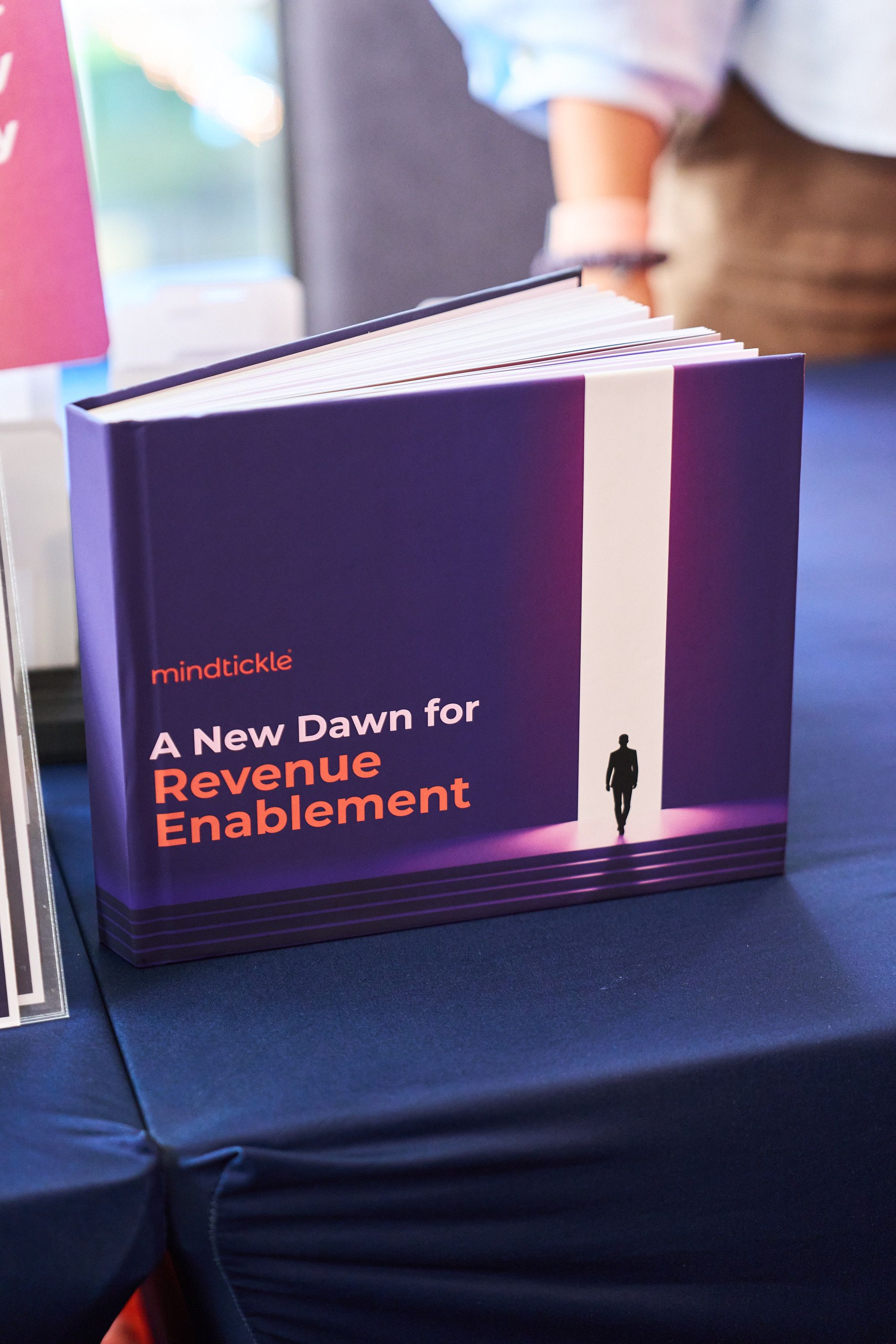
In September 2026, Mindtickle unveiled A New Dawn for Revenue Enablement at its Austin customer summit. The book gathered conversations with 30 enablement leaders, including customers at Cisco, Thomson Reuters and Henkel. It asked what AI had changed, where the time it saved was going, and what the work might look like in 2030.
Those questions suit Depura’s history. They ask participants to look at what actually happens after a tool arrives. The company now calls the distance between knowing and performing the Know-Do Gap. Its earliest quizzes had already exposed one part of that distance: people would spend time learning when someone gave them a reason to join in.
Depura’s story leaves room for both the seriousness and the smile he built into the name. Curiosity got the founders started. Customer needs kept revising the plan. Along the way, he had to learn which ideas to release, how to make himself understood and what preparation ought to accomplish. The treasure hunt continues, with rather more demanding clues.