An empty bus seat has a peculiar property: it expires. At departure time, yesterday's sales effort becomes either a passenger or a small rectangle of wasted capacity. The vehicle still needs a driver. The journey still consumes fuel. Kolors built its original proposition around that rectangle, asking whether better coordination could change the economics of a bus somebody else already owned.
- Independent operators supply the vehicles. Kolors coordinates the journey.
- Passengers can book digitally and still pay cash onboard.
- The Urbvan acquisition opened a second business: getting employees to work.
That last point changes the story. A person choosing a weekend departure and an employer arranging a shift change both need seats. But they buy those seats differently. Kolors began with one transaction and found an increasingly important business in the other.
The bus was already there
The founding pair brought complementary experience. Rodrigo Martínez grew up around the business; he describes himself as a third-generation bus operator. Anca Gardea leads product and technology. Their company paired knowledge of an old transport industry with the tools to reorganize it.
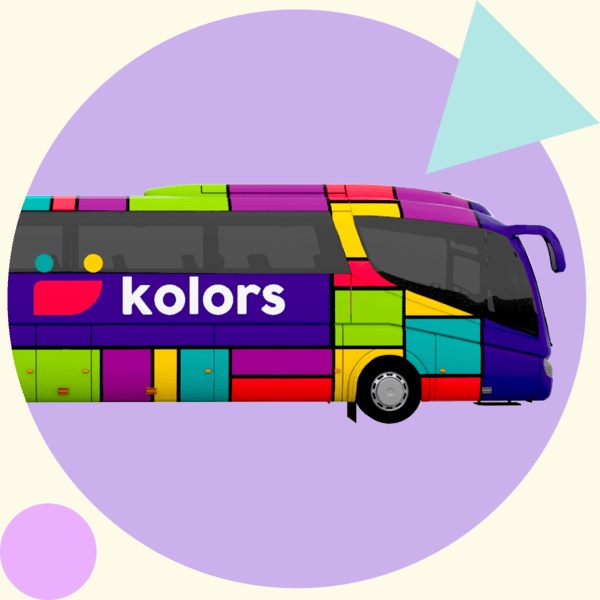
Consider the division of labor. A small operator owns, maintains and drives a bus. Kolors handles the commercial and digital machinery around it: routes, timetables, pricing, marketing, reservations and customer support. The vehicle remains someone else's asset. The passenger buys into a coordinated service.
That makes Kolors more involved than a website listing tickets. It helps shape what gets sold, where the journey begins and how the customer is treated. Its expertise sits between software and operations, where a change on a screen must eventually produce a bus at a particular place.
A very digital company. Cash welcome.
The useful detail is the payment choice. Kolors advertises reservations online with payment by card or cash when boarding. A customer can use a digital booking system without first becoming the sort of customer who pays for everything digitally. The product accommodates an existing habit.
In a 2021 investor interview, Martínez warned against transplanting products from mature markets into emerging ones without adjustment. The lesson is specific enough to copy: separate the convenience of booking from the method of payment. Requiring both to change at once can make an otherwise useful service harder to adopt.
“We have an asset-light model”Rodrigo Martínez · Alumni Ventures interview, 2021
There is another human accommodation. Kolors calls its onboard attendants Ambassadors. Its booking page describes them as people who travel along to help passengers. Technology can organize a reservation; somebody still needs to meet the traveler. The company also promotes boarding points outside the conventional central-terminal routine, with locations that passengers can inspect before booking.
The expensive part was changing the buyer
In June 2022, Kolors announced $26 million in funding, including a $20 million Series A led by UP.Partners. Toyota Ventures, Maniv Mobility and other investors participated. The money was intended to support expansion and technology. It was capital raised, rather than a measure of what the business had earned.
The next decisive number was $12 million. In September 2023, Swvl announced the cash sale of Urbvan to Kolors. Its announcement specified $9.5 million paid at closing and $2.5 million over a year. Buying an existing corporate mobility business supplied customers and capabilities that a consumer booking interface could not manufacture by itself.
Gross cash consideration
The overlap was already visible. In its acquisition announcement, Kolors connected intercity work travel with Urbvan's corporate customers. The deal joined different parts of a working person's journey, from travel between cities to the transport serving offices, factories and distribution centers.
Urbvan now markets corporate shuttles, industrial transport and group rentals. Its platform offers reservations, route changes, monitoring and QR boarding. The customer logos on its website include Danone, Comex, Huawei and PepsiCo. The buyer is an organization with an operating problem, as well as a traveler with a destination.
The timetable met the business model
By March 2026, Martínez described employee transport as the core business. In an El Cronista interview, he contrasted variable bus occupancy with corporate contracts that could run as long as 36 months. He also acknowledged delays and customer dissatisfaction in intercity service. International expansion remained an ambition, with Brazil, Colombia and the United States under consideration.
The shift suggests a practical explanation: recurring demand can be worth more than a larger collection of possible destinations. A factory's staffing schedule gives a transport planner something different from holiday demand. The acquisition changed which kind of demand Kolors could pursue.
There are two different things being sold. On the consumer side, the unit is a journey: a particular seat on a particular departure. On the corporate side, the offering is an arranged transport service. That distinction matters when assessing the company. More ticket buyers and more employer contracts would describe different kinds of progress, even if the same roads and vehicles appear in both.
What to borrow before buying a bus
For a traveler, the immediate use is straightforward: compare a route and departure, inspect the boarding point, reserve a seat and check the payment conditions. Kolors Rewards offers account-based travel benefits. Its separate Mobile service sells phone plans and SIMs, an unusual neighboring business for a transport brand.
A passenger comparing alternatives should look beyond the fare. A cheaper seat can lose its advantage if the pickup adds an inconvenient journey. Equally, a familiar terminal may suit someone better than a distributed boarding point. Kolors makes the location and payment arrangement part of the choice; the useful comparison is the complete trip.
For an employer, the conversation starts with employee locations, working hours and capacity. Urbvan describes a process of designing routes, assigning operators, launching service and refining it with operational data. Buying that coordination can spare a company from assembling every transport relationship itself.
The broader lesson has conditions. This arrangement depends on capable vehicle partners, enough passengers sharing useful routes, and reliable execution. Software cannot make a scattered workforce live closer together or remove traffic. A boarding point helps only if passengers can reach it. Kolors' opportunity is to make those constraints manageable, one scheduled departure at a time.