Andre Privateer has spent years helping hotels get noticed. The curious part of his current work begins after the noticing is done. A traveller has chosen the property, selected the room and reached for a card. Then the transaction falters. For the hotel, the prospective guest can disappear before becoming a booking worth counting. Privateer has a name for this almost-customer: the shadow guest.
It is a suitably odd preoccupation for someone whose career includes hotel inspections, distribution businesses, luxury property projects and teaching cultural tourism in Paris. Hospitality presents rather more photogenic problems. There are buildings to restore and destinations to sell. Privateer is now concentrating on the small administrative catastrophe that can occur between wanting a room and paying for it.
His company, Fikäfi, works on payment orchestration for hotels. He co-founded it and serves as chief executive. The proposition carries an operator's impatience: after all the work of attracting someone, the hotel ought to know whether its payment arrangements helped them finish. A beautiful booking website has limited consolation value when the money never arrives.
A career on the other side of the booking
Privateer's route into this problem runs through the business of making hotel rooms visible. At HotelRooms.com, where he led EMEA and Asia, the work connected properties with travellers across different markets. His tenure stretched from 2010 to 2018. The territory mattered: selling a room across borders involves differences in customer habits, distribution relationships and the mechanics behind an apparently simple reservation.
In February 2015, HotelRooms.com announced an expanded relationship with Warwick International and the addition of Steigenberger. Privateer was looking toward the Middle East, with Doha as a base for serving regional hotels. It was a moment when hotel marketers were also wrestling with customers who researched on one device and booked on another. Following a guest's intentions was already becoming awkward.
The Warwick relationship helps explain the commercial setting of his earlier role. HotelRooms.com offered advertising that directed travellers toward hotel properties, with the wider partnership extending an existing arrangement. For an owner, the value of distribution depends on whether the right prospective customers arrive at a price the business can sustain. Privateer's later focus on the payment step follows naturally from that practical concern. Once a hotel has paid to reach a traveller, the next handoff becomes part of the cost of winning that booking.
That earlier work offers a useful way into his present business. Advertising can put a hotel in front of the right person. Distribution can make the room available. Neither task guarantees that the final transaction behaves as expected. Privateer's career has moved progressively closer to that last step, where a commercial promise encounters a bank's rules and a customer's available payment method.
His professional range also extends into the physical hotel. He has worked on development and acquisition projects and inspected properties across 40 countries. At Machinelab Ventures, he is listed as a venture partner with an interest in travel technology. His teaching has included postgraduate cultural tourism seminars at the Sorbonne. The subject keeps pulling him between buildings, businesses and the people moving through them.
HSMAI recognized his hospitality sales and marketing work in 2015. His teaching adds another dimension to that commercial record. Cultural tourism concerns the reasons people travel and the places they encounter, rather than simply the room they purchase. Privateer has also expressed an interest in sustainable tourism and its relationship with rural and economic development. Those interests put the booking transaction inside a wider subject: what travel brings to a place, and who gets to participate in its business.

From Gwadar to Gilgit, a booking business on foot
Pakistan gave the distribution problem a different scale and texture. Privateer became co-founder and CEO of Ascendant, while also working on digital transformation at Hashoo Group. These were overlapping roles during a period when bringing accommodation online involved considerable work outside the screen.
By October 2019, he was describing an Ascendant effort in which more than 30 regional account managers had visited nearly 1,000 small hotels and guest houses, from Gwadar to Gilgit. More than 550 had signed up for a free website, booking engine and channel manager. These were the company's reported figures, but the method is as revealing as the count: people had to visit the properties.
The business teamed up with Hotel One, part of Hashoo Group, to offer budget accommodation through Roomph. Consistency was a stated concern. A listing could promise a room; the traveller still needed some confidence about what awaited behind the door. Privateer described selecting properties after seeing both attractive hotels and others missing basic facilities.
There is a stubborn physicality to that sort of digital transformation. A hotel does not become dependable because someone has added a reservation button. Someone must understand its operations, check its offer and explain why joining a system is useful. The account managers' journeys make a better picture of the work than the familiar image of a founder pointing at a laptop.
In 2022, Ascendant partnered with Faysal Islami on hotel booking services. Customers could check room rates, reserve and pay through the bank's website using bank accounts or cards. The agreement brought distribution into a place where customers already handled money. Several years before Fikäfi's payment pitch, Privateer was working at the meeting point between accommodation and financial services.
EMEA & Asia
Co-founder & CEO
Co-founder & CEO
Integration announced
The colleague who brought lunch to a meeting
Privateer's recollections of Pakistan begin with food. He remembered lamb achari at Chattha's and a Karachi colleague who interrupted a meeting to offer homemade paaye. His account moves through biryani, paratha, wedding celebrations and the smells released by monsoon rain. It reads like someone trying to fit several years of affection onto one plate.
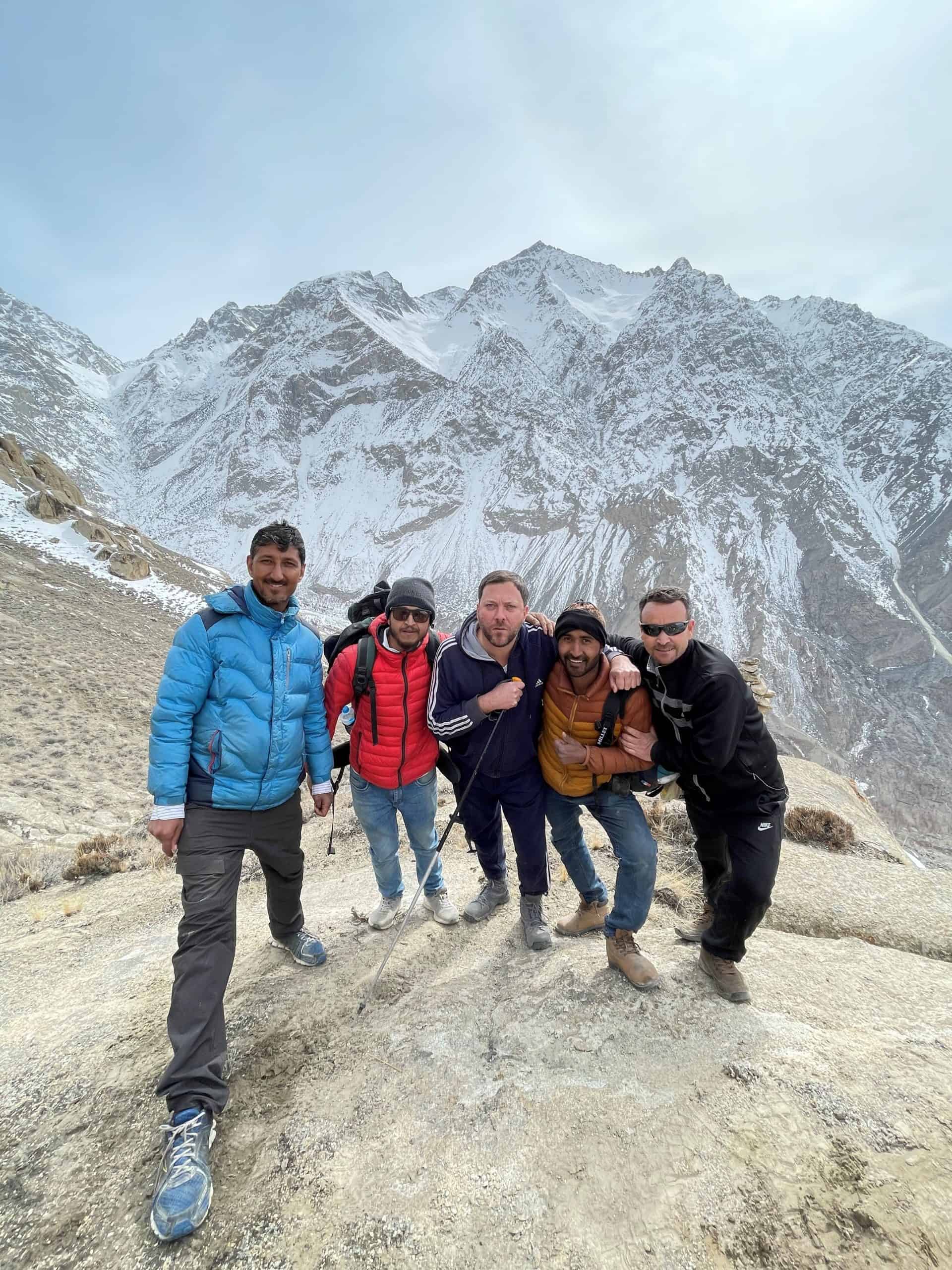
One photograph from that period shows him with companions in a mountain landscape near Skardu. Another places him at a business event, dressed for a very different kind of expedition. Together, they give his Pakistan chapter a breadth that an employment history cannot. He was working on tourism while also experiencing the country beyond a conference programme.
In April 2024, after leaving Pakistan, he wrote publicly about a proposed collaboration with Data Darbar co-founder Mutaher Khan. The idea was an employee review section with a measure of how consistently employers paid salaries on time. He presented it as a contribution he hoped to make. The proposal belongs among his stated intentions; it should not be mistaken for a completed project.
When the guest falls between systems
Fikäfi brings him back to an unresolved hotel problem. In his public writing, Privateer argues that general commerce infrastructure fits hotels imperfectly. A room may be reserved weeks before arrival. A deposit may be due immediately, with the balance collected later. The property has its own cancellation terms. The payment journey unfolds over time, rather than ending neatly at a checkout.
A failed attempt can therefore mean several things. A card is declined. A customer leaves a payment page. A link expires. The useful question is whether the hotel can see the interruption while there is still time to help the customer complete the reservation. Privateer's attention goes to those attempts that do not turn into an ordinary confirmed booking.
“A hotel is not a warehouse in Seattle.”
Andre Privateer, on payment systems built for general commerce
That sentence captures the briskness of his argument. It also shows a habit in his writing: he gives an abstract systems problem a physical setting. The comparison makes the difference between buying a product and reserving a future stay easier to grasp. Behind it lies a practical demand for hotel software to accommodate hotel behaviour.
The implications reach beyond a single declined card. If a property only counts successful reservations, it cannot use those records alone to understand all the people who tried to book. Paying for more traffic may simply send more customers through the same troublesome process. Privateer's business asks hotels to examine the handoff before increasing the advertising budget.
- 01 · ChoiceA traveller selects a room and rate.
- 02 · InterruptionA payment fails, stalls or expires.
- 03 · VisibilityThe hotel can identify the unfinished attempt.
- 04 · RecoveryThe guest gets another opportunity to complete.
The next booking travels through a partner
In March 2026, Elektraweb and Fikäfi announced an integration aimed at a platform portfolio described as 5,800 hotels. The announcement outlined a rollout beginning with selected properties. That distinction matters: the number describes the potential partner footprint, rather than a count of hotels already processing transactions through Fikäfi.
For Privateer, the arrangement links his distribution experience to the way his new company reaches customers. A property management or booking platform already has a relationship with the hotel. Embedding payment capabilities there lets Fikäfi travel along an existing commercial route. Each partner relationship can bring access to properties that would otherwise require individual introductions.
The company has described its future ambitions as extending into guest engagement and loyalty. Those plans would carry the relationship past the payment itself, toward another stay. The name Fikäfi takes its cue from fika, the Swedish coffee break tradition. For a business occupied with collecting money, it is an agreeably unhurried name.
Privateer's story keeps returning to the distance between an intention and its completion. A small hotel wants to sell online. A bank wants to offer travel booking. A traveller wants a room. His work has taken different forms around those decisions, from visiting properties to arranging distribution to examining checkout failures. Now he is asking hotels to pay attention to the guest who almost made it. Hospitality, after all, begins before anyone hands over a key.
Continue the conversation
Explore Fikäfi and Andre's LinkedIn profile. Read his Pakistan reflections, the Fikäfi startup interview and the Elektraweb integration announcement.
Watch Andre on How Does It WorkHotel rooms, pricing and travel in Pakistan · Episode 31