A student asks an AI search tool for help with a difficult paper. The machine produces an answer, perhaps with citations, perhaps after consulting several costly models. To the student, it feels free. To the company running the tool, the meter has already started. Somebody must pay for the answer. Koah, a San Francisco company founded in 2024, has an unusually direct proposal: let a relevant advertiser pay for a clearly marked place beside it.
- Koah supplies ad software to AI app publishers and sells the resulting placements to advertisers.
- Its formats include sponsored sources, cards, inline units and follow-up prompts, matched to the surrounding context.
- Its named customers range from Liner and Luzia to Viro; it announced a $20.5 million Series A in February 2026.
The apparent simplicity hides a very fussy design problem. A banner can sit at the edge of a website and be ignored. An ad inside a conversation arrives in the same intimate space as the answer. If it feels like the machine was bribed, the publisher may lose something more expensive than an impression: trust. Koah’s business depends on making paid material useful enough to notice and separate enough to understand.
The student and the bill
Koah’s founders, Nic Baird, Herrick Fang and Mike Choi, built for a particular class of customer: the independent AI application that serves many free users and pays for computation on every query. Baird has argued that a $20 monthly subscription makes sense for some affluent early adopters but cannot carry every consumer app, especially one serving users across many markets. A free tier can grow faster than its ability to fund itself. Advertising, in Koah’s telling, closes part of that gap.
The publisher installs Koah’s SDK, defines a placement and supplies the context around it. Koah’s system selects and renders an ad, then tracks whether it appeared and what happened next. Its documentation covers web, iOS, Android, Flutter and React Native. For the advertiser, the product is a campaign system: creative, targeting, budgets and conversion measurement. The publisher contributes the audience and the moment; the advertiser supplies the money and the offer; Koah runs the exchange between them. Its exact fee or revenue split has not been made public.
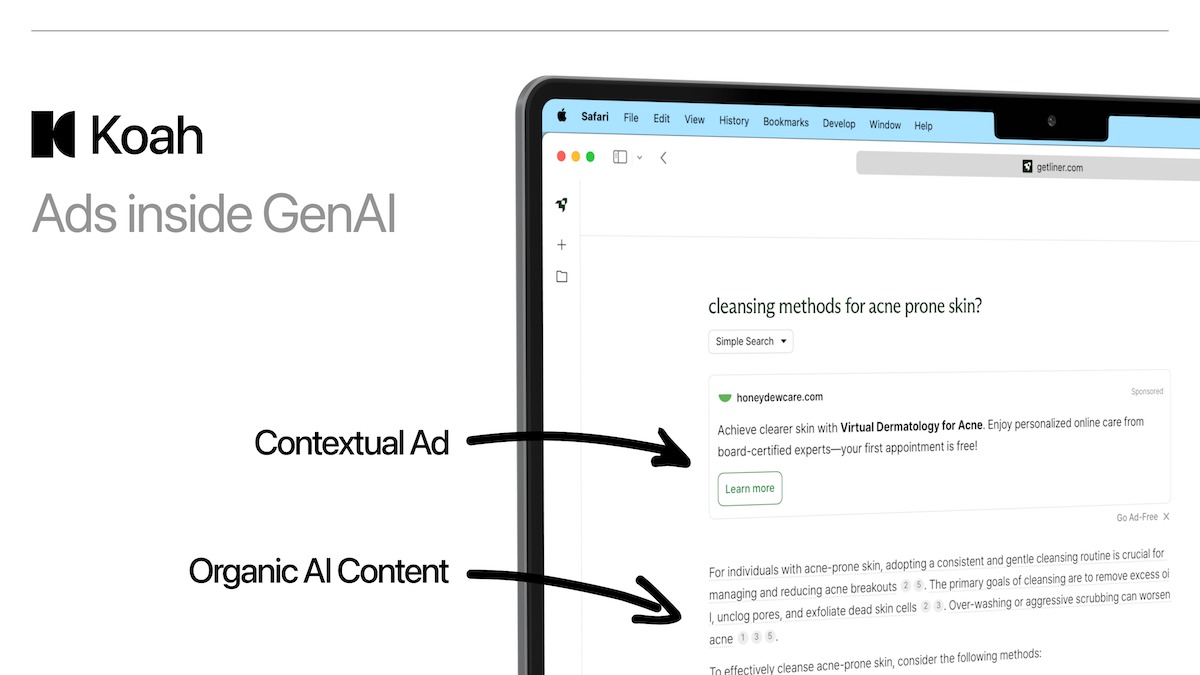
The word context matters here. A conventional display system might know a user’s broad interests or a page’s category. A conversation can reveal a task in plain language: planning a trip, preparing for a marathon or choosing software for a small business. Koah’s pitch is to match the ad to that live task, and to shape its format for the app’s interface. That is a stronger claim than “put ads in chat.” It is also harder to keep honest when the user is discussing something sensitive, personal or simply beyond the advertiser’s expertise.
A citation becomes real estate
Liner, an AI search app used for research, offers a useful test of the idea. It tried Google AdSense on web and mobile. According to Koah’s Liner case study, the units sat awkwardly in the product and often had little to do with academic queries. For an app built around sources and credibility, the mismatch was conspicuous. A founder introduction brought Liner to Koah. The teams tested ads above and below answers, inline placements, sponsored follow-up questions and sponsored sources beside citations.
The last format has a certain sly logic. A citation list is already where curious readers look for a next click. A paid source placed there can borrow the shape of useful navigation, provided it is unmistakably marked as paid. Liner says the newer formats produced a 122% lift in click-through rate and expanded its monetized surface area by 84%. Those are customer-reported results, and the figures say little about absolute revenue. Still, they explain why the team kept experimenting: the ad was finally behaving like part of the product rather than furniture brought in from another room.
“If we disrupt a user studying for an exam with a loud ad, they’ll bounce.”Luke Jinu Kim, Liner CEO
The Liner account also reveals what Koah really sells beyond software: iteration. Liner’s ad lead meets with Koah to review coverage, click-through rate and revenue metrics, then changes formats and placements. The copyable move is less glamorous than an algorithm. Start with one surface, keep the sponsorship label obvious, measure what users actually see, and compare the economics to the format it replaces.
The network has two customers
Luzia, an AI assistant used across Latin America, Europe and the United States, started with a small rollout before expanding Koah into more than half its ad inventory within two months, according to its case study. It reports twice the effective revenue per thousand impressions of its legacy providers and 1.5 times the click-through rate. Viro, a climate-focused AI app, used Koah ads to cover API costs and support renewable energy and cleanup projects. Sup AI tried standard display ads and affiliate links; its case study says neither suited the breadth of its conversations as well as contextual placements.
The other customer is the brand buying attention. Bitly’s paid acquisition team had tested several AI advertising platforms and wanted more visibility into which conversations drove useful traffic. In Koah’s account, Bitly organized campaigns around tasks such as lead generation, hospitality and event planning, then expanded from the United States into the United Kingdom and Brazil. Its case study reports an 8% session-to-signup conversion rate. The detail worth borrowing is the unit of analysis: the job a potential buyer is trying to finish, rather than a generic demographic label.
Koah’s own numbers require a little discipline. The company reported 175 million queries, 35 million native ad impressions and more than 2 million monthly active users across its ecosystem when it announced its Series A. Those figures describe network activity, not Koah’s revenue or profit. A later website figure of 3% click-through rate at scale is a company claim, not a universal result for every publisher. Anyone considering the platform should ask for a controlled test on their own audience, with retention, revenue per query, latency and post-click conversion on the same scorecard.
The cost of being welcome
The capital committed to this wager is clearer than its commercial terms. Forerunner led a $5 million seed round announced in September 2025, with South Park Commons and AppLovin co-founder Andrew Karam participating. Theory Ventures led a $20.5 million Series A announced in February 2026. The latter brought Theory’s Tomasz Tunguz, a former Google AdSense executive, onto Koah’s board. The two named rounds total $25.5 million. Koah said the Series A would support engineering, sales and a fuller AI monetization stack.
That stack has been growing in prosaic directions. Koah’s 2026 changelog lists a web SDK overhaul, public publisher reporting APIs, viewability-based impression counting, a server-side Conversions API and controls for advertisers managing multiple campaigns. The work sounds less cinematic than an ad that writes itself. It is what makes the market credible: an impression must be seen; a campaign must be attributable; a failed ad call must not freeze the answer. In August, Koah said it had brought complete ad responses under one second after upgrading its serving system.
The company’s competitive set stretches from Google AdSense and AdMob to AppLovin, affiliate links and an app’s own sponsorship team. Koah’s difference is the combination of query-level intent, formats made for answer interfaces and tools on both sides of the transaction. It cannot conjure commercial intent where none exists. A medical worry, a grief-stricken confession or a child’s homework may be poor places for a sales pitch even when the software can find a match. And a publisher with low traffic, thin advertiser demand or a fiercely ad-averse audience may find the revenue does not justify the intrusion.
That is the useful tension in Koah’s story. The company wants to make AI answers affordable by selling the space around them. It will succeed only where that space still feels like the reader’s. The ad must pay a bill, but the answer must remain the reason anyone came.
Figures from customer case studies and company announcements describe reported results in specific deployments. They are not forecasts for a new app or campaign.