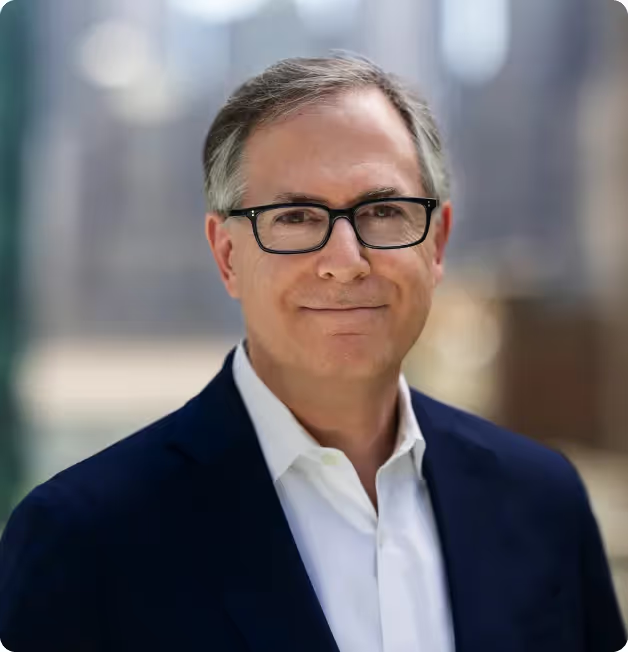
First it was display, at DoubleClick, back when banner ads were the frontier and a young consultant from Oliver Wyman decided the interesting work was in the plumbing of the internet, not the slide decks about it. Then it was video. In 2007 he walked out of the ad-serving giant with two colleagues - Doug Knopper and Diane Yu - and bet that the short clips loading on news sites would someday carry real money. That bet was FreeWheel. Comcast bought it in 2014 for roughly $360 million.
Now it is AI. Heller is chairman, founder and co-CEO of Firsthand, a New York company arguing something that sounds quaint until you sit with it: that generative AI is not a faster way to serve an ad. It is a different thing entirely - a medium, the way television was a medium, the way the open web was a medium. And mediums, unlike tools, change what you can say.
Firsthand builds what it calls Brand Agents: AI representatives that publishers and brands can send out to talk to people directly. Not a chatbot bolted to a help page. Something that meets a shopper in the moment of curiosity, answers the real question, adapts as the conversation moves, and - this is the part Heller cares about - belongs to the brand, not to the platform renting it screen space.
"Generative AI gives us a brand-new way of engaging with the consumer."
Jon Heller, on why Firsthand is not an ad-tech company
The cartridge theory of AI
Heller is unbothered by the model wars. Firsthand treats ChatGPT, Gemini and Claude as interchangeable - "cartridges," in the company's language, swapped in and out as the technology lurches forward. The durable value, in his telling, is not which model you use this quarter. It is the layer underneath: who owns the knowledge, who controls the content, who decides what the agent is allowed to know.
That layer has a name. Firsthand calls it Lakebed - a quiet pun on the data lake - and it is the rights-management system that lets an agent draw on a company's content while keeping it siloed and protected from the tech giants that would otherwise hoover it up. For a founder who watched DoubleClick get absorbed by Google and AppNexus by Microsoft, the instinct to keep the data in the building is not paranoia. It is pattern recognition.
The reunion
Firsthand is also a band getting back together. Heller's co-CEO is Michael Rubenstein, the former president of AppNexus, whom he first met at DoubleClick early in both their careers. The third founder is Wei Wei, the company's CTO. The cap table reads like an industry reunion too: AppNexus founder Brian O'Kelley, longtime DoubleClick and 1stdibs chief David Rosenblatt, and Hollywood power broker Michael Ovitz through Crossbeam all put money in, alongside lead investor Radical Ventures, FirstMark Capital and Aperiam.
The pitch they are backing is contrarian about Heller's own industry. While much of the market races to slap the word "agent" on existing marketing software, Heller waves it off. The opportunity, he insists, is not automating the old playbook faster. It is throwing the playbook out.
"A lot of the stuff that's described as agents today is optimizing or automating marketing as it already exists. We think the opportunity is so much different and bigger than that."
Jon Heller
What he is really building
Strip away the funding headlines and the thread is consistent across twenty-five years. Heller keeps showing up at the seam between how advertising works and how it is about to work - and he keeps choosing the side of the people who make the content over the platforms that distribute it. FreeWheel gave media companies control over the ads inside their video. Lakebed gives them control over the knowledge inside their AI. The enemy has changed shape. The customer has not.
With the Series A in hand, Firsthand has said it plans to roughly double its headcount, pushing the team toward 50 or 60 people as it moves from pilots with publishers and brands toward something wider. Heller has done the scaling part before. He has also done the selling part. What he has not done before is bet that the unit of advertising itself - the impression, the placement, the thirty-second spot - is the thing about to be replaced. That is the wager on the table.
It is a strange place for an adtech founder to end up: arguing, in effect, that the ad as we know it has run its course. But Heller has spent a career being early to exactly these moments. The interesting question is not whether he believes it. It is whether, for the third time, he is right.