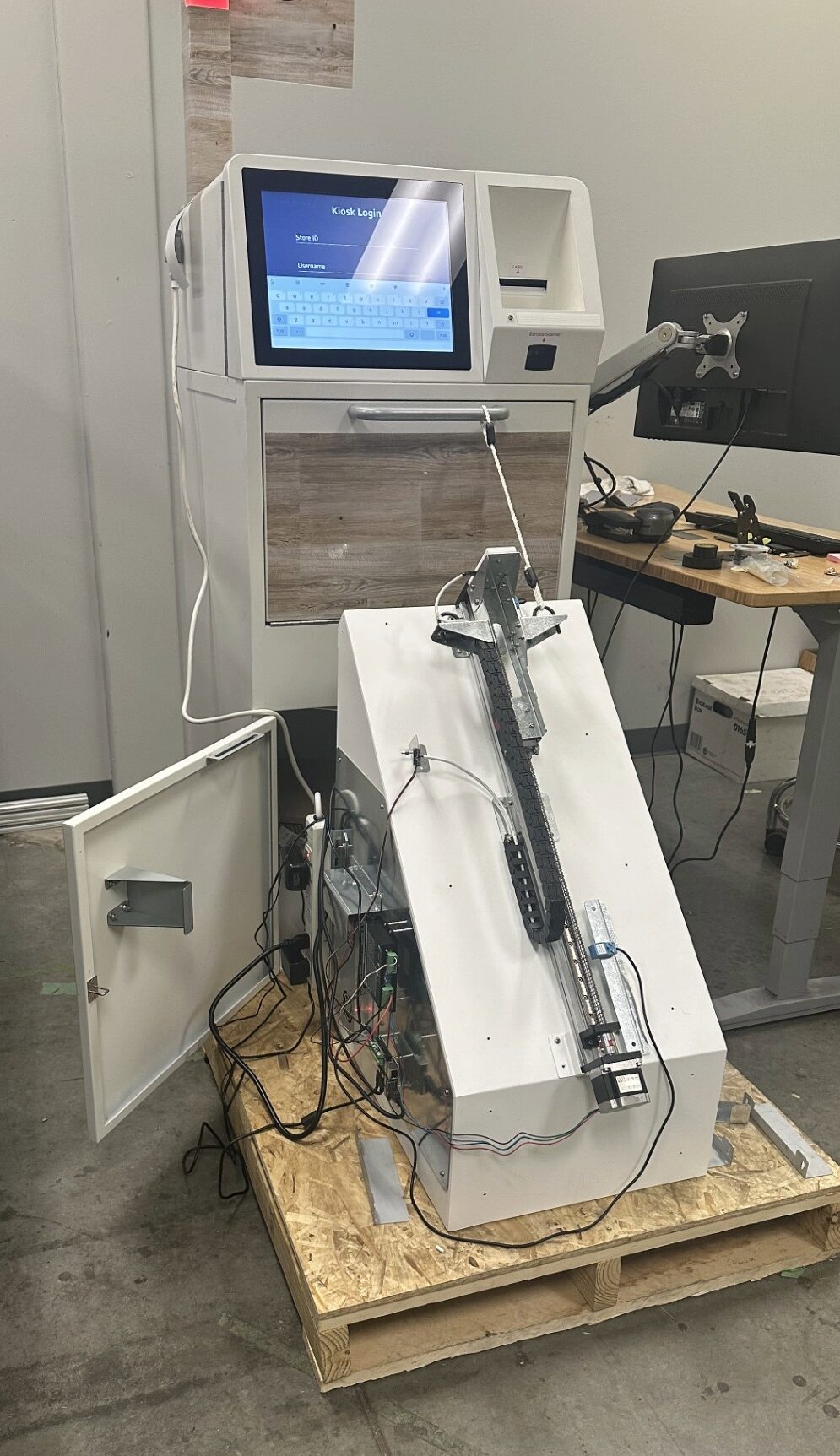
The door was the problem. On some of KIOSK Information Systems’ Automated Returns Kiosks, long use brought weld tears, cracks and stress around the drop mechanism. The machine could offer a perfectly agreeable screen while the part accepting the parcel endured another shove. A returns counter had become a box. The box still had to survive the customers.
- KIOSK builds the hardware, integrates the software and supports the deployed machines.
- Its customers buy completed transactions: returns, check-ins, payments and tickets.
- The revealing details are mechanical testing and small pilots, rather than screen size.
- Automation still needs people for repairs, exceptions and the work behind the transaction.
Engineers Andrew Mills and Jeff Murphy built a Python-programmed robot arm to exercise the returns mechanism and record cycles and forces. Testing designs to failure would make component life something they could measure. There is a pleasing indignity here: a company selling convenience had to build a machine that inconvenienced its own machine.
A transaction wearing a metal suit
KIOSK’s name is unusually literal. Founded in 1993, the company designs and manufactures self-service terminals, writes and integrates software, installs machines and supports them in the field. Its products handle tasks that are individually unremarkable and collectively expensive: paying a bill, returning an online order, registering for an appointment, buying food or checking in for a journey.
For the operator, the product is a completed task with fewer queues and less repetitive handling. The cabinet contains the means: touchscreen, computer, scanner, payment terminal, printer or other peripherals selected for the job. Buying the enclosure without settling the workflow would be rather like buying a splendid reception desk and forgetting to hire receptionists.
The company lists retailers it has served, including IKEA, Walmart, CVS, FedEx and REI. Those names establish the kind of buyer it addresses; they do not establish identical installations or current contracts. Healthcare organizations, hospitality operators, government agencies and transportation businesses also appear across its market offerings. The common requirement is a repeatable public-facing transaction.
The tablet that asked too much
A March 2024 KIOSK case study describes an unnamed Northeastern healthcare system that tried tablets for patient registration. Wi-Fi was unreliable. Patients found photographing identification and insurance cards awkward while handling the devices. The team then piloted six freestanding kiosks and expanded to 135 across several facilities.
Wired connectivity and integrated cameras addressed the practical problems. The kiosks also accepted copays. Patients who completed forms beforehand could check in in under two minutes, according to the case study. Staff remained available for people who preferred human assistance. It is a vendor-published account, but the sequence matters: test a small deployment, solve observed difficulties, then expand.
A reported rollout, not a forecast for every hospital.
The interesting buying question is therefore physical. Can a person complete this task comfortably, in this room, with the documents and belongings they actually carry? A cheaper device can become an expensive compromise when the furniture, connection and camera turn every registration into a small juggling act.
The employee on the other side of the box
Returns offer a similarly instructive division of labor. KIOSK’s current offering integrates Blue Yonder software; earlier materials describe the Doddle partnership. A shopper identifies the return, selects items and a reason, deposits the goods and receives digital communication. KIOSK says its ARKs process an average of 1.3 million returns per month across installations in the United States and several European countries.
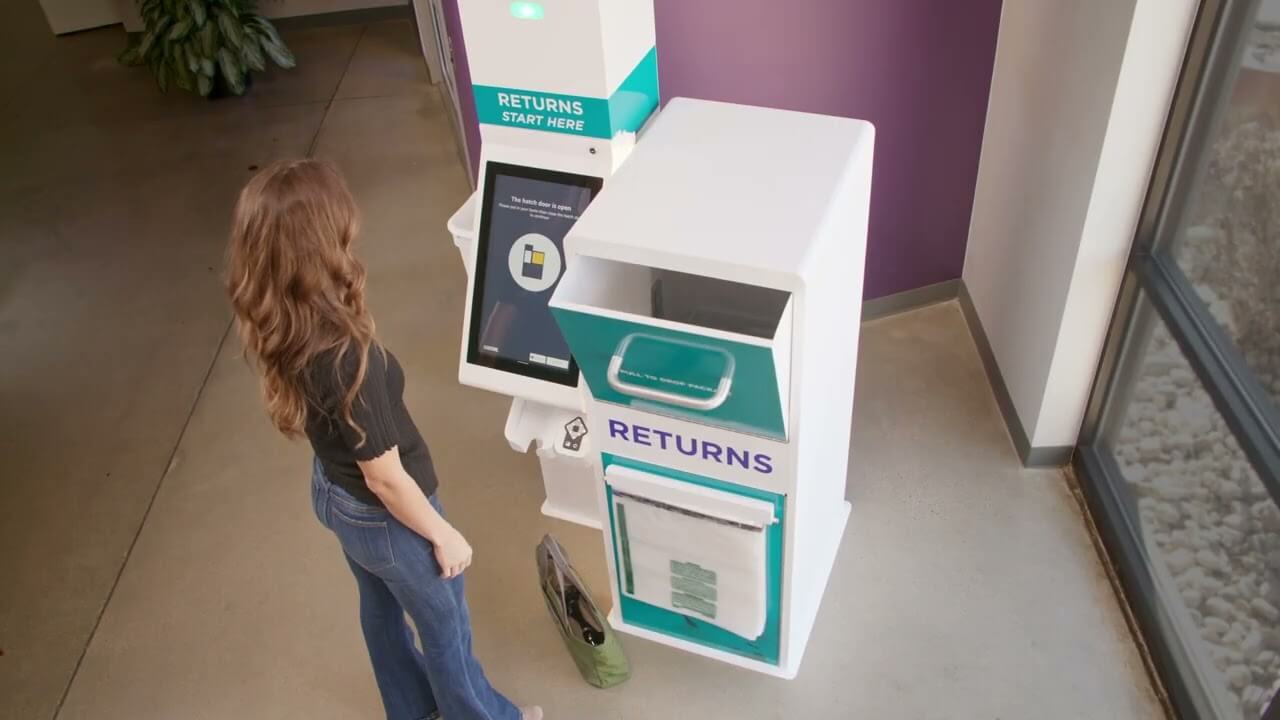
The staff workflow deserves equal billing. An application alerts employees when the bin is nearly full. Someone empties it, inspects the goods, confirms refund eligibility and routes items for restocking or distribution. The kiosk changes the handoff; it does not make inspection and inventory work evaporate. That distinction is useful to anyone calculating the labor saved.
- IdentifyCustomer selects the return
- DepositGoods enter the drop-box
- InspectStaff checks refund eligibility
- RouteRestock or send onward
A historical Doddle-KIOSK brochure proposed a 12-week proof of concept in one location, accepting only online returns to simplify integration. It identified transaction time, transaction volume, customer satisfaction, staff satisfaction and return reasons as measures. That is a sensible experiment to copy: choose one bounded job, establish the data connection and judge the entire handoff before multiplying the machines.
What the buyer is paying for
KIOSK operates as a business-to-business supplier. Customers can choose standard models or commission custom designs, with engineering, software integration, deployment and support arranged around the project. Its published premium-service material describes three- or five-year packages and monthly or annual billing. Hardware sales can therefore sit beside continuing service obligations.
A useful budget has several lines: enclosure and peripherals, software and integration, site preparation and installation, then monitoring, parts and field maintenance. Those are purchasing considerations, rather than a published universal price. The sensible comparison is the cost of keeping a transaction available throughout the intended deployment, including the operator’s remaining staff work.
“self-service should be simple, scalable, and fully supported”Jeremy DuPont · August 2026 partnership announcement
KIOSK’s support offering combines technical troubleshooting with on-site dispatch and remote monitoring. Its KNECT IoT platform tracks deployed systems and components. The practical appeal is accountability: when the screen works but the peripheral does not, a buyer wants a service path that reaches both. A procurement document should name that path before the installation starts.
The family behind the cabinet
Rick Malone entered the business after working in point-of-sale technology. In a 2004 interview, he explained that an ownership change at his employer and the competitive, capital-intensive POS market helped push him toward kiosks. He had also declined a transfer back to Southern California. Colorado suited him; the new business gave him a reason to stay.
Posiflex announced an approximately $105 million cash acquisition of KIOSK in August 2016. The parent later acquired Portwell in 2017. KIOSK says that family relationship lets it source key components, including computers, displays, scanners and printers, within the group. Component continuity is a persuasive concern for a machine intended to operate through years of maintenance.
Its own differentiators include enclosure engineering, manufacturing, software, certification work and services. KIOSK reports ISO 9001:2015 quality and ISO 14001:2015 environmental certifications. Its in-house compliance work brings safety testing into development. Buyers should compare that scope with alternatives such as Olea Kiosks and Frank Mayer, which also offer standard and custom kiosk manufacturing. Custom metalwork alone is no exclusive claim.
AI arrives. The service job stays.
Partners extend what the machines can do. UST supplies computer-vision capabilities for Vision Checkout, where customers place goods for recognition and payment. Ready Credit supplies the payment platform and prepaid-card infrastructure behind ReadySTATION cash-to-card kiosks. A cashless operator can use that arrangement to serve a visitor carrying banknotes. The hardware occupies the boundary between two payment habits.
KIOSK’s Integration Exchange names Incode for identity verification, Vengo Labs for programmatic advertising and Compunetix for video assistance. These are different services sharing a physical endpoint. Their usefulness depends on the actual transaction; an advertising integration is not automatically a better registration experience.
Two 2026 announcements take the company further into hospitality. July’s TRUEOMNI partnership combines NEXI guest engagement with KIOSK hardware and deployment. August’s HotelKey announcement describes registration, identity verification, payments, room assignment and key issuance through GuestKey integration. These are announced capabilities and partnerships. The HotelKey release also reports more than 300,000 KIOSK deployments worldwide.
For a prospective buyer, the appealing lesson is modest enough to use. Begin with a transaction that customers can understand and staff can support. Keep an assisted route for exceptions. Test the connection, accessibility, peripherals and physical handoff. Measure the pilot. If the bin cannot be emptied, the inventory cannot be inspected or the patient cannot finish the form, a faster screen has merely moved the queue. The door remains part of the product.