A knee machine can move a leg. It cannot, by itself, tell a surgeon what happened after the patient went home. That small distinction explains much of Kinex Medical Company’s business. The equipment belongs in a living room; the information belongs with the people directing recovery. Kinex’s job is to make the journey between the two less awkward.
- Kinex supplies prescribed recovery equipment and handles delivery, fitting, instruction, and billing.
- KinexCONNECT pairs a knee motion machine with a cellular tablet for exercise guidance and utilization reporting.
- Patient costs depend on coverage. A 2026 federal billing settlement adds a serious question about the business behind the devices.
This is an equipment company with a service business wrapped around it. Its work includes the reassuringly ordinary tasks that technology presentations tend to skip: arranging a delivery, adjusting a device, explaining its use, and answering a call when something goes wrong. Recovery has little respect for a beautifully drawn product roadmap.
The living room becomes part of the clinic
Continuous passive motion, or CPM, means a machine moves a joint through a prescribed range while the patient relaxes. Kinex supplies devices for knees, elbows, shoulders, and hands. In its description of the home setup, a trained representative delivers the equipment, measures the patient for fit, and explains the controls to the patient or family. The physician supplies the guidelines and goals.
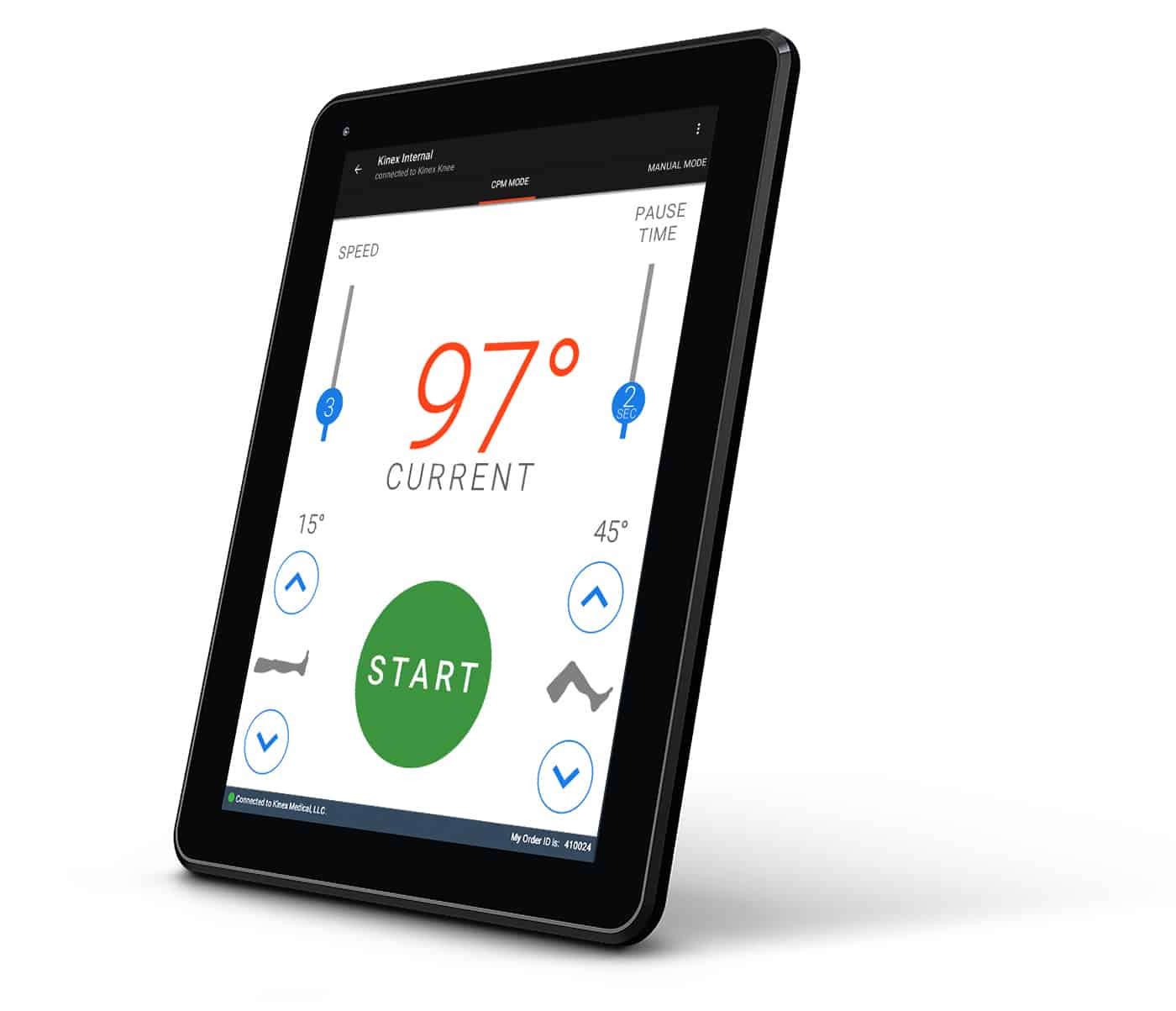
KinexCONNECT adds an Android tablet to the knee machine. The screen controls movement while collecting and reporting utilization data. It also offers clinician-selected exercise videos. These are related jobs, but different ones: the machine provides passive movement; the videos guide exercises; the reporting gives the care team a record of use.
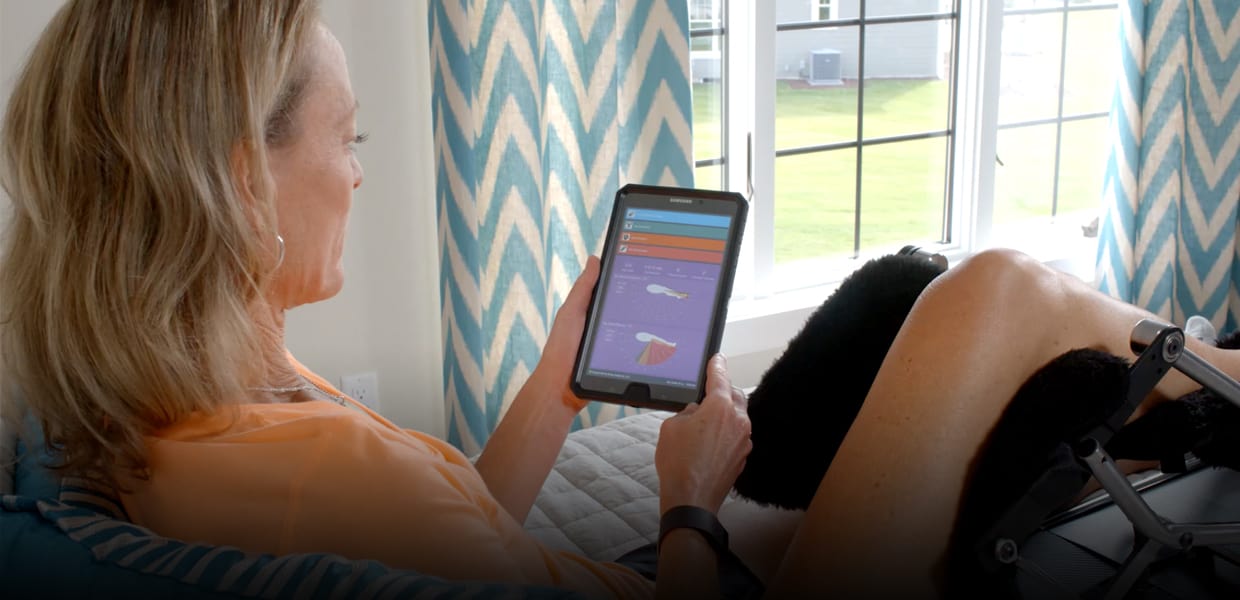
The cellular connection is a useful piece of restraint. Kinex says patients need neither home internet nor an app download. The patient is already learning how to manage a recovery routine. Asking them to become the household network administrator would be an eccentric addition to the prescription.
The company frames this arrangement as a response to shorter hospital stays and the move toward ambulatory surgery. Once patients leave, the clinician’s view becomes less immediate. A device that sends information back offers one way to narrow that gap. Whether a particular patient should use it remains a clinical decision.
A car gadget takes a detour
The connection did not begin with a tablet. An AT&T customer account describes a ten-unit prototype using another carrier, an expensive custom USB option, and an alternative borrowed from automotive diagnostics: an OBD-II device. When that device stopped working, revised firmware solved the problem. Kinex later adopted cellular tablets to improve the patient interface and reporting.
“It was a small number for a proof of concept, but it was a learning experience for us.”
Paul Jebe, Kinex IT director, describing the early prototype
The practical lesson is to test the connection as part of the product. A motor that works and a report that never arrives make a rather incomplete pair. The same account describes using consumer tablets to contain cost, with replacement models requiring testing. Borrowing familiar hardware can simplify a patient’s experience while leaving the engineering team with plenty to do.
Three parties, one prescription
The person using Kinex equipment is not the only person choosing or paying for it. A physician directs its use. An insurance plan determines benefits and reimbursement. Kinex works between these parties, managing equipment and the administrative steps that allow it to reach a patient.
The company says it supports more than 2,000 doctors and serves more than 5,000 patients a month across 35 states. Those are its own reported figures. Its stated capabilities include around-the-clock on-call support, an in-house repair department, and contracts with more than 300 insurance providers. The reach rests on people and distribution as well as a connected screen.
- 01PrescribePhysician directs use
- 02CoordinateBenefits and paperwork
- 03FitDelivery and instruction
- 04FollowUse, support, reporting
Merit Capital Partners describes financing a majority recapitalization of Kinex and R&M Rehabilitation with debt and equity. R&M brought a regional distribution business into the combination. In August 2014, Kinex/R&M acquired Isokinetics, another home orthopedic equipment provider. These transactions suit a business whose usefulness depends on reaching the patient’s door.
The catalogue has more than knees
Kinex’s selection includes DonJoy shoulder and knee braces and Exos spinal braces. Its cold therapy range includes ThermoComp, IceMan, and Cryo/Cuff products. It also supplies JAS joint stiffness splints, compression devices, and rehabilitative stimulators. A buyer is dealing with a supplier that can draw on several product families.
Some of the most revealing work takes place away from the knee machine. Kinex offers individual mastectomy consultations and fitting for bras, breast forms, and recovery garments. Its compression offering includes ready-to-wear, custom, and nighttime garments, plus pneumatic pumps. Here the service depends on measurement, listening, and choosing an appropriate fit.
The lymphedema ordering process makes the administrative effort visible. Kinex asks for a signed prescription, insurance information, and supporting medical notes. It describes an initial welcome call within 24 to 48 hours, followed by benefit verification that typically takes three to four days; prior authorization can extend that time. A garment has dimensions. An order has dependencies.
The price is an insurance conversation
Kinex’s patient FAQ describes both rental and purchase transactions. It says patients receive an estimated cost, then the company submits charges to insurance. The insurer’s explanation of benefits identifies allowed amounts, coverage, and patient responsibility. A later bill may include a deductible, coinsurance, a copay, or a noncovered product.
A provider-facing savings claim answers a different question. In a 2021 article, Kinex estimated that KinexCONNECT could reduce total care costs by $1,000 to $2,000 per case compared with outpatient therapy and home health. That is a company estimate about a rehabilitation episode. It is not a device price, an individual patient’s saving, or a guarantee.
Kinex’s market report drew on 189 orthopedic and health-system leaders surveyed by Sage Growth Partners. These percentages describe surgeon responses, not patient outcomes.
There is an understandable commercial attraction here: care delivered at home, fewer logistical burdens, and information returned to the prescriber. But interest in a model and evidence for a patient are separate questions. The survey records appetite for change; it does not decide an individual treatment plan.
A $6.925 million reckoning
On March 5, 2026, federal authorities announced that Kinex agreed to pay $6,925,000 to resolve allegations of unnecessary brace billing from 2019 through 2024. The government also alleged improper cost-sharing waivers and free equipment used to induce acceptance. Kinex entered an HHS-OIG Corporate Integrity Agreement. It does not admit liability.
That development belongs in the company’s profile because insurance billing is central to its service. Useful equipment and justified reimbursement require separate scrutiny. A connection that records device use cannot establish whether a different product should have been supplied.
What is worth borrowing
Kinex’s operational design offers several concrete ideas: bring equipment to the patient, teach its use at setup, avoid unnecessary installation steps, and give the prescribing team information it can act on. Its careers page advertises delivery, patient service, sales, and data-entry roles. The staffing makes sense for the work: someone has to keep the physical and administrative journeys together.
The home itself also matters. Kinex’s patient information describes checking for a suitable equipment location, safe electrical access, trip hazards, and the patient’s ability to enter and leave the device. A connected service needs usable connectivity and a team that responds. A prescribed product needs appropriate clinical selection and a clear coverage conversation.
The alternatives depend on the problem: another equipment supplier for a brace or rental, a therapist for supervised rehabilitation, or another platform for remote guidance. Those choices can overlap. The useful question is what support this patient needs, in this home, under this plan. The answer deserves more care than a catalogue checkbox.
See the equipment in action
Explore Kinex Medical, the KinexCONNECT system, and its YouTube overview. For practical details, visit patient questions and company articles. Follow Kinex on LinkedIn or Facebook.