The clinically-backed intimate-care brand that decided menopause and vaginal health were a product problem, not a personal failing - and refused to whisper about it.
Santa Monica & New York · Founded 2019 · Est. ~15 people
Here is a fact that is both obvious and, somehow, a business opportunity: roughly 6,000 women enter menopause in the United States every single day, and until recently almost nobody was selling them anything good. The symptoms - dryness, discomfort, hot flashes, sleeplessness - were treated as either too clinical for a store shelf or too private for a conversation. Kindra's entire premise is that this gap is silly, and that vaginal health is just health.
Kindra did not begin in a garage. It began, of all places, inside a partnership between the venture firm M13 and P&G Ventures - the corporate innovation arm of the company that makes a great deal of what is already in your bathroom. In 2019 the two built a launchpad, a sort of company-manufacturing machine, and Kindra was the first thing that rolled off it. This is an unusual origin. Startups are supposed to be scrappy underdogs; Kindra was, more or less, assembled on purpose by people who understood both consumer goods and direct-to-consumer distribution.
What they assembled is a line of estrogen-free, doctor-formulated products with names that are almost aggressively plain. There is the Daily V Lotion. There is the V Relief Serum. There is, yes, the V Lube. The plainness is the strategy. An entire category had spent a century hiding behind soft, euphemistic language, and Kindra's bet was that clarity would sell better than coyness. It is hard to build trust in a product you are too embarrassed to name.
The other half of the bet was science. Kindra's flagship formulas are patent-pending and, per the company, the first to bring peptide technology - the sort of thing you associate with premium skincare - into intimate care. That is a clever piece of positioning. Borrow the credibility of an adjacent, glamorous category, and a lotion for vaginal dryness starts to look like an innovation rather than an errand.
It seems to be working the way trust is supposed to work. Kindra says its products are recommended by more than 6,000 OB/GYNs, pelvic-floor therapists, oncologists, urologists and sexual-medicine specialists. That is a different and slower kind of marketing than a viral ad - you have to convince the doctor, who then convinces the patient - but it compounds. A recommendation from a clinician is worth more than an impression, and it is much harder for a competitor to buy.
The market data does the rest of the arguing. As Female Founders Fund's Anu Duggal put it, women control 80% of all healthcare buying decisions in a $3.5 trillion industry, and yet only 36% felt even moderately prepared for menopause. When demand and preparation diverge that sharply, you have found the place where a company should be built. Kindra was built there.
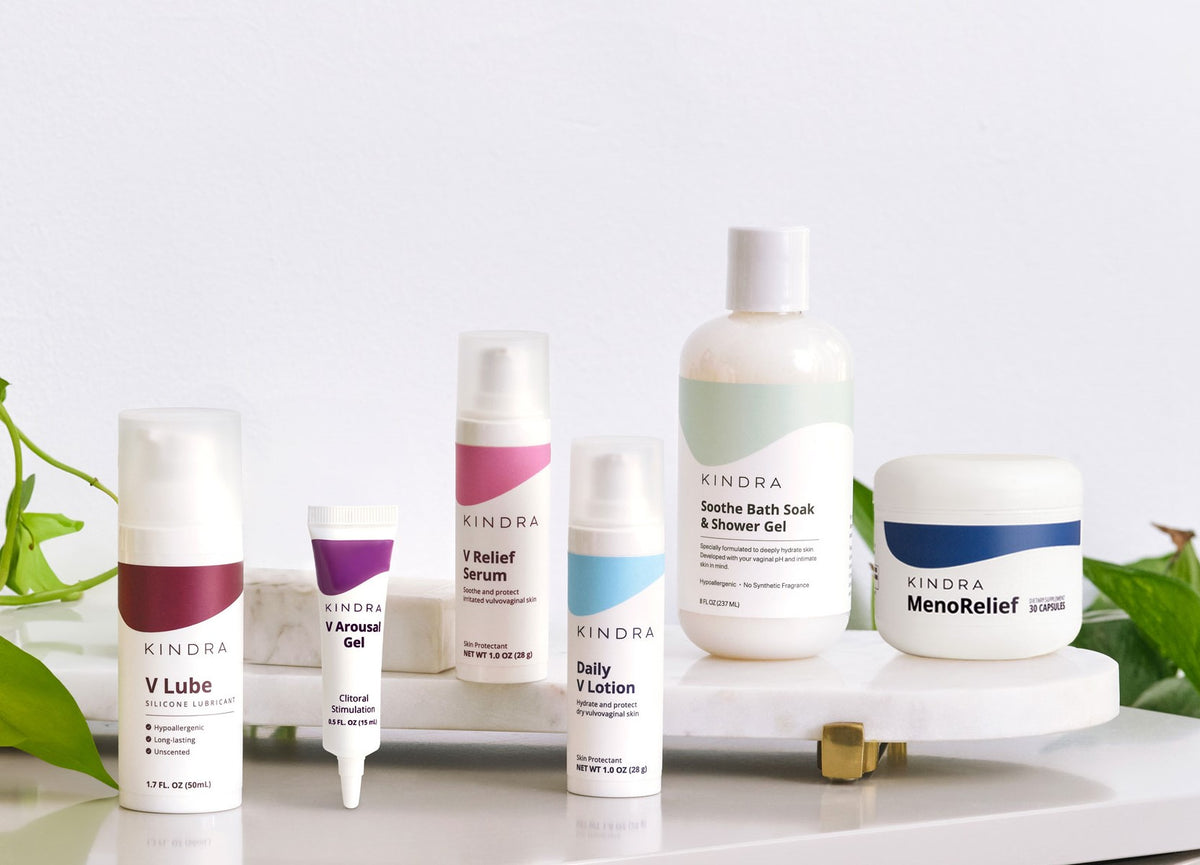
One category, many life stages. The same intimate-care system is aimed at menopause, perimenopause, postpartum, and the side effects of medications and treatments - which is a tidy way to sell more than one product to the same person over many years.
An estrogen-free daily vaginal moisturizer for ongoing dryness and discomfort.
A peptide-based serum targeting dryness, itching and irritation from hormonal shifts.
A body-safe personal lubricant designed to reduce friction and support comfort during intimacy.
A vulva-safe bath soak formulated to calm sensitive intimate skin.
A naturally-derived supplement for menopause symptoms - hot flashes, sleep, brain fog.
A symptom quiz, the Kindra Journal, and a provider program that turn a purchase into a relationship.
Kindra's stated mission is to transform vaginal health and sexual wellness for women navigating hormonal shifts - through clinically-tested products, reliable education, and community. The framing is deliberate. It does not sell menopause as a crisis; it sells intimate care as ordinary maintenance, the way you would sell moisturizer or a multivitamin. Reframing a stigmatized problem as a mundane one quietly changes who thinks the product is for them.
The business model is classic direct-to-consumer e-commerce, run on Shopify Plus, with the repeat-purchase economics of a consumables brand. The products are estrogen-free, progestin-free, fragrance-free, hypoallergenic, cruelty-free and vegan - a checklist assembled to remove objections one by one. And in 2026 the model widened: a commercial partnership put Kindra's line into a legacy retail network, which is how a DTC brand grows up without abandoning the customers it started with.
Kindra has raised about $7.9M. The more interesting line is who wrote the checks - a list you would be happy to see on any women's-health brand.
Backers include Female Founders Fund (lead), Primetime Partners, Anne and Susan Wojcicki, Katie Couric Media, The Community Fund and H Ventures - alongside original builders P&G Ventures and M13. When YouTube's and 23andMe's co-founders are on your cap table, the investor list works as a marketing asset as much as a source of capital.
Launches as the first company off the M13 x P&G Ventures launchpad - a DTC brand for estrogen-free menopause solutions, resources and community.
Closes a $4.5M seed round led by Female Founders Fund, with the Wojcickis, Katie Couric Media and others joining.
Expands the line beyond menopause into broader vaginal and sexual health; adds a further seed tranche and grows clinician recommendations past 6,000.
Announces a strategic commercial partnership with PHE - parent of Adam & Eve and Wild Secrets - including distribution, co-branded marketing and a minority equity stake.
"Kindra is on a relentless mission to deliver real innovation in women's vaginal and sexual health."
Hasti Nazem & Afshan Dosani · Co-CEOs, Kindra"Women control 80% of healthcare buying decisions in a $3.5T industry, yet only 36% felt prepared for menopause."
Anu Duggal · Female Founders Fund"Sexual health has been treated as a category apart - whispered about rather than championed. That era is over."
Lewis Broadnax · CEO, PHE