At Le Moo in Louisville, some vintage Louis Vuitton luggage has acquired an unlikely second career: seating people who have come for steak. The restaurant’s specialty booth turns the material of travel into a reason to stay put. Luxury, having spent years at baggage claim, has finally secured a dinner reservation.
The booth makes a useful introduction to Kevin S. Grangier. Before restaurants, he founded CarryOn, a communications agency. Later came Belle Noble and a collection of Louisville dining rooms with different cuisines and temperaments. A repurposed suitcase belongs comfortably in that career. Grangier has spent years thinking about what an object, a name, or a room causes people to expect.
His restaurants give that question physical consequences. A guest must sit somewhere. A server must cross the room. The light has to fall on a face as well as a plate. Whatever an owner imagines, dinner eventually arrives at the very practical business of people spending an evening together.
The current Le Moo experience includes a contribution supporting local animal rescue when guests book the Louis Vuitton booth. It is a small intersection of Grangier’s interests: elaborate surroundings, a memorable occasion, and animals. Even the furniture has been given something to do beyond looking expensive.
Before the table, the audience
Grangier grew up in Sellersburg, Indiana, and attended Western Kentucky University. His alumni profile identifies him with the class of 1986. He later described the university’s influence in terms that reached beyond professional preparation: encountering other people and cultures helped shape how he understood an audience.
That interest carried into consumer communications. By 1996, he was a public relations manager at Miller Brewing and WKU’s Public Relations Practitioner of the Year. In 1998, he founded his agency in Los Angeles. The work would bring him into contact with familiar consumer names and a much larger geographical canvas than the Louisville area.
A 2012 corporate filing identified him as CarryOn’s CEO and described a client history including Coors, ESPN, the NHL, IHOP, Yahoo!, and Lindt. It also recorded related ventures in interactive communications and brand identity. This was experience in translating between businesses and the people those businesses hoped to reach.
Those are different audiences with different reasons to care. Someone choosing chocolate, someone watching hockey, and someone deciding where to eat cannot be addressed as an interchangeable crowd. Grangier’s later restaurant work would make that distinction visible: separate names, separate rooms, separate invitations to come inside.
Kentucky, with somewhere to go
The Village Anchor opened in 2010. Grangier arrived at restaurant ownership with experience in product development and branding, and without a restaurant background. He applied what he already knew to an evening out: identify the audience, decide what it should feel, and make the details support the proposition.
The restaurant and its sister bar, the Sea Hag Pub, offered him two related settings. The Village Anchor’s own description pairs a Parisian bistro influence with an English pub sensibility, Southern comfort food, a Victorian lanai, and a patio below. The imagined escape was close enough to be part of a neighborhood routine.
An upholstered chair and a familiar song are choices about how long someone might want to linger. Generous food and a comfortable setting make a different invitation from a dining room arranged around ceremony. Grangier had taken the language of consumer experience and given it opening hours.
He remained interested in how people think, including employees as well as customers. His WKU account treats understanding those audiences as a continuing difficulty of the job. That is a revealing admission from someone whose rooms can appear so confidently composed. The set can be finished while the work of understanding its occupants continues.

Steak school, then the chandeliers
Le Moo opened in 2015 in the former KT’s restaurant space. Developer Kevin Cogan had approached Grangier about the property, and Grangier saw possibilities in its brick and ironwork. The resulting steakhouse mixed industrial elements with chandeliers, velvet, brocade, and a conspicuously playful name.
He also did his homework on the meal. Before opening, he studied the local competitive landscape and attended steak school in Ohio. He learned about cuts, how cattle are broken down, and the differences associated with feeding and genetics. The decorative confidence had a less photogenic companion: preparation.
His account of service is similarly specific. Food presentation, timing, seating, lighting, drinks, the host, and the server all belong to the same experience. A room can contain plenty of beautiful objects and still fail a guest in the interval between being seated and being noticed.
The booth is the joke people remember. The number of decisions surrounding it explains the business. There is no chandelier bright enough to make a badly managed wait feel intentional.
Le Moo also became a setting for drag brunch. In January 2023, Ethan Hawke, Maya Hawke, and Laura Linney visited while the film Wildcat was being made in Kentucky. Their appearance supplied a particularly recognizable guest list, but the underlying attraction was an occasion with its own personality. A steakhouse could host more than one kind of gathering.
- ArrivalEntrance · music · welcome
- Settling inSeating · lighting · attention
- DinnerFood · timing · presentation
Auditioning for grandmother
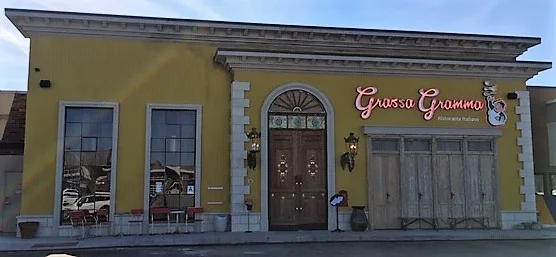
For Grassa Gramma, the theatrical instinct became unusually literal. In June 2018, Italian grandmothers brought food to Oxmoor Center to audition for the restaurant’s namesake role. Grangier joined design consultant Lesa Buckler and executive chef Robert Rice on the judging panel.
There was a branded backdrop, preparation space, and Italian music. The prospective grandmother would be a taster and greeter. Before the restaurant had welcomed its dining public, its identity already had people, recipes, and a public occasion attached to it.
It is an amusing hiring exercise, and also an unusually direct expression of what Grangier wanted the name to mean. A grandmother could suggest welcome, authority, abundance, and opinions about whether you had eaten enough. A logo would have had trouble doing all that over lunch.
The built environment pursued the same idea at a different scale. The construction brief described a 7,000-square-foot restaurant intended to suggest a small Italian town. Another project partner’s account identifies the work behind its booths, upholstery, and drapery. Atmosphere required carpentry and fabric as well as an idea.
By early 2019, diners were entering that environment. The room’s apparent ease rested on collaborators turning a description into things that could be measured, built, installed, and used. Grangier supplied a world to imagine; other people helped make it possible to sit down in it.
The collector at home
The appetite for objects with previous lives extends beyond his restaurants. At his Anchorage home, Bellewood, Grangier collected art and furnishings with histories of their own. A sofa discovered beside the road during his departure from Los Angeles came with him, was rebuilt, and received a new covering.
He retained its marks in the wood. Silk covered the front; an old wedding train supplied the back. The combination has something of his restaurant sensibility: material with associations, an unexpected pairing, and a willingness to let a piece keep evidence of where it has been.
His favorite painting depicted a monk. What mattered to him was the sincerity he saw in the eyes. Elsewhere in the house were works made by his mother. These preferences give the collector a more personal scale than an inventory of valuable objects would.
He also described preferring smaller spaces, including the library and a renovated cottage. That preference sits interestingly beside the public rooms he creates. Someone can enjoy designing an entrance with theatrical force and still want a confined, comfortable place to read. A taste for spectacle need not occupy every hour of the day.
A decade before the drawing
By 2025, Sake a Gogo had joined his Louisville work, bringing Japanese cuisine to NuLu. Grangier said he had imagined the concept roughly ten years before putting pen to paper. An idea can spend a long time as a private possibility before it becomes somebody else’s dinner plan.
The opening also supplied an inventory of obstacles. In a public LinkedIn post, he described an old Japanese door lost in a warehouse fire, sidewalk work delaying the facade, and utilities that needed moving before a sign could arrive. The polished invitation had a construction story behind it.
His hospitality work expanded into Hotel Bourré Bonne as well, including brand development and design involvement. He described working with developers and other creative entrepreneurs, and learning within that partnership. The hotel offered a broader setting for interests that already crossed food, architecture, and naming.
At the same time, he outlined practical conditions for another project: an audience for the concept, suitable timing, a compatible leadership team, and a workable budget. Expansion beyond Louisville remained something to consider rather than a reason to repeat a restaurant elsewhere. Each proposal had to earn its place.
“You do need to have respect for people and a passion for serving them.”Kevin Grangier · 2025
The clock gets a vote
The Kentucky Restaurant Association named Grangier its Restaurateur of the Year in 2025. Awards belong to the public story of a career. The daily story still involves less accommodating matters, including the hour at which people are ready to eat.
When a later Kentucky Oaks start time was announced in July 2025 for the following year, Grangier considered both possibilities. Earlier diners might create an opportunity; racegoers leaving the track late might simply be tired. Oaks night was among his group’s three biggest reservation nights of the year.
He said his restaurants would accommodate guests with later kitchen hours. It was a practical response to a change he could not decorate his way around. The guest experience includes the schedule of the city outside the restaurant, along with everything carefully arranged inside.
“You do need to have respect for people and a passion for serving them,” he said in 2025. The sentence places a straightforward obligation beside the elaborate rooms. Someone comes in with an evening to spend. Grangier’s work is to make all those decisions about food, furniture, people, and timing add up to a reason to stay.