A customer calls a business. Somewhere behind the familiar greeting sits another company’s software, routing the conversation, keeping the record and helping an agent decide what happens next. Kevin Childs works in that largely invisible space. His current business gives other companies a way to put their own name on the experience. In software, as in tailoring, the label can be a surprisingly consequential piece of cloth.
Childs is co-founder and CEO of CallCorp, a cloud contact-center technology company. His career begins well before that title. He came through staffing and workforce operations, moved into selling hosted contact-center technology, and later advised the industry on people and performance. His route into software ran through the people expected to make it work.
That history offers a useful way to read the company he leads today. CallCorp gives partners a choice about how much of the customer-facing business they want to run. This is an arrangement about work, responsibility and money. The logo is merely the part the customer can see. The rest becomes apparent when a configuration needs changing, an agent needs help or an account needs attention. A provider can sell an offering under its own name only if the arrangements behind that name can support it. That operating question gives this career its continuity.
Before the software, there were the shifts
Between 1991 and 1998, Childs held senior management positions at the Salt Lake operation of SOS Services. He subsequently became a senior regional vice president at Adecco Employment. There, his responsibilities included a Florida operation with $100 million in business, 120 staff and 4,500 associates. Employers included financial institutions and Fortune 1000 companies, with contact centers among the operations he supported.
Those figures describe an operating assignment, rather than the valuation of a startup. They put his early career in the world of employers, staffing requirements and large groups of working people. Before a software platform can improve an agent’s day, somebody has to recruit that agent and arrange the work. Childs’s management experience began on that side of the desk.
By July 2005, he had become part of UCN, the communications company behind inContact. UCN promoted him from vice president of inContact to president over sales, marketing and support, and elected him executive vice president. His earlier assignment had covered the product’s strategy and sales team. The new job joined the commercial promise to the organization expected to support it.
The train strike and the telephone
An episode involving MetTel gives the early cloud business a wonderfully ordinary setting: the commute. During New York’s December 2005 transit strike, inContact enabled MetTel to route service calls to the homes of half its customer-care team. Those employees could not reach the office. The calls reached them instead. A technology proposition had acquired a very practical test.
In October 2006, UCN announced a broader agreement under which MetTel could sell inContact services to its own customers. MetTel already used the system internally. The next step was distribution through an established communications provider, with access to that provider’s business accounts. There is a recognizable ancestor of CallCorp’s partner strategy in that arrangement.
Childs described the appeal in plain language: “They don’t have to change a thing.” He was talking about customers keeping their existing numbers while gaining contact-handling services. The selling point was continuity. A business could add capabilities without asking its customers to learn a new way to reach it. For callers, that is a better advertisement than an architectural diagram.
“They don’t have to change a thing.”Kevin Childs / on customers keeping existing numbers, 2006
A break in the career line
His UCN career also included a consequential setback. In February 2008, the company removed Childs as executive vice president of global alliances after an investigation into the allocation of a customer account between its Telecom and inContact reporting segments. UCN’s audit committee concluded that he had acted recklessly and that his conduct was inconsistent with its ethics code.
The account purchased long-distance service rather than inContact software. UCN said it would move $1.3 million in revenue for the first nine months of 2007 from the inContact segment to Telecom, along with associated costs and expenses. The company distinguished that segment correction from the much smaller effect on total corporate revenue: a $900 timing difference between reporting periods.
The distinction matters when describing what happened. The issue concerned how business was assigned between segments, and it cost Childs his executive position. A company selling both traditional telecommunications and hosted software had to account for those businesses separately. The customer account fell on the wrong side of that division. His subsequent consulting roles would return him to the contact-center industry from a different position.
Back to the people answering
By 2011, Childs was discussing contact-center work as a practice leader at Manpower. He described an operation employing 10,000 contact-center representatives in the United States and serving more than 3,500 companies. Those were Manpower’s figures, not the size of a company he owned. His argument concerned how to match people, technology and the customer’s expectations.
He emphasized talent selection, flexible labor, performance management and process improvement, while preserving the client’s control over leadership and customer experience. An industry debate about moving jobs overseas was also a debate about what happened after somebody answered. Cost mattered. So did the quality of the interaction and the company’s ability to see it.
In October 2012, Childs appeared on Bruce Belfiore’s CallTalk program for a discussion titled “Working Successfully with Generation Y.” He was introduced as a senior partner at OneSource Consulting and acting contact-center practice leader with ManpowerGroup. The subject placed him firmly in workforce management, with younger employees and the organization of service work on the agenda.
An April 2017 Call Center Campus program in New Orleans listed him for an opening keynote under the OneSource name. Taken together, these appearances trace a professional life spent moving between the commercial side of service technology and the people doing service work. The setting changes from a sales organization to a radio discussion to a conference room. The practical questions travel with him.
The old team, a different place for the brand
At CallCorp, Childs works with people whose contact-center experience reaches back to inContact. The founding group includes Drew Judkins, David Peterson and Shane Kelly. Today Judkins is co-founder and CTO, Peterson is chief architect, and Kelly leads engineering and infrastructure. Their responsibilities span the commercial, architectural and engineering work behind the offering.
The company describes its aim as making contact-center technology accessible and adaptable. Its partner audience includes resellers, managed service providers, carriers and customer-experience firms. These are organizations that may already have customers and service relationships, but want a contact-center platform to build into their own offering. Childs’s company supplies the underlying technology.
That division has a particular appeal for an established provider. A customer may already call it for communications or managed services. Adding contact-center software can extend that relationship. The provider must then decide how much delivery, configuration and support it can actually handle. A new line on the invoice arrives with a new list of obligations.
- The partnerBrand, offer and customer relationship
- The shared decisionsDeployment, operating scope and support
- CallCorpThe contact-center platform underneath
Two offers, two amounts of homework
CallCorp’s current partner terms make the distinction explicit. Refer CCPro lets a partner introduce a qualified customer while CallCorp manages the product, delivery and ongoing service. The published referral revenue share is a flat 30 percent. Qualified white-label arrangements give partners greater control over their own brand and customer relationship, with revenue shares from 35 to 70 percent depending on volume and operating responsibility.
These percentages describe different arrangements; they are not a promise of net profit. The white-label path involves taking on more work. For a partner, choosing between the two requires an honest account of its capabilities. An organization with a sales relationship has one starting point. An organization prepared to operate and support an offering has another.
This is where Childs’s career makes the present business more interesting. Staffing, sales, consulting and partner distribution each expose a different piece of the same service. Read against that experience, CallCorp’s two paths are a practical admission that its partners will have different resources and ambitions. Each needs a commercial arrangement that fits the job it is prepared to do.
A small screen, a long chain of responsibility
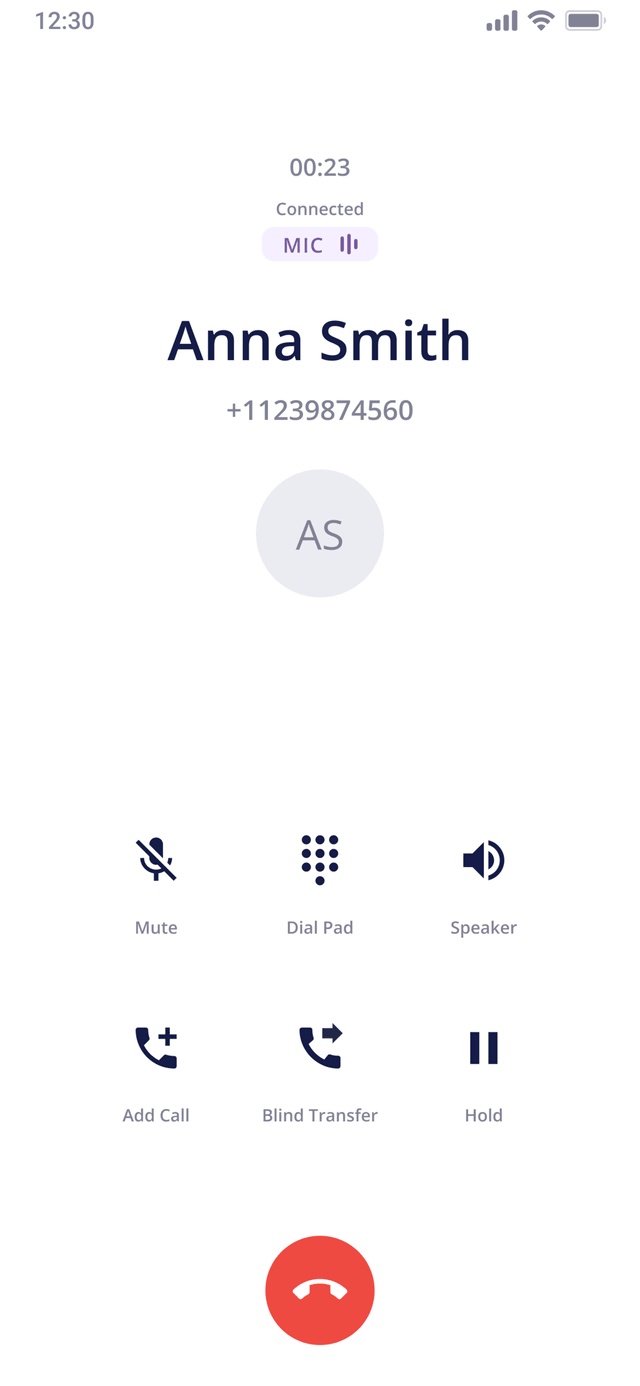
The product itself returns the discussion to familiar objects. CallCorp’s mobile interface shows an active call with controls for mute, keypad, speaker, hold and conference. Behind that compact screen, the platform brings together routing, agent work, reporting and integrations. For the person on the telephone, however, the experience still comes down to whether the conversation goes somewhere useful.
In October 2026, the Cloud Communications Alliance announced that CallCorp and Zoom would sponsor its November 10 dinner in Singapore. The planned gathering, limited to 25 leaders, covers AI, regulation and partnership opportunities across Asia-Pacific. It is a current example of the company’s participation in the communications partner community. Sponsorship alone says nothing about Childs’s personal travel plans.
His professional story now stretches from large staffing operations to a company willing to put its software behind somebody else’s brand. The recurring question is who takes responsibility for the relationship once the technology is in place. CallCorp gives that question a commercial form: bring the opportunity, or qualify to build and operate the offering. Somewhere at the far end of the arrangement, a customer is still waiting for an answer.
Follow the conversation
- CallCorp leadership
- Kevin Childs on LinkedIn
- Kevin Childs on X
- 2005 UCN promotion
- 2006 MetTel announcement
- 2008 UCN filing
- 2011 contact-center discussion
- Listen: Working Successfully with Generation Y
- 2017 Call Center Campus program
- CallCorp founding group
- Partner models
- CallCorp platform
- Singapore dinner announcement