Kerstin Block had an eye for other people’s clothes. Eventually, she needed a place for the dresses to go. A devoted secondhand shopper, she had developed the familiar bargain hunter’s problem: an eye that worked rather faster than the wardrobe could accommodate. In 1974, she and her husband, Spencer, opened a little resale shop in Tucson. Some of its first stock came from their own closets and those of friends. A personal enthusiasm had acquired opening hours.
The premise was agreeably practical. Block would select clothes that other people might want, arrange them somewhere inviting and pay customers cash or trade for pieces she could sell. Shopping could finance more shopping. The contents of one closet could become the answer to another. There were worse ways to spend a working life than finding a good home for an interesting shirt.
She called the business Buffalo Exchange. Over the next fifty years, the shop became a nationwide chain, and the founder remained interested in the thing that had started it: what was on the rack. The story of that growth runs through a Swedish student’s journey, an improvised storefront and a family whose afternoons often ended at work.
A boat, a bus and a different wardrobe
Block was born in Stockholm in 1942. In 1960, aged eighteen, she traveled to the United States on a scholarship to study anthropology at the University of Arizona. After arriving in New York, she took a Greyhound bus to Tucson. Asked years later about the emotional magnitude of that journey, she treated it with considerably less ceremony than an interviewer might have expected.
She had already been making her own clothes. Clothing offered room for invention, and she was comfortable looking different. At university she met Spencer, who noticed both her appearance and her clothes. Their life together would take them between Sweden and the United States, with stops in Chicago and Eugene before they settled in Tucson.
Anthropology might have led her to a museum career. Instead, her attention found another home among everyday objects. There is a certain family resemblance between arranging a collection and arranging a shop: selection matters, presentation changes what people see, and an object can become more interesting when somebody has bothered to look at it carefully.
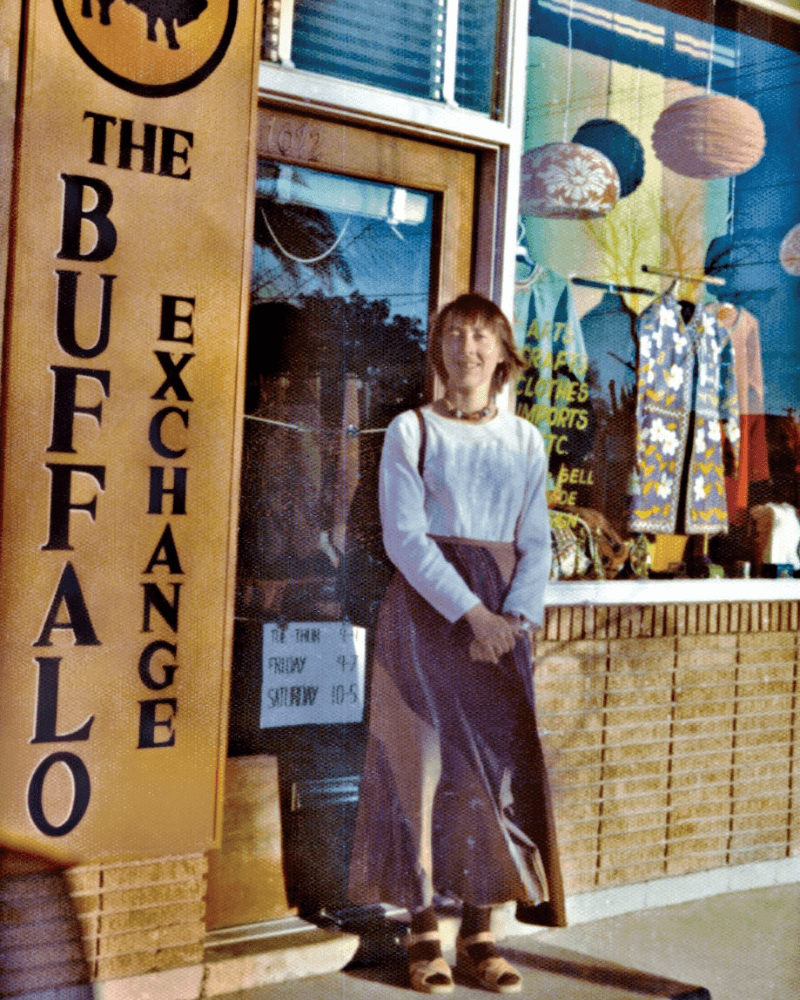
Four hundred square feet of possibility
By the time Buffalo Exchange opened, Block had experience arranging furniture displays at Sam Levitz. Spencer was a librarian and had grown up working in his family’s fish market. Their preparation was an assortment of useful fragments. A furniture showroom teaches presentation. A market teaches the daily business of selling. Neither came with instructions for building a clothing chain.
The first space measured 400 square feet. Early clothing racks were made from old bicycle wheels. Denim, hand-woven shirts and Kork-Ease shoes were among the merchandise; a common early price was $3.50. The fittings and the stock shared a sensible willingness to give existing things another job. Nobody needed a solemn explanation of reuse to understand a good pair of shoes.
The name had its own division of labor. To Kerstin, Buffalo sounded American, with a western association she liked. Spencer supplied Exchange, a word that described the transaction. Together, they had a name with some personality and a fairly clear set of instructions. Bring something in. See what it might be worth. Have a look around.
The delicate business of saying no
The exchange model depended on choosing. A store paying for inventory has to consider what the next customer will buy. A seller, meanwhile, may be thinking about what an item originally cost, where it was worn or how much it once meant. Those are two quite different valuations to bring to the same counter.
Buffalo’s buyers had to navigate that difference. They assessed condition and style, explained their decisions and sometimes handed much of a bag back. The task involved judgment about clothes and tact with people. An unwanted garment could still be somebody’s treasured memory. The employee standing between those interpretations needed more than an enthusiasm for vintage.
That counter also gave the business a useful immediacy. A customer could receive value for accepted clothes without waiting for another shopper to purchase them. Today, Buffalo describes the choice as 25 percent of its selling price in cash or 50 percent in store credit. The percentages belong to its present terms; the principle of paying at the counter runs back to Block’s original idea.
- 01Bring clothes
- 02The buyer selects
- 03Cash or trade
- 04Back on the rack
One wardrobe makes room. Another finds something to wear.
A chain with a neighborhood accent
After the first shop found customers, the Blocks took more space. A Tempe location followed in 1976. Expansion eventually carried Buffalo into California and farther across the country. The original pleasure of discovery had proved portable, even if the clothes themselves depended on who happened to walk through each door.
Local buying helped the stores take on the character of their surroundings. A neighborhood supplied both customers and much of the stock. The inventory could therefore reflect the place where it was sold. For a business built on individual pieces, difference between branches was part of the appeal. Shoppers could recognize the name and still have no idea what they would find inside.
Growth also brought decisions about limits. In 2016, Buffalo closed its east Tucson store after years of difficulty making that location work. Block acknowledged that the shop had moved repeatedly without finding a good home. Even a familiar business, in its hometown, could require an unromantic decision. An eye for possibility had to coexist with a willingness to stop.
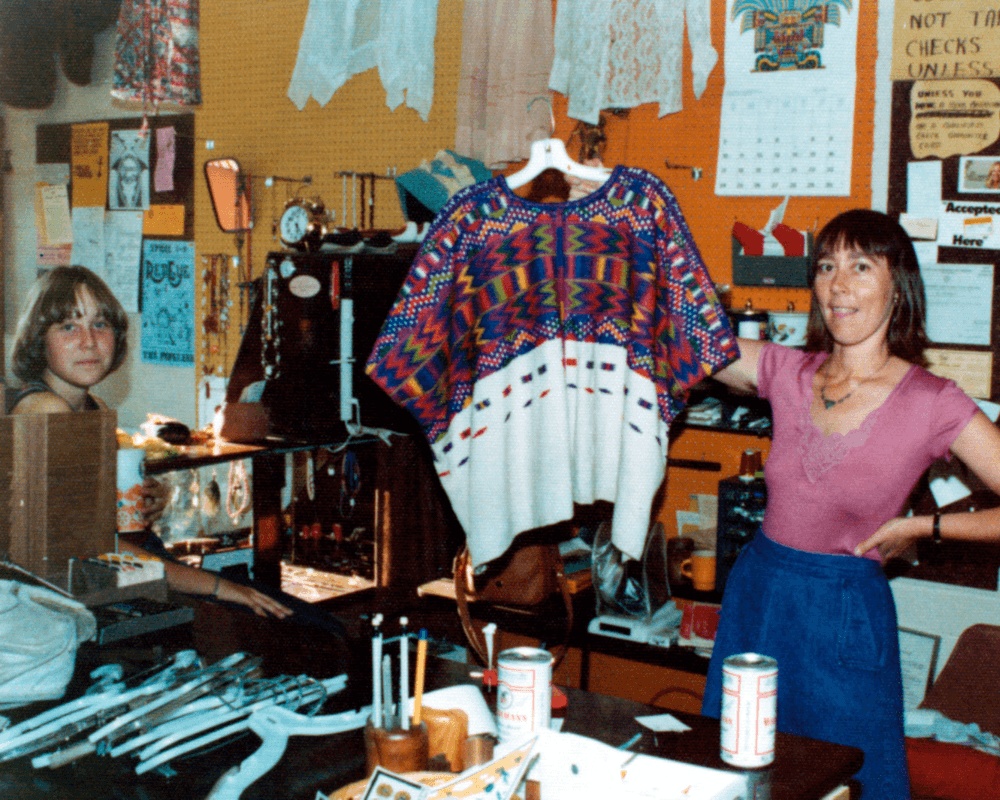
The work behind the good finds
Block understood that expansion changed the job. An appealing concept could get a store started; keeping it running required people who wanted to work together. She spoke about investing in employees and finding colleagues with whom a shared working life was possible. Clothes were the attraction. People made the attraction function day after day.
Success did not keep her from examining the details. In later years she remained candid about what she thought, and the company remembered her hands-on involvement in developing future leaders. A founder’s taste could start the business, but other people needed the confidence and judgment to keep buying when the founder was elsewhere.
There was room for celebration, too. For Buffalo’s fortieth anniversary in 2014, a renovated 1969 Airstream became a traveling vintage shop. The tour carried the company’s early enthusiasm around the country in a vehicle with an appropriately secondhand history. A business devoted to giving old things another outing had found itself a rather suitable birthday carriage.
“It’s always been about the clothes.”
Kerstin Block
The family business, after school
For Rebecca Block, the company was woven into childhood. Her parents would drop the children at school, work at the store and collect everyone for the journey home. After school there were tasks to do. The business supplied the family’s routine as well as its livelihood. Becoming familiar with retail began with simply being there.
Rebecca later worked across the company and served as vice president from 2008 until 2024. When Kerstin retired around Buffalo’s fiftieth anniversary, Rebecca became CEO. The handover followed almost thirty years of close work together. A change in title marked a particular moment in a much longer education.
The next generation also joined. Kerstin’s granddaughter Melissa Haskin started working in stores while in high school and went on to management roles. That continuity gives the family story an everyday texture. Knowing the business meant knowing its unglamorous jobs, the condition of the merchandise and what actually happened when somebody arrived carrying a bag.
Still shopping, still editing
On a family shopping trip described by Buffalo Exchange, Kerstin arrived in a blue polka-dot Marimekko dress bought secondhand, carrying clothes to sell. She kept a relatively small wardrobe and cleared it out regularly. The founder remained a participant in the system she had helped create. Even her closet had to make its case for keeping something.
She also noticed that the shoe section needed reorganizing. That combination feels telling: the pleasure of shopping accompanied by the professional reflex to improve the shop. Having spent decades looking at clothes, she could hardly be expected to stop observing the furniture of the experience. Retirement did not automatically switch off her eye.
A wardrobe with somewhere to go
Giving became another recurring part of the company. Kerstin and Spencer established an arts fund through the Community Foundation for Southern Arizona in 1994. Over more than twenty-five years, the Buffalo Exchange Arts Award provided $244,000 in grants to emerging artists. The same interest in the visual world that animated a wardrobe extended into local cultural life.
Other programs connected shopping with donations. Tokens for Bags let customers direct a small contribution to a nonprofit instead of taking a bag. Earth Day sales raised money through bargain-priced clothes. These were modest transactions repeated across stores, a practical way to attach giving to an ordinary visit rather than reserve it for an occasional announcement.
Block died on August 29, 2025, aged eighty-three, a year after retiring. By the time of reporting that September, Buffalo Exchange had 41 stores in 15 states. Rebecca was leading it. The little shop’s original proposition remained legible at the counter: someone had clothes to let go of, someone else might want them, and a buyer had to recognize the possibilities.
The clothes kept moving. That was the arrangement Kerstin had made room for.