By the time Kendall Warson was 23, she had completed the life plan. This is an awkward achievement. Life plans are supposed to shimmer safely in the distance, not arrive early and demand a sequel. Warson had studied fashion at Parsons, earned honors, and worked around names that require no explanatory footnote: Marc Jacobs, Diane von Furstenberg, Helmut Lang. The dream had behaved impeccably. It was the dreamer who had changed.
She had been drawn to visual language before she possessed much of its vocabulary. At 16, a summer program at Rhode Island School of Design was the first place, she has said, where she felt plainly good at something. She earned top marks despite growing up in a home that was not especially crafty. Fashion offered a route from instinct to structure. Parsons supplied the grammar.
But fashion also gave Warson a useful disappointment: proof that reaching a destination does not oblige you to remain there. In her mid-twenties, she left the startup where she had been the first employee and spent about eight months consulting on websites, reading, and taking stock. She could make visual design quickly enough to support herself in a few hours a week. The rest of the time went to a harder commission: deciding what the next chapter should be about.
First, build the room
The startup was Wonderspaces, an immersive-art company that brought large-scale installations to audiences outside the usual museum circuit. Warson joined at the beginning and became creative director. In two years, the model grew from one location to four. The exhibitions she curated drew between 150,000 and 200,000 visitors every three months.
Immersive art sounds like fog machines and good lighting. Operationally, it is closer to air traffic control. Artists live across countries. Installations arrive with technical demands, fragile parts and opinions. Audiences need an invitation that neither overexplains nor condescends. Warson managed a network that grew beyond 500 international artists and learned that the experience in the room is decided by an enormous amount of work outside it.
design
art
marketplace
fintech
The work also exposed a less photogenic problem. Most artists are small-business owners without the software or training to behave like one. They invoice, collect, track buyers, manage inventory, ship work and market themselves across a jumble of tools. Galleries serve a minority. Social media gives artists distribution, but it was not designed to handle a four-figure purchase with trust, provenance and a human story attached.
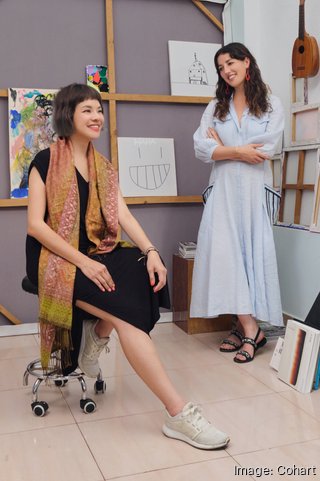
Warson saw the missing machinery. In 2021, she and Shyevin S'ng started Cohart, a social marketplace and operating system for artists, galleries and collectors. They had met while curating a digital gallery in Asia. They then built together for roughly a year and a half across continents before meeting in person. It was a co-founder relationship conducted first as a long-distance correspondence, with a company attached.
Then, persuade the room to exist
Cohart faced a familiar venture problem with an especially unfashionable twist. The art market was large, old and conspicuously short on software exits. Warson did not have a business-school network or a neat list of warm introductions. So she manufactured one conversation at a time. She joined founder communities, searched their directories for people who mentioned investing, and asked women and people of color for 15 minutes.
Some calls went badly. Others ended with an introduction, then another. One cold approach traveled through seven people before producing Cohart's first $50,000 angel check. The seed lead came through a call Warson nearly had no reason to take. An engineer suggested a friend who had just returned from Art Basel; the friend was a fund partner and eventually led the round. The detour was the road.
“We've pitched probably 400 plus, maybe 500 investors. It's been insane, because we started so cold without any type of connection.”Kendall Warson
Her conclusion was unfashionable in a different way. Founder advice prizes the ruthless calendar, but ruthless efficiency would have eliminated the strange call that mattered. Warson decided to be generous with her time and introductions. At Cohart, that became a sales method. Instead of paying an art fair a large sponsorship fee, the company could offer its director an audience and a platform for ideas. Give something useful first; let trust do the expensive work.
The product thesis was social as well as practical. Warson argued that people do not buy art by staring at isolated JPEGs and prices. They develop taste by seeing who collects whom, hearing an artist's story, and borrowing confidence from a community. Cohart combined business tools with those signals. By 2025, Warson said the company had raised more than $6 million. Its invoice system had processed a first $70,000 sale. The glamour lay in discovery. The leverage lived in payments and operations.
Her language around collecting was deliberately permissive. Own a work and you are already a collector, whether or not the word feels grand. A first original need not come with an auction paddle or a Swiss storage facility; she pointed newcomers toward work in the $100 to $500 range and toward the quieter authority of their own taste. This was more than a marketing position. Categories can police the door. Change the category and the guest list changes with it.
The founder relationship needed its own redesign. Warson and S'ng worked with an executive coach in what Warson described, with cheerful directness, as founder therapy. New technical leaders had disturbed the equilibrium between two non-technical founders. Rather than pretend that organizational strain was merely a problem on a spreadsheet, they treated the partnership like any relationship worth keeping: something that required a safe place for difficult conversations. Warson later credited that partnership, more than the product, with carrying Cohart forward.
She extended the lesson beyond her own company. As a coach in The Hidden Genius Project's alumni venture seed program, Warson helped young founders reduce broad ambitions to practical choices: the customer to begin with, the market narrow enough to enter, the next experiment worth running. One participant described her as determined and honest, able to break a business problem down to its smallest useful parts. It is a neat complement to curation. One practice chooses what belongs in the room; the other decides what must happen first.
A canvas made of invoices
In June 2026, Warson joined Monk as founding growth marketer. Monk makes AI-native software for accounts receivable: collections, cash application and the uncelebrated work between sending an invoice and recognizing the money. If the move from contemporary art to enterprise finance appears severe, look again. Both markets depend on complicated backstage systems. Both ask a buyer to trust something partly invisible. Both become easier to enter when somebody cares about the first encounter.
At Monk, Warson's remit includes positioning, product marketing, brand activation and an LLM-first growth engine. She is translating software whose appeal is measured in fewer manual hours and faster payment. Her recent writing on cash application has the brisk skepticism of someone who learned not to trust a pretty number without asking what it counts. An auto-match rate, she notes, means little unless vendors define the payments, invoices and exceptions beneath it.
Design, in this career, has never meant making an object attractive after the difficult decisions are over. It means arranging attention. A fashion display guides the eye. An exhibition guides the body. A marketplace guides trust. A fintech brand guides a skeptical finance leader toward a new behavior. Warson keeps changing industries because the verb remains portable.
Monk also returns her to a problem she had already met in another costume. At Cohart, an artist could sell a work and still face the dull sequence after the celebration: invoice, reminder, receipt, reconciliation. At Monk, that sequence is the product. The company uses software agents alongside rules and human review to help businesses collect and apply cash. Warson's task is not to make the complexity disappear. It is to give a finance team enough clarity to decide which complexity the machine can carry.
The glamour lay in discovery. The leverage lived in payments and operations.
She also understands the hazard of allowing work to become the only room. During one of Cohart's hardest fundraising stretches, Warson joined a women's soccer league after more than 15 years away from the game. She kept playing. Soccer became her “third space,” a place where nobody needed a pitch, a roadmap or a founder's confidence. She has played as often as four times a week.
Other boundaries followed. Saturdays without the computer. Long silent walks. At least 10,000 steps a day, even if that required loops around an airport. Regular calls with family. These are not tricks for extracting more output from the body. Their charm is that they restore a self from whom output is not being requested.
Warson's career is easy to describe as a sequence of pivots, but “pivot” is startup language for a more ordinary human act: noticing that your old answer no longer fits the question. She moved from making objects to shaping rooms, then from shaping rooms to building markets, and from a market for art to the cash machinery of business. Each move looked sideways. Each carried the same concerns forward: access, trust, presentation, and the administrative systems that decide whose work gets to circulate.
The ledger may be less lovely than the gallery wall. It is also where intention becomes consequence. A painting sold is a payment due. A company growing is a collection process strained. Warson has arrived at the place where every beautiful idea eventually reports for duty: the back office. Naturally, she is working on the invitation.