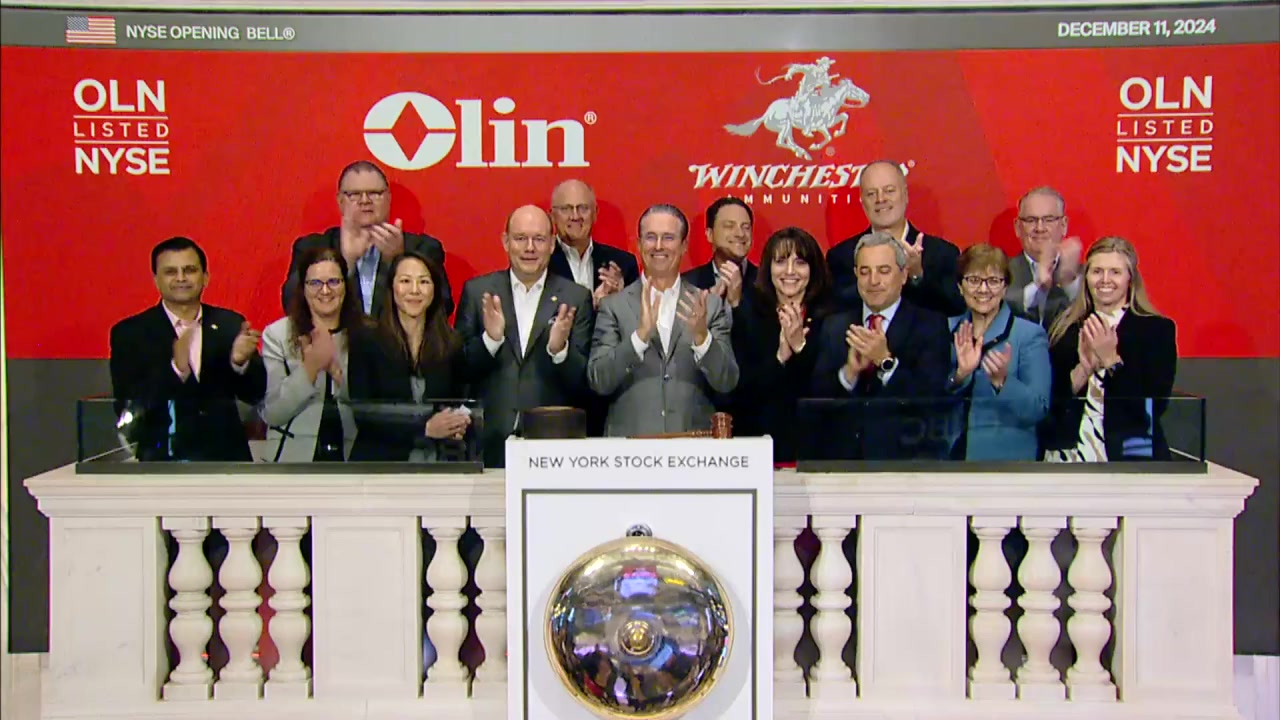
Ken Lane got a brief appointment with a very punctual audience in December 2024. At the New York Stock Exchange, Olin’s president and chief executive joined colleagues to ring the opening bell ahead of the company’s Investor Day. The ceremony offered a tidy image of corporate leadership: a team, an exchange, a scheduled beginning. Chemical manufacturing rarely provides such convenient punctuation.
Lane had taken charge of Olin on March 18 that year. His working life had already carried him through Malaysia, China, Britain, Belgium and the United States, through technical jobs and commercial responsibilities, through catalysts and polyurethanes. He arrived with the experience of someone accustomed to seeing a business from several sides of the same factory gate.
By June 2026, he was preparing for another beginning. Olin and Huntsman announced an agreement to combine, with Lane designated to become chief executive of the proposed OlinHuntsman Corporation. The distance between those two moments is the interesting part of his story. How does an engineer assemble a company capable of enduring an industry that keeps changing the conditions around it?
A career with a rather large site plan
Lane earned a bachelor’s degree in civil engineering at Clemson University and a master’s in management at the University of Alabama in Huntsville. The pairing is apt for a career spent moving between physical production and the decisions that make production commercially useful. There is concrete in this story, even when the conversation turns to capital allocation.
His early ambition was construction. He later explained that chemical-plant building, particularly in Asia, supplied his route into the industry. Olin was already familiar: it had supplied a company he worked with in the late 1980s. Becoming its chief executive would eventually put him on the other side of a relationship that predated the job by decades.
The geography became specific early. In 1993, he was working at Amoco Kuantan PTA in Kuantan, Malaysia. By 1997, his assignments had taken him to Decatur, Alabama. From 1999 came BP Chemicals roles in Naperville, Illinois, and London. In 2004, he was vice president of business optimization at Innovene in Shanghai. This was a practical education in how the same industry operates in different places, with different customers and constraints.
BASF followed in 2006, initially with responsibility for urethane chemicals in Wyandotte, Michigan. Strategic marketing for polyurethanes took him to Brussels in 2009. In 2013, he moved through European isocyanates leadership to become president of the catalysts business in Iselin, New Jersey. The itinerary reads like an unusually demanding university exchange program. Each move also changed the scale or character of his responsibilities.
- 1993Kuantan
Amoco - 2004Shanghai
Innovene - 2009Brussels
BASF - 2024Olin
President & CEO
Learning to choose, and to stop
Catalysts put Lane close to businesses where chemistry, manufacturing expertise and customer requirements meet. In April 2014, BASF and Japan’s Toda Kogyo announced negotiations over a cathode-materials joint venture. As catalysts president, Lane described the proposed partnership in terms of combining manufacturing and innovation expertise. The pattern would recur: find capabilities that work better together, then make the industrial arrangement support the ambition.
After leading BASF’s monomers division in the first part of 2019, he joined LyondellBasell that July to lead global olefins and polyolefins. He served as interim chief executive from January through May 2022. Later responsibilities included manufacturing and commercial oversight across the Americas, Europe, Asia and international markets, together with global procurement. It was a substantial rehearsal for running a company whose operations refuse to fit inside one national economy.
The interim assignment included an uncomfortable decision. In April 2022, LyondellBasell announced plans to exit its Houston refining business. Lane’s explanation acknowledged employees, families and the surrounding community alongside the financial rationale. “These decisions are never easy,” he said. The original timetable was a plan announced then, rather than a description of when the refinery ultimately stopped.
That episode adds weight to a résumé otherwise easy to read as a succession of promotions. Industrial leadership includes deciding where a company should cease committing resources. A plant has employees and a community around it. The decision remains a business decision, but Lane’s public account recognized that the consequences extend beyond the spreadsheet.
The first month belongs to other people
Olin’s board announced his appointment in February 2024, with Scott Sutton due to hand over the following month. William Weideman became chairman. The separation of chairman and chief executive gave Lane a defined executive assignment as he entered the business. He also joined the board and its executive committee.
His early public dispatch was about visits. Within four weeks of starting, he reported meeting hundreds of Olin teammates around the United States. He also described conversations with legislators in Washington about shooting sports and the company’s military customers. The opening circuit reflected the range of the job: manufacturing teams, lawmakers and the distinct responsibilities of an ammunition business.
There was a customer problem to address, too. On his first Olin earnings call in April 2024, Lane acknowledged tensions that had developed in the industry. He defended the need to obtain value for Olin’s products while committing to working relationships even where agreement proved difficult. “Even if we can’t agree, we’re going to continue to find ways to work together.” It is a more revealing operating promise than a declaration of enthusiasm.
Team building soon became visible in appointments. In May, Olin announced Deon Carter as the next leader of Chlor Alkali Products & Vinyls, effective in June. Lane linked the hire to performance and development of the existing team. His own experience was broad; running Olin would still depend on putting other experienced operators in consequential jobs.
“Even if we can’t agree, we’re going to continue to find ways to work together.”Ken Lane / April 2024 earnings call
A strategy measured in useful additions
The December 2024 Investor Day gave Lane and his colleagues a public platform to explain their direction. The agenda connected the core businesses, commercial discipline, capital allocation and financial targets. Olin also announced an increase in its share-repurchase authorization to $2 billion. Authorization described the board’s permission to buy shares; it did not mean the money had already been spent.
The emphasis on improving the existing business acquired a physical example in April 2025. Winchester completed the acquisition of AMMO, Inc.’s small-caliber ammunition manufacturing assets. They included brass-shellcase capabilities and a 185,000-square-foot facility in Manitowoc, Wisconsin. This was an addition to an established manufacturing system, with a particular role inside it.
Winchester president Brett Flaugher explained the arrangement: specialty production at Manitowoc would allow older, larger plants to concentrate on high-volume products. The point was the fit between facilities. An acquisition can be described by its purchase agreement; understanding it requires following the work that moves through the factories afterward.
Olin projected incremental first-year adjusted EBITDA of $10 million to $15 million, including synergies, and $40 million annually after full integration and realization of the anticipated benefits. Those were forecasts. Keeping that distinction intact matters when judging Lane: an announced opportunity creates an obligation to execute, and the announcement itself cannot discharge it.
The facility acquired with AMMO’s small-caliber ammunition manufacturing assets in April 2025.
A builder’s obligation to the people inside
Lane’s account of management also runs through the less theatrical documents employees encounter. His opening letter to Olin’s Code of Conduct makes ethical decision-making applicable at every level, including officers, managers and directors. Annual training, consultation and conversations with managers form part of that expectation. The language puts responsibility into recurring actions rather than reserving it for a ceremonial statement.
A January 2026 equal-opportunity communication carries the same emphasis on daily decisions. Employment choices are to rest on qualifications, performance, potential and other legitimate business considerations. Managers have duties, and employees share responsibility for a respectful workplace. These are stated commitments, whose value depends on how people experience them in practice.
Even his public activity away from a quarterly results discussion has tended to concern colleagues and community. In 2020, while at LyondellBasell, he served as executive sponsor of Global Care Day, the company’s worldwide volunteering initiative. The available record presents a leader speaking about collective work. It gives the profile a human dimension without requiring a private-life legend.
The next structure is still being assembled
The Huntsman agreement announced on June 16, 2026 moved Lane’s assignment onto a different scale. The proposed company would pair Olin’s upstream chemical production with Huntsman’s downstream formulations and advanced materials. Lane was selected as its prospective chief executive; Peter Huntsman was designated non-executive chairman. The companies identified more than $400 million in potential cost synergies and integration benefits.
The proposal makes sense as a continuation of the career on paper: production, customers, procurement, complementary businesses. Whether it delivers the promised resilience remains an execution question. Corporate combinations can announce their arithmetic in a morning. Factories, systems and teams take longer to combine.
Shareholders approved the necessary proposals on August 25. On September 11, the companies announced that the U.S. Hart-Scott-Rodino waiting period had expired, satisfying a key condition. Other regulatory approvals and customary conditions remained. The stated expectation was completion in the first half of 2027. As of October 21, 2026, Lane’s current title remained president and chief executive of Olin.
There is a pleasing continuity here. The civil-engineering student who expected to build things found his way into chemicals through plant construction. His later work has required assembling businesses, choosing partners and deciding where resources belong. The opening bell supplies a photographable beginning. The more consequential work is what happens after everyone leaves the balcony and goes back to making things.
Upstream production+Huntsman
Downstream capabilities
June 16 Agreement announced
August 25 Shareholder approvals
September 11 HSR waiting period expired
First half 2027 Expected close, subject to remaining conditions
Follow the work
Explore Lane’s career, hear his public appearances, and follow the next transaction milestones.