A private-company share can make its owner wealthy on paper and leave them waiting for a buyer. The valuation arrives in a funding announcement. The cash requires another person, another price and a transaction that can actually close. Kelly Rodriques has built much of his career around the inconvenient distance between those things. At Forge, the San Francisco business he has led since July 2018, that distance became the assignment.
There is an earlier, more literal bar in his story. At Fresno State, Rodriques competed in the pole vault. His 1986 outdoor mark of 5.45 meters, or 17 feet 10½ inches, still appears in the university’s record book. The event offers a useful image for a career in operating businesses: speed matters, but so does what happens when you plant the pole. Momentum alone supplies a rather unreliable landing plan.
Rodriques had expected to become a teacher and coach. A disappointing meet cost him an anticipated USC track opportunity; Fresno State coach Bob Fraley became his mentor instead. He graduated in 1989. Even then, business had crept into the schedule: his student ventures included construction and taking the university’s bulldog mascot to local events. Education, athletics and enterprise were already sharing a calendar.
The business behind the business
His move into technology put him close to another set of practical handoffs. He ran Novo from 1994 to 2002, then Totality from 2002 to 2006. The names are less familiar today than the companies they served. In a 2003 interview, his work at Novo was described through commercial web applications for General Motors, Orbitz and Procter & Gamble. He had also worked at Ogilvy & Mather, establishing a digital brand group.
At Totality, the task involved managed services and customer infrastructure. These are businesses that become particularly noticeable when something stops working. They also require a leader to connect a client’s ambitions with the systems supporting them. A website can be announced with ceremony; keeping the infrastructure running is a continuing obligation. That distinction would follow Rodriques into finance.
Between October 2006 and January 2010, he was an operating partner at Ignition Growth Capital. There he led an investment in mFoundry, the mobile-banking software company. A later SharesPost announcement identified him as a founding investor and noted the company’s acquisition by Fidelity Information Systems in 2013. He was moving between running businesses and backing people who ran them, carrying operating experience into investment decisions.
In March 2010, he became CEO of PENSCO Trust Company. The work brought him into alternative assets and the machinery required to hold them. PENSCO’s business included private equity, real estate and other investments that did not trade on an exchange. A transaction profile at the time of its sale described more than $10 billion in assets under custody and an automated system for funding and managing investments.
Custody is easy to overlook in a story about investing. Yet the asset has to be held somewhere, documented and administered. PENSCO’s tools addressed those requirements with electronic signatures, document submission and workflows that changed with the type of investment. For Rodriques, the experience supplied a close view of how much work surrounds an asset after someone decides they want to own it.
Opus Bank acquired PENSCO in 2016. Rodriques’s tenure there ended that September, and he became managing general partner of Operative Capital, an early-stage financial technology investor. His next operating role would draw together several parts of that background: technology services, investing, alternative assets and the awkward business of getting a financial process from intention to completion.
Commercial web applications
Managed technology services
Alternative-asset custody
Private-market infrastructure
A rival becomes part of the plan
Rodriques’s relationship with private-share trading preceded his arrival at Forge. In October 2016, he joined the SharesPost board. The announcement said he had invested in more than 20 venture-backed firms. In February 2017, digital-advice technology company Trizic also appointed him to its board, alongside Asiff Hirji. Trizic CEO Drew Sievers welcomed the operating and financial experience they brought to the company.
That boardroom route makes the next development more interesting. Rodriques became CEO of Forge in July 2018. Two years later, Forge announced a combination with SharesPost, with Rodriques continuing to lead the combined business. A company he had advised was becoming part of the company he ran. Business relationships have a habit of refusing to stay in the boxes assigned to them.
The May 2020 announcement put the combined historical transaction volume above $6 billion. It described a customer base of more than one million and a plan to bring together trading, custody, data and company services. SharesPost founder Greg Brogger would leave the chief executive role and remain involved as a Forge director. The point of the combination was to make the marketplace more useful through a broader network and more information.
Rodriques’s ambition depended on several parties finding reasons to participate. A shareholder might want cash. An investor might want exposure to a particular company. The company itself had an interest in its ownership arrangements. Trading information could help participants assess a price, while company liquidity programs could organize sales around the issuer’s requirements. The market had to accommodate those different interests in the same transaction.
A private market rings the public bell
On March 22, 2022, Forge listed on the New York Stock Exchange. The photograph from that period supplies a little financial comedy: a business devoted to private shares, celebrating in front of the public exchange. Rodriques stood outside beneath an orange Forge banner. The picture catches a milestone; the difficult work of making a market would continue after the banner came down.
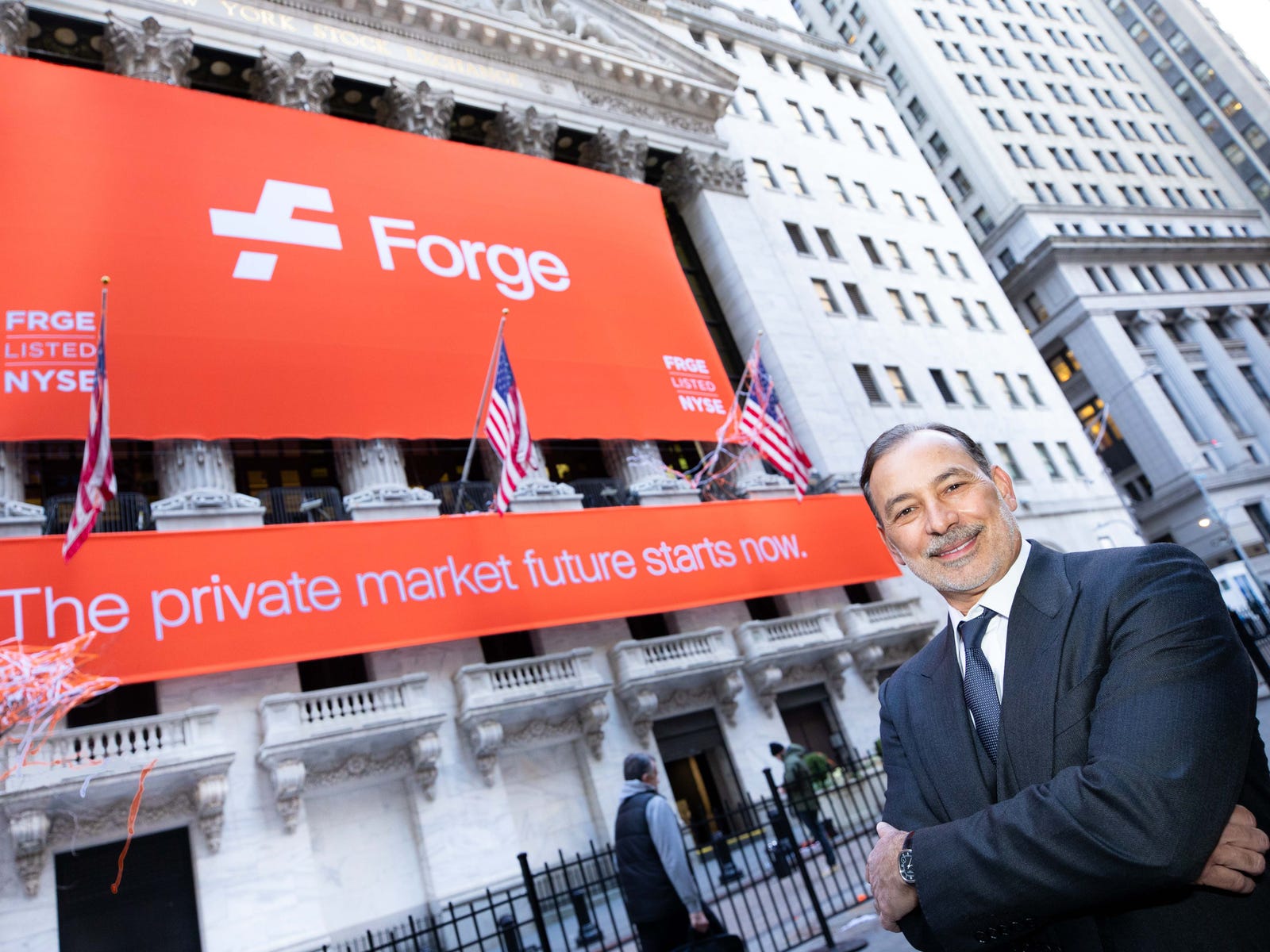
His message on listing day framed the public debut as a step toward the private market he wanted to build. He described shareholders and investors participating more easily, companies managing employee liquidity programs, and data informing decisions. The aspiration was broad, but its pieces were concrete. A market needs ways to enter, ways to understand what is available, and ways to complete the exchange.
That September, Forge announced a European expansion with Deutsche Börse. The partner brought market and regulatory knowledge as well as a network of participants. The proposed offering included company liquidity programs, a marketplace and private-market data. Rodriques was taking the same operating problem across borders, where local requirements made an established exchange partner especially relevant.
“The growing interest in private market investing and the growing need for liquidity by private growth companies transcends geographic borders.”Kelly Rodriques, September 2022
When the market talks back
Building through 2022 also meant responding to weaker conditions. In an August earnings call, Rodriques said Forge had deliberately slowed hiring and would watch the quarter before deciding whether to accelerate staffing. The company’s plans had to meet the market’s pace. Even a business designed to help people trade through uncertainty has its own budget, employees and decisions to manage.
By his 2023 CNBC appearance, Rodriques was describing a substantial repricing. He called the period the “Great Reset.” Rather than offer only a prediction about the next IPO, he discussed the difference between bids and asks. The spread had narrowed to 17% from highs of 26%, he said, while highly liquid periods were closer to 11% or 12%.
A smaller gap. Still a gap.
Historical ranges Rodriques discussed on CNBC in 2023. These describe bid-ask spreads, not investment returns or current prices.
The measurement gets close to Forge’s central problem. A seller’s idea of value and a buyer’s willingness to pay can be separated by an expensive silence. Narrowing that distance makes a transaction more plausible. It does not guarantee one. Rodriques’s commentary focused on the mechanics of agreement, a useful counterweight to the excitement that can surround famous private-company names.
At Reuters Next in December 2023, he returned to the infrastructure required for a global market: standardization, firm bids and asks, and useful data for price discovery. He said Forge had assembled about half a million investors and roughly 16,000 institutions on its platform. The network helped justify the technology investment; the technology, in turn, was meant to make the network work better.
The company’s own financial results also demanded attention. Forge reported a $66.33 million net loss for 2024. A growing market and an expanding platform did not remove the need to build a sustainable business. For an executive whose public message concerned liquidity, the company’s economics formed a separate, persistent test of execution.
The next bar is distribution
In November 2025, Charles Schwab announced an agreement to acquire Forge in a transaction valued at approximately $660 million. By then, Schwab said investors had bought and sold more than $17 billion in private-company shares through Forge. The proposal connected Forge’s marketplace, company relationships and data with an established investing institution. Distribution was becoming a central part of the next assignment.
The acquisition closed on March 2, 2026. Forge shareholders received $45 in cash per outstanding common share. Schwab said integration was underway and that Forge would continue operating its business and maintaining issuer relationships. Products and capabilities would be introduced to more individual investors and registered investment advisors over time. The announcement described a process, with work still ahead.
Rodriques’s August 27 update made that next stage explicit. He remained identified as Forge’s chief executive and described plans for new products, an enhanced investing experience and continued communication during integration. The larger parent offered resources and reach. Turning those advantages into useful services remained an operating task, involving the people and companies already participating in the market.
There is continuity beneath the changes of company name. Novo helped businesses put applications on the web. Totality dealt with infrastructure. PENSCO administered alternative assets. Forge connects private ownership with potential transactions. Across those roles, Rodriques has worked where an attractive proposition acquires practical requirements. The next bar is another handoff: carrying a specialist marketplace into a broader investing business, one workable transaction at a time.