A private investment can come with a roomful of documents and still leave out the thing that matters. A relationship has a history. A decision has a reason. Neither necessarily fits into the neat little field where a software system would prefer to find it. This is the territory Ismail Badereldine has chosen for his company: the space between what a firm possesses and what it can actually use.
Badereldine is the co-founder and chief executive of FinBursa, based in Dubai. His route there passed through Brookfield Asset Management, eFront and BlackRock. More than twenty years in financial markets and technology sit behind the proposition he is now building. The career matters because his subject is so thoroughly practical. Software can be impressive in a demonstration and awkward when several people need it to carry the same piece of work.
Consider the ordinary indignity of a document called “final.” Its title expresses an ambition. Its successors express reality. Badereldine’s business addresses a more consequential version of that confusion: investment professionals managing relationships, transactions and information that do not share a dependable record. Capital may travel internationally; the explanation for a decision can remain stranded in an inbox.
A career inside the machinery
At Brookfield, Badereldine delivered software and data solutions across the organisation. At eFront, he spent seven years working in investment management technology, including leading Professional Services in the Middle East. His work involved sovereign wealth funds, institutional investors and investment managers across several markets. Before FinBursa, he was Director and Head of Client Transformation for the Middle East and Africa at BlackRock.
Those are roles concerned with how investment organisations function. A firm’s technology has to meet its habits, responsibilities and expectations. The person installing or changing it encounters the distance between a process described on paper and a process conducted by people. Badereldine’s professional progression puts that distance near the centre of his story.
His academic record includes ESCP Business School, which his LinkedIn profile dates to 2020-2021. The same profile lists a Project Management Professional credential issued in April 2010 and proficiency in Arabic and English. These details belong to a working career rather than a founder mythology. There is something refreshing about an entrepreneurial story with room for project management. Someone eventually has to make the parts agree.
- BrookfieldSoftware & data solutions
- eFrontSeven years; Middle East professional services
- BlackRockClient transformation, Middle East & Africa
- FinBursaCo-founder & CEO
That is also what gives this founder story its scale. The institutions in his biography are large; the problems he now describes can be small enough to overlook. A note, a permission, a missing connection between records: each becomes consequential when another person needs to act on it. His company begins with those details.
Dubai, May 1
FinBursa officially launched from the Dubai International Financial Centre on May 1, 2025. The launch brought Badereldine’s operational background into an entrepreneurial setting. Prince Mohammad bin Nawaf Al-Saud was also named as a co-founder in the announcement. The venture presented a combination of investment-firm tools and a marketplace for information about private-market opportunities.
One part, FinBursa 360, offered firms a customisable portal with tools for onboarding, pipeline management, fundraising, data rooms and reporting. Another connected investors and capital seekers. Its stated model included zero success fees and investor-initiated contact. The arrangement gave the company a particular position in the transaction: providing the environment in which participants could work and discover opportunities.
The distinction matters to the story of its chief executive. A technology company’s choices about fees and contact shape the behaviour it encourages. When an investor decides whether to begin a conversation, discovery proceeds at that investor’s pace. When a platform does not take a success fee, that pricing choice becomes part of how it describes its independence. The design and the business model are in the same conversation.
An introduction is only the beginning
In June 2025, FinBursa and PLAYBOOK announced a partnership aimed at information and access gaps affecting women in private-market investing. PLAYBOOK, founded by Wafa AlObaidat, works on women’s learning and professional networks. The partnership connected that educational mission with FinBursa’s investment technology and opportunity information.
Badereldine was announced as the leader of a June 25 webinar on navigating private-market investments. Its subjects included private equity, venture capital and private debt, with women participating as individual or institutional investors. Female founders in the PLAYBOOK community were also to gain exposure to FinBursa’s investor network and capital-raising pathways.
This is a useful expansion of his work. Access has several practical requirements: a person needs to understand an opportunity, encounter it, evaluate it and know how to respond. A network can arrange an introduction. Education can make the conversation intelligible. Technology can organise the information that follows. Each solves a different part of the same problem.
By 2026, Badereldine was also discussing FinBursa’s partnership with PLAYBOOK and Women Spark around the Women Shaping Wealth Summit in Riyadh, scheduled for April 6-7. He described barriers in knowledge transfer, deal visibility and infrastructure. The emphasis remained consistent with the company’s purpose: make participation workable for the people on both sides of a prospective investment.
“Technology should unlock opportunity in both directions”Ismail Badereldine, on FinBursa’s PLAYBOOK partnership
The pocket-sized deal room
In April 2026, FinBursa announced an investor mobile app for discovering opportunities in startups, private companies and funds. Badereldine framed it as a way to make access functional and direct. The company described a technology layer connecting investors to the people raising capital, with a zero-success-fee model.
A mobile app is a small object with a large organisational implication. It asks whether a task previously spread across introductions, messages and document requests can become easier to begin. That question fits Badereldine’s career unusually well. The investment remains an investment, with all the judgment it requires. The mechanics of finding and reviewing its information are available for redesign.
The Google Play listing describes FinBursa as an environment for qualified and sophisticated investors, where they can review private-market information without unsolicited outreach. It also describes tools for teams to manage relationships, deals and fundraising together. Discovery and the subsequent work are two parts of the product’s scope. For Badereldine, the invitation to participate comes with an argument about how participation should be organised.
What a firm gets to keep
His August 3, 2026 essay, “Everyone’s AI Reads the Same Deal Book,” adds a sharper question to that argument. If competitors can use increasingly capable analysis on the same information, where does a firm’s advantage reside? Badereldine turns towards institutional knowledge: the experience and relationship history that may exist inside the organisation without being adequately recorded.
The essay includes a hypothetical partner whose years of conversations with a founder leave little useful record for a successor. Badereldine explicitly presents it as an illustration. Its force comes from the question underneath: how much of a firm’s work belongs to the firm, and how much remains inseparable from the person who remembers doing it?
Here his writing offers a revealing qualification. He discusses objections to his argument and identifies the need for independent evidence about outcomes. He also discloses his commercial interest as the chief executive of a company building this infrastructure. The argument invites scrutiny. A founder selling software has reasons to favour better records; readers can still examine whether the proposed problem deserves attention.
A relationship begins with a person.
The confident answer with a missing page
On September 14, Badereldine published another essay, this time about AI and the consolidation of private-capital systems. His focus moved to the completeness of the material available to software that reads and reasons. An answer can sound finished even when the relevant information never reached the system.
That observation gives his earlier career a contemporary setting. Client transformation has long required people to think about where information lives and how it moves. AI adds a demanding new reader to the organisation. A well-written response deserves questions about the material behind it. Fluency is a pleasant quality in an assistant, but a committee would reasonably like the rest of the file.
FinBursa’s stated direction keeps decision-making with people. Its ambition is to give them shared context across their work. Badereldine’s recent essays make the intellectual case for that direction, while his company provides the commercial expression. The question running through both is plain enough to survive the vocabulary of financial technology: when the next person opens the record, will they understand what happened?
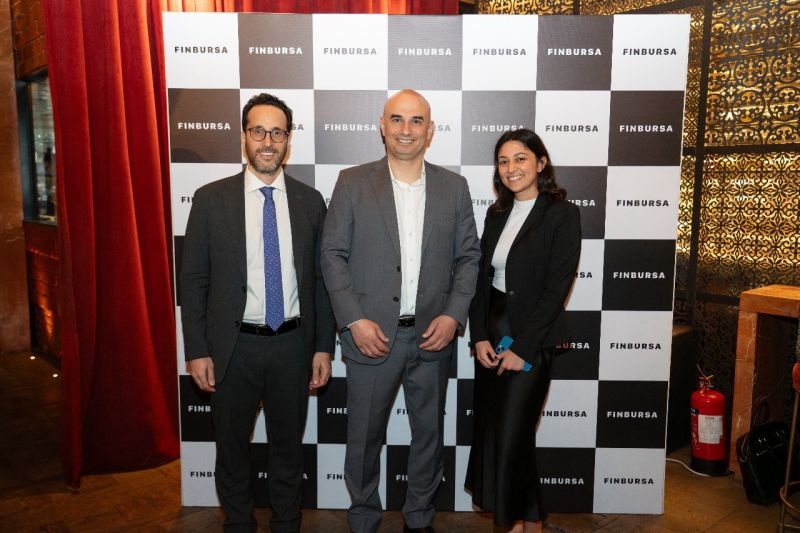
His story now sits at that junction. A career spent working on investment organisations’ systems has become a company, an access agenda and a series of arguments about what organisations remember. The launch photograph captures a beginning. The more revealing image is the working record he wants a team to inherit: documents connected to decisions, decisions connected to relationships, and enough history for someone else to carry the conversation on.