A gold ring can spend years doing nothing more strenuous than sitting in a drawer. Selling it asks rather more of its owner. Someone must establish what it contains, weigh it, calculate an offer and persuade a stranger that the number is fair. The metal may be familiar. The transaction can still feel like an examination for which only the other person has revised.
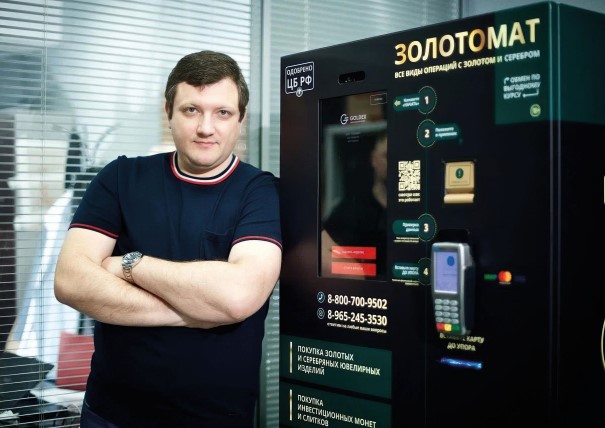
Dmitry Plushevsky built a business around shortening that encounter. As CEO and co-founder of GOLDEX GLOBAL, he works on automated terminals that evaluate and buy precious metals, with machines that can also sell investment coins and bars. The proposition has a pleasing physical simplicity: put an object into a machine, receive an assessment, decide whether to proceed. Getting there has required years of hardware development, retail testing and conversations about how such a transaction should work.
His route gives the idea its particular character. He came to gold with experience in software and in the decidedly physical business of pawnshops. The combination matters. An app can rearrange information; a gold-buying machine must deal with the object itself. A ring cannot be persuaded to become a spreadsheet, however excellent the presentation.
Before the machine, the counter
Plushevsky’s early work crossed several industries. After higher education, he worked in advertising, then established a mobile games studio. By 2016, he says, he was investment director at a small venture fund, looking for innovations. Physical gold trading struck him as an area where technological change had left much of the daily work untouched.
There is a small, concrete relic of the games chapter. The Android credits for Metro 2033: Wars, released in 2014, list Dmitry Pluschevskiy as CEO in the DaSuppa team. The game’s universe belongs to author Dmitry Glukhovsky. A software studio and a precious metals business may seem unlikely neighbours on a CV, but both involve turning an elaborate system into something another person can actually use.
GOLDEX describes its founder as an entrepreneur with experience in internet marketing, software development and the pawnshop industry, and as a co-owner of a Russian pawnshop network with more than 100 branches in Moscow. Those are operating businesses with counters, staff and objects to assess. They offer a different education from studying a market entirely through a laptop.
In 2022, explaining the robot’s origins, he was direct: “We dreamed of replacing humans with robots.” He described a large pawnshop network, difficulties with personnel and a desire to make gold exchange possible in stores. The origin was an operating problem. Every new location needed people able to perform the work. Automation offered a way to reproduce the process without reproducing all of those staffing demands.
A prototype has to survive the real world
The early Custody Bot presentation contains a detail that rarely makes it onto a polished product brochure: an unsuccessful attempt to develop the machine using three external contractors. The same development account describes forming an internal team, building a prototype and testing the principles of operation. It is a useful interruption to the tidy founding story. The idea did not arrive already dressed for the shop floor.
A Custody Bot demonstration launched in September 2018. By May 2019, Plushevsky was describing improvements to the diagnostic system and the protection of the casing, with retail testing in Moscow planned next. Each change addressed a different requirement. Measuring metal, protecting property and operating in a public location are connected jobs, but solving one does not automatically solve the others.
The hardware forced the project to move at the speed of physical evidence. Software can be rewritten overnight. A mechanism still has to accept a real object and behave consistently. That is the appeal of this part of his story: the idea is easy to sketch, while the equipment has to earn its place in the sketch.
GOLDEX dates the start of its gold automation division to 2018 and describes four years spent developing and testing equipment. Its Russian network has operated since 2022. The interval gives some proportion to the five-minute pitch. A brief transaction can contain years of work that the customer never needs to see. The customer has brought an earring, after all, rather than an appetite for the history of mechanical engineering.
The ledger behind the jewellery
Before GOLDEX’s current retail proposition, Plushevsky was CEO of GoldMint. In 2019, that project joined gold-backed financial assets, a blockchain network called MINT and the Custody Bot. Its proposed system linked measurements of physical gold with digital records. The hardware and the ledger were intended to describe the same underlying property.
He explained the practical case in terms of pawnshop financing. Recording gold-related operations could make a shop’s holdings easier to audit and help funders understand the business. The customer’s identity and details of the loan were not, he said, transferred into that blockchain record. The distinction between evidence about the metal and information about the borrower was part of the design.
His argument also had a price at its human end. “We believe that a pawnshop loan shouldn’t be more expensive than a bank loan,” he said. Better information, in his account, could make funding easier to obtain and allow a lower rate for the customer. This was an aspiration for the model, rather than a claim that every borrower had already received cheaper credit.
The thread running through these projects is legibility. A customer wants to understand an offer. A financier wants to understand the assets. An operator wants to understand what is happening across a network. A physical object needs to become a measurement, and the measurement needs to be useful to someone beyond the person who took it. Gold gives the project its subject; those separate demands give it its difficulty.
“We believe that a pawnshop loan shouldn’t be more expensive than a bank loan.”Dmitry Plushevsky, 2019
Five minutes, and a decision
At the 2022 PLUS-Forum, Plushevsky presented a terminal that could assess an item’s composition, fineness and weight in three to four minutes. Visitors could watch it working. Demonstration changes the terms of a technology conversation: there is an object, there is a process, and there is a result to inspect. The machine must now answer to the jewellery.
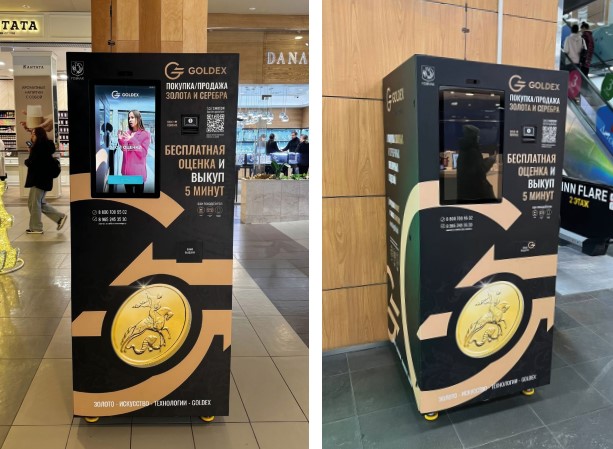
The current GOLDEX product description gives automatic analysis a five-minute window and describes non-destructive diagnostics. Its machines occupy about one square metre. A Goldomat evaluates and buys old jewellery and investment gold, and sells bars and coins. A separate vending product sells investment gold, while a pawnshop version adds temporary storage. The family resemblance is clear, but the jobs differ.
That small footprint is part of the business proposition. A machine designed for a retail location must fit into the place where a customer already goes. The company also supplies network management software and interfaces for payment and identity systems. A metal assay is only one part of completing a transaction; accepting an item is not the same operation as paying for it.
The five-minute idea is therefore a useful way to read Plushevsky’s work. The number describes a customer’s experience of analysis, not a promise that every commercial or regulatory complication disappears. His challenge is to make a demanding process feel ordinary. An ordinary experience can be a considerable engineering achievement, even when its reward is that nobody stops to admire it.
- 01AssessWeight and metal composition
- 02ValueAn offer based on precious metal content
- 03DecideThe owner chooses whether to sell
Simplified transaction flow. GOLDEX describes automatic analysis in about five minutes.
Gold travels. The machine must follow
On April 23, 2025, Eco Bright Future announced a partnership with GOLDEX GLOBAL to establish a joint operating company in the UAE. The plans combined gold-to-cash machines with a platform for tokenizing physical gold using Universa technology. The announcement identified Plushevsky as chief strategy officer, a reminder that the international partnership involved business development as well as product design.
His stated reason for starting in the UAE was its financial infrastructure and established gold trading traditions. Neighbouring countries were part of the intended expansion. Alexander Borodich, Eco Bright Future’s founder, was the other named voice in the partnership. These were announced plans for deployment and digital infrastructure, not a tally of machines already installed.
The proposal brought the two halves of Plushevsky’s earlier work together again: a physical exchange point and a digital representation of the asset. International growth adds another question to the engineering brief. A machine may have a repeatable design, but the market around it has its own institutions, rules and habits. Choosing where to begin is itself part of building the product.
Gold-to-cash terminals + a physical gold tokenization platform
From building a terminal to building a market
In July 2026, Plushevsky’s remit widened. He became deputy chairman of the Union of Gold Miners of Russia, with responsibility for developing the retail precious metals market and working with participants, industry associations and regulators. The union was founded in 1995 and includes miners, refineries, banks and engineering organisations. The appointment moved him into a conversation spanning more of the gold industry.
He set out an approach that gave no single investment instrument priority. Bars, coins, unallocated metal accounts and gold-linked digital financial assets all belonged in the discussion. He wanted a broader range of understandable, legal options for citizens, and said ideas from market participants would be discussed with regulators and implemented in stages. A strategy was being prepared for an anticipated autumn presentation.
On August 6, 2026, he attended a roundtable in Kostroma on the region’s jewellery industry. Federal and regional officials, industry groups and jewellery companies took part. The agenda included regulation, production support, transparent circulation of precious metals and domestic demand. These are the surrounding conditions in which a retail terminal must operate. The machine occupies one square metre; its working environment is much larger.
Plushevsky’s career has arrived at an interesting junction. He sells a specific way of handling gold while helping discuss a market with several ways of owning it. The broader role asks him to listen beyond his own equipment. His stated preference for several accessible instruments gives that work a clear test: whether customers gain choices they can understand.
The ring in the drawer remains a useful measure of the whole undertaking. It already exists. It has an owner. Nothing in a business plan can decide whether that person wishes to part with it. What a business can do is make the next step easier to understand. Across counters, prototypes, ledgers and industry meetings, that is the question Plushevsky keeps returning to: how much work should someone have to do to turn gold into money?
Follow the gold
- GOLDEX products and company ↗
- Dmitry Plushevsky on LinkedIn ↗
- The 2025 career interview (Russian) ↗
- GoldMint’s 2019 project account ↗
- Watch: Plushevsky on Alternative Investments ↗
- GOLDEX on YouTube ↗
- The UAE partnership announcement ↗
- July 2026 industry appointment (Russian) ↗
- August 2026 Kostroma roundtable (Russian) ↗