FILED FROM 575 FIFTH AVENUE, NEW YORK — A YESPRESS DOSSIER
Who They Are Now
The deal got done before lunch
It is a Tuesday at a private equity firm whose name you would recognize. A confidential information memorandum lands in an associate's inbox - two hundred pages of management commentary, segment data, and footnotes. A few years ago that document marked the start of a long week: linking cells, rebuilding a leveraged buyout model from a colleague's template, checking and re-checking formulas at 1 a.m. Today the associate forwards it to Mosaic. By the time the coffee is cold, there is a working model on the screen. The math is done. The argument can begin.
Mosaic sells software, but what it actually sells is time - the hours investment professionals spend doing arithmetic instead of judgment. The company calls itself an operating system for deal makers, which sounds grand until you watch it turn a week into ten minutes. Then it just sounds accurate.
"Each year millions of hours of high-value investment professionals' time are wasted on table-stakes modeling."
— Mosaic, on the problem it was built to delete
The Problem They Saw
Finance runs on a spreadsheet held together by caffeine
Private equity is, underneath the strategy decks, a math business. Every deal needs an LBO model. Every model needs a discounted cash flow. Every cell needs to link to the next one without breaking. For decades the industry's answer was the same: hand a junior analyst a copy of Excel and the weekend, and hope the formulas hold.
The problem is not that Excel is bad. The problem is that it is too good at hiding mistakes. A single mislinked cell can quietly change an internal rate of return, and nobody notices until the deal is priced. The work is repetitive, error-prone, and - this is the part that stings - mostly identical from deal to deal. Mosaic looked at that and asked the obvious question that somehow nobody had productized: why is a person still doing this by hand?
"From a 200-page CIM to a complete LBO model in under ten minutes, with consistent outputs."
— The Mosaic vision, compressed
The Founder's Bet
Ian Gutwinski built the tool he wished he'd had
Mosaic was founded by Ian Gutwinski, its CEO, who came at the problem from inside it rather than from a lab. The thesis was unfashionably specific: don't build a chatbot that talks about finance, build an engine that does finance correctly. That meant pairing generative AI - good at reading messy documents - with rules-based calculation engines that do not hallucinate a cash flow.
It was a bet that the market wanted accuracy more than novelty. In an industry where a wrong number is a fireable offense, that turned out to be the right thing to wager on. The team grew to roughly 42 people across two financial capitals, New York and Toronto, weighted heavily toward engineering and product, with the kind of security posture - SOC 2 Type II, AICPA SOC - that you need before a firm managing billions will let your software near its deals.
The contrarian part was the choice of where to point the AI. The fashionable move in 2025 and 2026 was to build an assistant that chats - a co-pilot that summarizes, suggests, and occasionally invents. Mosaic went the other direction. The generative layer reads. The deterministic layer calculates. Keeping those two jobs separate is unglamorous engineering, but it is the difference between a model a managing director will sign off on and a slide nobody trusts. Gutwinski's wager was that finance would pay for the boring version, and the boring version is exactly what shipped.
PRODUCT 01
Quick LBO
Near-instant leveraged buyout and DCF models, generated without anyone manually linking a single cell.
PRODUCT 02
Mosaic Vision
Billed as the first commercial AI that reads and translates existing financial models and source documents.
PRODUCT 03
Mosaic Autopilot
An agent that turns an email prompt or a CIM into an MD-ready draft model in roughly five minutes.
PRODUCT 04
Excel, Honestly
Every model downloads to Excel with working formulas and best-practice structure. No black box, no trust falls.
The Product
It does the boring part perfectly, on purpose
The clever move in Mosaic's design is restraint. It would have been easy to promise an AI that "thinks like a managing director." Mosaic instead promises an AI that does not get the formulas wrong - and then hands the result back as a normal Excel file you can open, audit, and edit. Mosaic Vision ingests the documents. Mosaic Autopilot drafts the model. The rules engine guarantees the math. The human keeps the judgment.
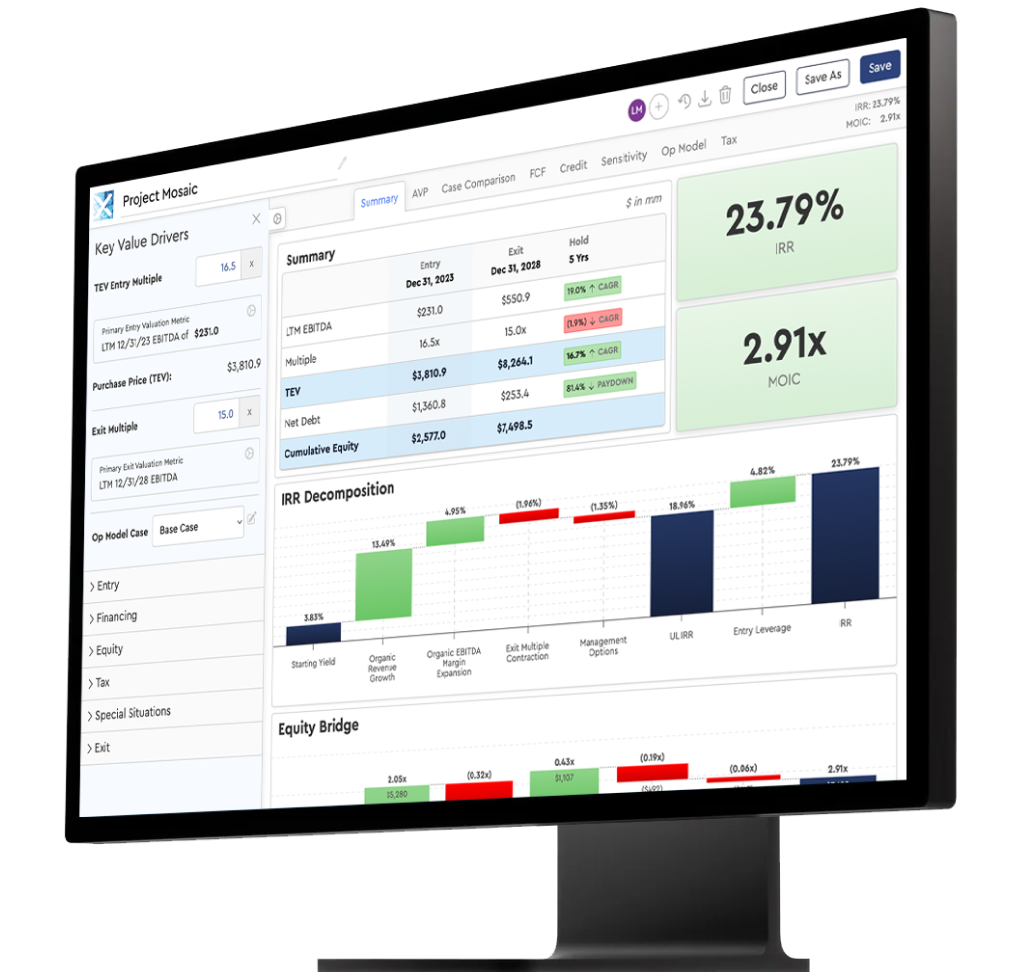
The result is transparency, which is a strange thing to find exciting until you remember the alternative is trusting a number you cannot trace. Analysts get IRR decomposition, value-creation levers, scenario sensitivity, and deal-team collaboration on top - the parts of the job that were supposed to be the job, before the spreadsheet ate the week.
Mosaic's bet is quietly radical: in a field obsessed with what AI might say, it built one that simply refuses to add wrong.
— YESPRESS, reading between the cells
Milestones
// A short history of giving the weekend back
FOUNDING
Investor Technology Group, Inc.Mosaic is built by people who lived the modeling grind, headquartered on Fifth Avenue in New York with a second office on Bay Street in Toronto.
2025
Banking comes callingTwo major investment banks select Mosaic, signaling the move beyond private equity into banking and credit.
APR 2026
$18M Series ARadical Ventures leads. Ryan Shannon and John Megrue join the board and advisory; Ontra's Troy Pospisil is involved too.
NOW
Five of the top tenMosaic counts five of the world's ten largest private equity firms among its customers, and is expanding into private credit.
The Proof
The client list reads like a deal sheet
Skeptics in finance do not buy on vibes; they buy on references. Mosaic's are unusually heavy. Warburg Pincus, CVC, Evercore, New Mountain, Bridgepoint, Investcorp, Onex, and the Ontario Teachers' Pension Plan are among the named users. The company says it serves five of the top ten global private equity firms - a sentence that does more selling than any tagline could.
That roster matters for a reason beyond bragging rights. These are not firms that adopt software because it is new. They adopt it because a partner watched a model open in Excel, traced every formula, and could not find a flaw. Reference selling in private markets is a small world; the firms talk to each other, and a tool that survives one due-diligence team's scrutiny tends to travel quickly to the next. By 2025 the pull had spread past private equity entirely: two major investment banks signed on, and private credit funds followed the same logic. The pattern is consistent - whoever has to produce the model fastest, and defend it hardest, has the most to gain.
The funding round reflects the same conviction from the other side of the table. Radical Ventures led the $18 million Series A, and the names that came with it are telling. Ryan Shannon, a former private equity investor at TPG, joined the board. John Megrue, the former chief executive of Apax, came on as a strategic advisor. Troy Pospisil, who built Ontra into a fixture of deal workflow, is involved too. This is not tourist capital chasing an AI headline; it is people who have lived inside the problem putting money behind the fix.
The week that became ten minutes
// Time to complete a core LBO / DCF model
Traditional Excel build~1 week
Bars not drawn fully to scale - if ten minutes were shown true to a week, you would need a microscope. That, roughly, is the point.
"Up to 20x faster" is the kind of claim that sounds like marketing until a managing director sees the Excel file open clean.
— On why the references stuck
The Mission
Give the judgment back its time
Mosaic's stated mission is not "automate finance." It is narrower and better: repurpose high-value professionals' time away from table-stakes modeling toward the strategic, data-driven conversations that actually move returns. The model was never the deliverable. It was the toll you paid to get to the decision. Mosaic is trying to abolish the toll.
Radical Ventures led the Series A to fund exactly that - engineering and product, customer training for investors and bankers, and a go-to-market push across private equity, private credit, and investment banking. The capital is a vote that the toll is worth abolishing at scale.
"The model was never the deliverable. It was the toll you paid to reach the decision."
— YESPRESS
Why It Matters Tomorrow
Back to that Tuesday
Return to the associate and the cold coffee. The model is done, but that is not the interesting part. The interesting part is what fills the week that the model used to eat. More deals screened. Better questions asked. Scenarios run that nobody had the hours to run before. When the cost of building a model drops toward zero, the volume of thinking that surrounds it goes up.
That is the wager Mosaic is making about the next several years of private markets: that the firms which win will be the ones who spend their hours arguing about the deal instead of formatting it. The CIM still lands on a Tuesday. The week it used to cost is the thing that changed.
#privateequity#ai#fintech#lbo#dealmodeling#saas#investmentbanking#privatecredit