Gillian Anderson remembers an elevator in Cannes. Her years on The X-Files were behind her, and Kelly Bush Novak had a suggestion: the actor needed a publicist. Anderson had relied on her manager and the studio's publicity staff. Novak thought her public narrative could have been handled differently. Anderson's response was wonderfully practical: would Novak take the job?
An elevator is a pleasingly economical setting for this exchange. No conference table. No presentation with an optimistic arrow climbing into the upper right corner. Just an assessment of a career, delivered before the doors opened. The anecdote, which Anderson recalled in 2024, catches something essential about Novak's work: she notices the distance between what an artist does and what the public thinks they do.
That distance has supplied her with a business for more than three decades. As founder and CEO of ID, she has worked across actors, filmmakers, musicians and brands. The interesting part of her career is how often the publicity assignment expands. A conversation about coverage becomes a conversation about the next project, a return to performing, or who gets to speak for themselves.
Three clients, and room to grow
Novak came to Hollywood from her native San Francisco in 1991 and worked for publicist Susan Geller. It was a business of faxes and messengers, with access to stars carefully negotiated through intermediaries. Remembering that period in 2021, she described a changing role: being “a bridge between your clients and the media.” The phrase makes the work sound almost civil. Anyone who has watched an entertainment interview go sideways knows how much engineering a bridge can require.
In 1993 she started her own company with three little-known clients. The agency took the name ID the following year. The small beginning matters because it places the later client lists in proportion. A publicist starting with unfamiliar names must help create a reason for an editor to care. Existing fame cannot do the introduction. There is a person, a piece of work and the task of getting somebody to look.
Patrick Stewart became her first major client. Their association lasted well beyond that initial breakthrough: her later professional biographies still described him as a client, and credited her with introducing him to social media. The pairing offers a useful view of her career. A relationship can endure while the means of reaching an audience changes completely. The actor remains the actor; the publicist has to keep learning the room.
ID grew into an agency with teams in Los Angeles and New York. Mara Buxbaum became its president. Its business extended across personal publicity, film, brands and digital work. In 2006 Novak took the agency into brand representation through Starbucks Entertainment. A coffee company entering entertainment might seem an unlikely neighbour for a Shakespearean actor. Both, however, need somebody to explain why an audience should give them its time.
- 1991Learn
Works with Susan Geller - 1993Build
Starts her agency - 2006Expand
Enters brand representation - 2008Make
Founds VIE Entertainment
A bow tie returns to work
Paul Reubens supplies a more revealing measure of Novak's influence than a long list of familiar surnames. She encouraged him to bring Pee-wee Herman back to audiences in 2007. The return passed through Spike TV and, later, a Broadway production. She also had a producing credit on The Pee-wee Herman Show on Broadway, the HBO special drawn from the stage show.
The work involved giving a performer another occasion to perform. That is a particular kind of advocacy. Reubens already had an instantly recognisable character; the challenge was making space for new encounters with him. The bow tie was familiar. The invitation needed renewing. Publicity and production became adjoining jobs, each helping make the other possible.
Novak's own ventures made that overlap explicit. She founded VIE Entertainment in 2008, adding management to her work. Her screen credits include producing Freeheld and executive producing Into the Forest, both released in 2015. These are positions close to the making of a project, with responsibilities that begin before the interviews are booked.
She has also worked on the public presentation of other people's films. Her film team's campaigns included The King's Speech, The Artist, The Revenant and Roma. Those titles span a royal drama, a silent-film homage, a survival story and an intimate portrait of domestic life. A useful campaign has to recognise the particular film in front of it. Even an awards season cannot make all those stories interchangeable.
The career questionWhat does a person get to do next?
An idea running through Novak's work
Who gets to tell the story?
Elliot Page became a management client through VIE. In December 2020 Novak helped with the messaging and strategy around his public announcement that he is transgender. The announcement belonged to Page; the communications work required attention to how his words would reach an enormous audience. A publicist's involvement can be most consequential when the person speaking has something more important at stake than a release date.
Her advocacy also reached the magazine rack. She arranged the People cover coverage of Ellen DeGeneres's wedding. Set beside the Page announcement, the assignment shows two different forms of visibility: a couple's celebration and an individual's account of himself. Both entered a culture that would argue about them. The professional task included making room for the people involved to be recognisable as people.
Novak is married to Linda Novak and has two daughters. In 2015 she was included in the Out100 as a producer, manager and publicist. Discussing LGBTQ representation that year, she welcomed the progress while arguing that better material and more opportunity were still needed. Her interest extended to what gets made and who gets a chance to make it, questions no magazine cover can settle on its own.
A deadline for the industry
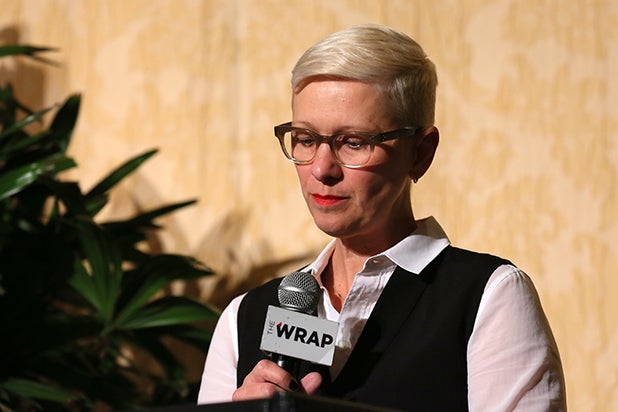
In October 2017 she stood at a microphone at the Power Women Breakfast in Los Angeles and put a date on an ambition. Borrowing a proposal from her client Joey Soloway, she called for equal gender representation across entertainment by 2020. She included executives, directors, writers, showrunners, department heads, unions and boards. It was an unusually specific shopping list for an industry well supplied with expressions of concern.
The arithmetic was easy to remember: “50/50 by 2020.” She also called for transparency around settlements and nondisclosure agreements, and for the industry to hold institutions accountable for enabling abuse. Her speech tied workplace power to political participation and economic opportunity. The deadline was a demand she made in 2017, rather than a result she could declare three years later.
The breadth of the speech matters. A publicity executive knows how much attention actors receive. Novak asked the room to look at the less photographed people who decide which careers are possible. Department heads and board members seldom get the same red-carpet treatment, but they have considerable influence over who reaches the carpet in the first place.
Equal gender representation across entertainment by 2020.
A target she advocated, not a measure of the industry's results.The audience can answer back
Social media brought another version of the same problem. Novak had helped clients reach audiences directly. She later pressed the companies hosting those conversations to deal with targeted hate and doxxing. In a Lesbians Who Tech conversation shared in 2023, she described meetings involving GLAAD, the Human Rights Campaign and technology companies. Her concern was the gap between a platform's promises and what happened to the people using it.
She spoke about threats and harassment extending beyond the screen, and about the difficulty of getting platforms to act. The testimony gives her digital work a second dimension. Expanding somebody's audience creates responsibilities as well as opportunities. A larger following is an attractive number on a report. It is also a larger group of people who can reach the person behind the account.
Her civic interests have included physical places too. In July 2021 she submitted a public comment supporting historic monument status for Oil Can Harry's, the Los Angeles LGBTQ venue. Pride Live also named her among the Stonewall Rebels supporting the development of the Stonewall National Monument Visitor Center. A publicist who spends her working life helping stories travel has also backed places where community stories can remain.
The next chapter is still being written
In a Sundance Collab session, Novak turned to a problem many artists would happily postpone: developing a personal brand. The session covered defining what makes an artist's work distinctive and choosing digital strategies to communicate it. Her advice to students at Vassar's 2022 career programme was concise: “Ensure that your online presence aligns with your values and objective in life.” That instruction sets a higher bar than simply keeping an account busy.
There is a practical consistency here. The artist has to decide what the work means before a publicist can help explain it. An online presence can accumulate by accident, one post and one search result at a time. Novak's advice asks for some authorship over that accumulation. It also leaves the person with a job to do beyond handing the whole thing to a professional.
The work continues. In September 2026 Blake Lively was reported to have signed with Novak after leaving longtime publicist Leslie Sloane. It adds another widely watched career to her responsibilities. In October 2025 she had also joined MPTF's board of governors, and her speaking engagements have continued to connect entertainment publicity with questions about technology and representation.
Back in that Cannes elevator, Novak saw a gap and said something about it. The exchange remains a useful miniature of a career whose assignments have ranged from a returning comic character to a public demand for equality. Each involved deciding what deserved another look. Hollywood has plenty of people prepared to tell you who you are. Novak has made a long working life out of considering what you might do next.
Follow the conversation
More from Kelly Bush Novak and the work around her.