Katie Drasser once hosted a dance party with people representing 30 countries. It is a pleasingly unruly detail to find in an executive biography. A résumé usually arranges people into institutions and dates. Here, for a moment, everyone has been asked to dance.
Drasser is the CEO of RockHealth.org, and bringing people together has been a recurring part of her work. Her career has passed through social enterprise, startup development, leadership programs and the Aspen Institute. Across those settings, the invitation has consequences. Someone gets a conversation, a public platform or a chance to meet a person who can help.
Another detail in her biography reaches further back: she played on an all-boys ice hockey team growing up to win the approval of her three brothers. It is an unusually candid motive to include in a professional biography. Sibling approval has its own rigorous selection process. Before the executive title, there was a girl on the ice, with an audience she wanted to impress.
Capital with company
Before Aspen, Drasser worked on ventures that combined organizational design with social purpose. She helped design a network of charter schools, worked on integrating microfinance with other development activities, and helped develop Good Capital, a venture fund investing in expanding social enterprises.
Her academic background included a bachelor’s degree in political science from Colgate University and a master’s degree from the University of North Carolina at Chapel Hill. Politics and administration are useful territory for someone whose work would involve institutions as well as individual entrepreneurs. An idea can be persuasive and still need an organization capable of carrying it.
Good Capital’s investments included the Hub Bay Area and the Social Capital Markets Conference. Both belonged to the world of people connecting enterprise with social change. The conference, in particular, makes the relationship visible: capital has owners, founders have plans, and somebody must arrange a meeting between them.
That earlier chapter helps explain the shape of Drasser’s later work. A fund, a school network and a leadership program require different expertise, but each turns an intention into a set of arrangements. Who can participate? What support exists? Where does the next introduction come from? These questions are less glamorous than a launch announcement and more useful the following morning.
The accelerator question
In December 2014, Drasser and writer and entrepreneur Vanessa Valenti coauthored “The Gender Accelerator.” Their question was whether startup accelerators could help ventures supporting women and girls. The article considered a program backed by the Nike Foundation and the Unreasonable Group, and examined what such programs could accomplish.
Their interest extended beyond attracting money. They considered relationships between accelerators and investors, evidence about revenue, and the difficulty of measuring social impact. They also argued that ventures serving women and girls needed to incorporate the perspectives of the people they intended to support.
The article was hopeful, with room for doubt. An accelerator could offer mentors, financing and a network; its value still needed examination. That is a useful discipline in a field where a promising mission can make a program sound successful before its results arrive. Drasser and Valenti were asking what the machinery actually did.
The question fits her earlier experience at Good Capital. Helping a venture grow requires attention to the relationship between money, practical support and the people doing the work. An introduction is worth more when the parties understand what they can offer each other.
A decade spent making introductions
Drasser spent ten years at the Aspen Institute before joining RockHealth.org in 2021. She became Managing Director of the Aspen Global Innovators Group, leading global leadership programs addressing poverty alleviation and human rights. She also worked on festival programming, a job in which deciding what deserves a conversation is part of the work.
In 2016, she participated in an Aspen session called “Creating Value on the Fringe: Social Entrepreneurs,” alongside Prabhjot Singh, Kevin Starr and Marika Shioiri-Clark. The discussion examined what established organizations could learn from smaller enterprises approaching familiar problems differently. That interest in people outside the established center would recur in her later work.
At Aspen, leadership programs also supplied practical support. A 2020 fellowship announcement described a year of training in public speaking, writing and networking for six community leaders. The arrangement recognized something that institutions can easily overlook: having experience worth sharing and having access to a public platform are separate accomplishments.
When Drasser announced her departure for RockHealth.org, she remembered the people. She thanked her Aspen colleagues for their wisdom, creativity and humor. Her excitement about the next job came with an invitation: “I can’t wait to cook up new collaborations.” A little later came the send-off: “Now sleeves up. Here I go!” It sounded like someone ready to get back to work with company.
The nonprofit seat at the table
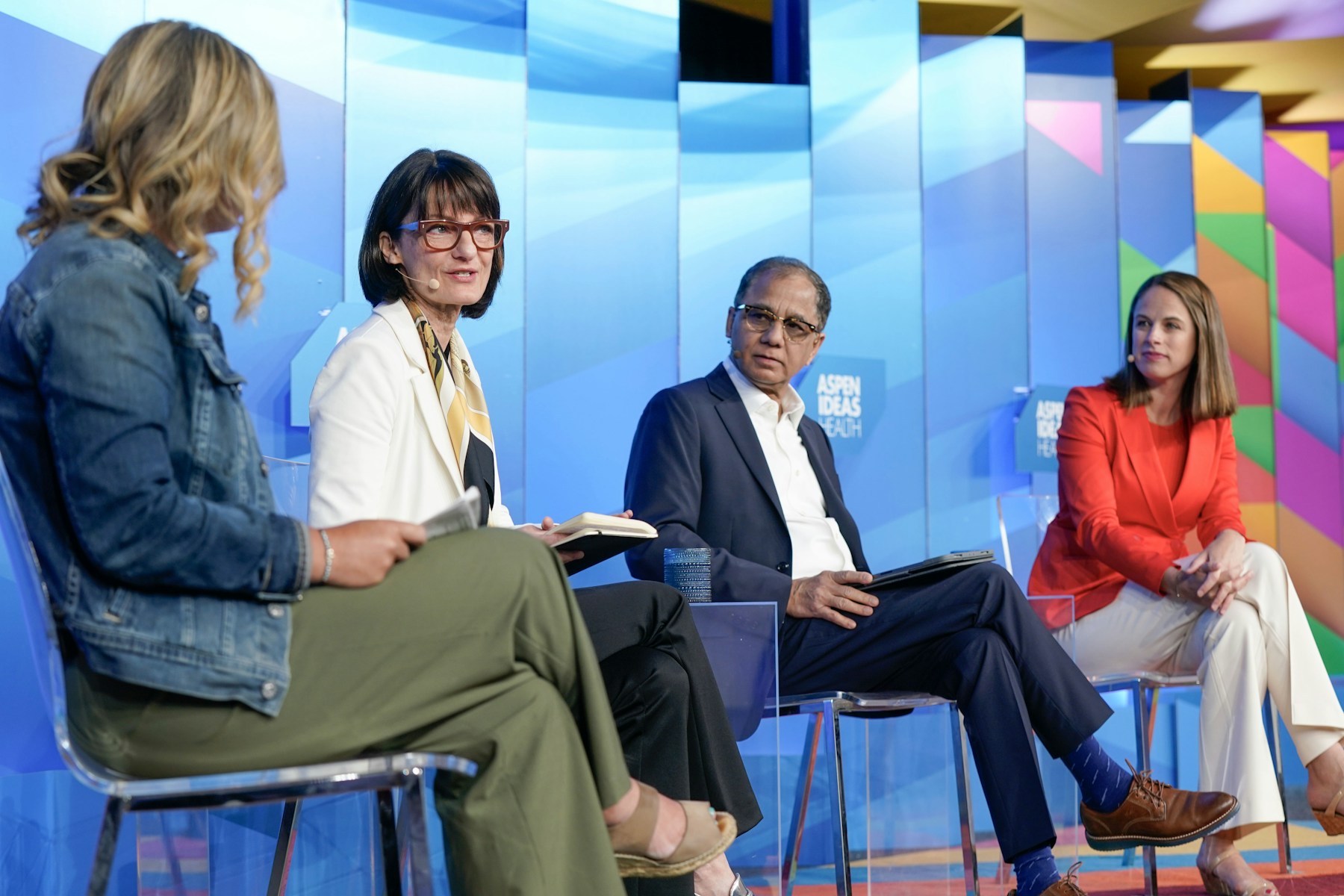
Rock Health announced Drasser’s appointment as the independent CEO of its nonprofit on March 2, 2021. She arrived with experience in leadership programs and social enterprise, taking responsibility for an organization that already had a history of bringing entrepreneurs and other leaders together.
There is an organizational detail worth getting right. RockHealth.org is the nonprofit within the Rock Health family. The family also includes a venture investment business and an advisory business. Those activities share relationships and a broader purpose, while placing different responsibilities on the people leading them.
For Drasser, the nonprofit role makes support for innovators central to the job. The work includes convening people, recognizing their contributions and creating opportunities for shared learning. A founder may need capital; the same founder may also need a peer, an introduction or a chance to explain an idea to a different audience.
The distinction matters when reading her career. Her title belongs to the nonprofit, and her background includes a fund. That combination puts organizational support and investment in the same frame without treating every useful relationship as a transaction. Some of the work is making space for a conversation whose value becomes clear later.
A map with more than three cities
In a 2023 essay coauthored with Jennifer Simmons, Drasser described a way of thinking about gatherings through people, place and purpose. The piece discussed workshops, networking events and design sessions, alongside the organization’s larger meetings. Different formats allowed different kinds of participation.
The geography was part of the argument. San Francisco, New York and Boston remained important gathering places, while Tulsa, Nashville and Atlanta had also welcomed the community. The authors wanted to work more with regional networks and people whose experience might be missed by the usual circuit.
A city on a conference calendar can look like a logistical choice. It also influences who can attend and whose work becomes visible. Moving a conversation changes its surroundings, its participants and the knowledge available in the room. A wider map can therefore make an agenda more interesting before the first speaker begins.
Under the exchange roof
The New York Stock Exchange offers a rather grand setting for discussing the awkward parts of building a company. On March 19, 2024, Rock Health’s CEO Summit brought more than 120 CEOs there for peer discussions. Drasser coauthored the account with Simmons and Carmen Heredia Rodriguez.
The participants came from companies at different stages, from pre-seed to Series D and beyond. Roughly two-thirds were first-time founders, and more than 40 percent identified as founders of color. The range gave the gathering a practical premise: someone else might already have encountered the problem you were trying to solve.
Discussions included selecting investors, finding suitable partners and explaining a company clearly. Founders considered customers as potential investors and grants as another source of funding. They also discussed building a circle of peers. The themes gave the event a purpose beyond being photographed in an impressive building.
New York Stock Exchange
The 2025 summit brought more than 100 CEOs back to the exchange. Drasser, Simmons and Michelle Moore’s account emphasized the realities of leadership, investor alignment and sustainable company building. Participants questioned partnerships that produced a prestigious announcement without changing the business.
The discussion also considered the work of preparing a company for public scrutiny, and the need to build a sound organization while keeping options open. Those concerns are sober companions to the venue. A stock exchange can encourage thoughts of a finish line; the participants spent time on the responsibilities that would follow.
Across the two accounts, the useful material came from people talking about decisions. Which investor fits? Which partner helps? How does a leader communicate amid uncertainty? Drasser’s role as a convenor and coauthor places her close to these exchanges of experience. The gathering has done something when its participants leave with a better question to ask.
The invitation stays open
In 2026, Rock Health announced that Drasser would transition from CEO to Strategic Advisor at the end of the year. As of October, that change is still ahead. She will continue supporting the organization in the new capacity.
The announcement credited her with strengthening partnerships and bringing people across sectors together. It also described curiosity, rigor and generosity in her leadership. Those observations come from colleagues, and they concern how the work was done as much as what was built.
“Show, don’t tell.”
A phrase colleague Jennifer Simmons recalls Drasser sharing
A career built around other people can be difficult to summarize with a single trophy or number. Drasser’s story is easier to follow through the arrangements: a fund for social enterprises, a program for emerging leaders, a room where founders exchange experience. Each offers somebody a way to take part.
The dance party belongs in that story without having to carry its argument. Thirty countries is an excellent guest list. The professional work is more demanding, with budgets, decisions and responsibilities attached. Both begin with an invitation. Drasser has spent much of her career considering whom to send it to, and how to make it worth accepting.