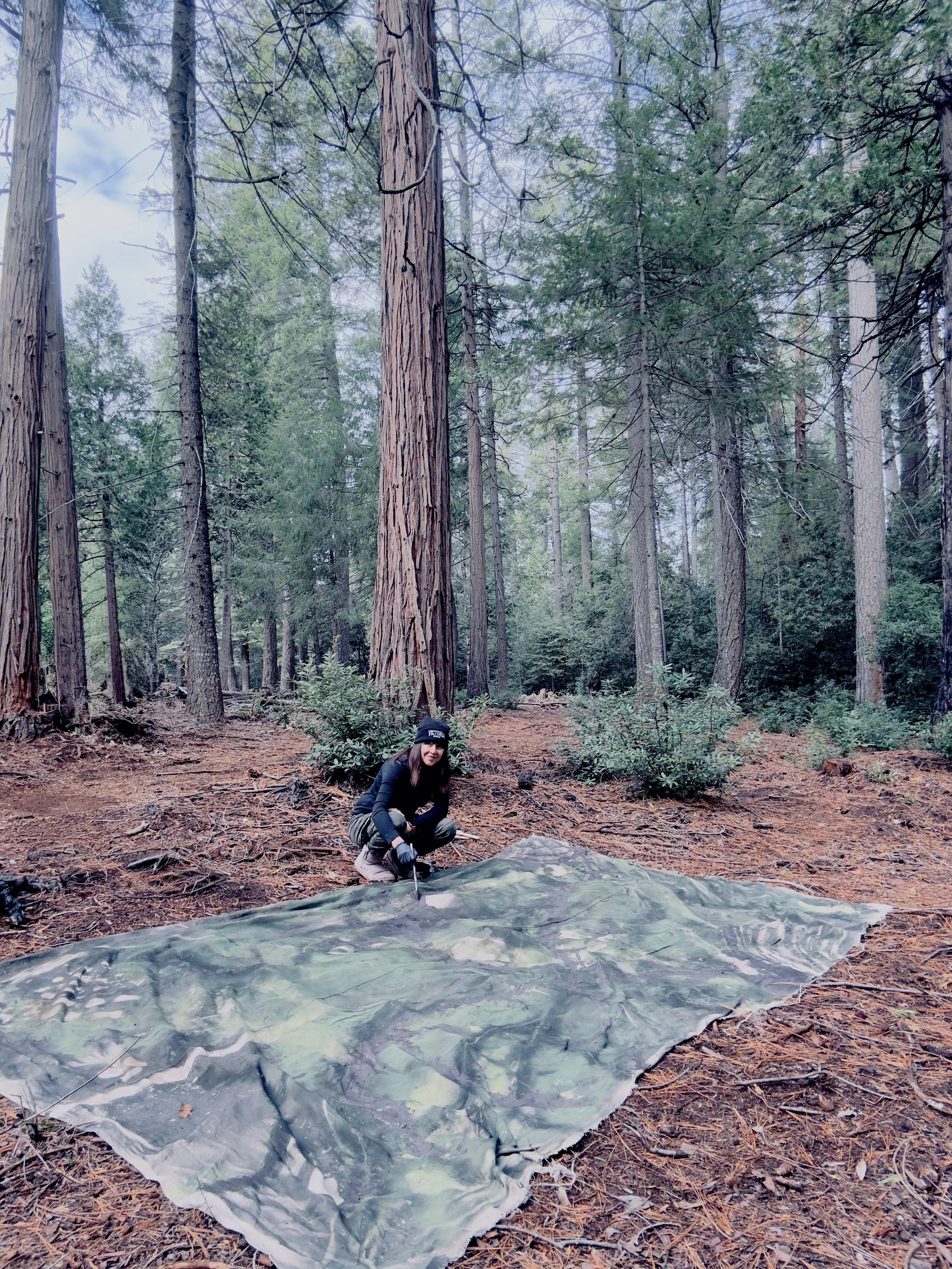
Katherine Filice sometimes leaves a canvas in the forest for a year or more. Soil, roots and the seasons get there before the studio does. When she retrieves it, the surface already carries a history. Painting begins with something that has happened, rather than something waiting politely to happen.
It is an unexpected working arrangement for someone who spent decades directing commercial creative work. A canvas underground cannot be hurried through an approval meeting. The weather is unlikely to read the brief. Yet this patient, partly unpredictable process belongs to the same person who founded Articulate Solutions in Gilroy in 1991 and built a career helping organizations decide how they should appear to the world.
The interesting distance in Filice’s story lies between those two kinds of authorship. She knows how to construct a visual message with care. She has also made room for marks she did not design. Following that distance takes us from company identities and technical pens to paper that behaves like sculpture, and eventually to a forest allowed to make its own contribution.
A very public career, a private practice
Articulate Solutions gave Filice a long education in other people’s purposes. Its work encompassed branding, websites, advertising and communications for businesses, public agencies, universities and nonprofits. Her specialty was making a brand hold together across different media. Consistency, in that setting, is practical: the organization has to remain recognizable when its message changes format.
The work earned specific recognition early on. In 2004, she received a Crystal of Excellence in the Print Media Communicator Awards for an identity and stationery package for Business Builders LLC. Two additional distinctions recognized a Fifth Gear Racing brochure and photography and illustration for Vox One/Bluespoon. The range matters. Her commercial practice already moved between images, words, materials and the problem of making them agree.
A 2011 business profile described clients ranging from family businesses and local charitable groups to corporations and nationwide accounts. That breadth makes the later art career less like an abrupt discovery of creativity. Filice had spent years working visually, with the everyday accountability that comes from making things somebody else needs to use.
She also completed a bachelor’s degree in organizational leadership at the University of San Francisco, whose alumni magazine places her in the class of 2012. Leadership and fine art make an interesting pair of credentials. One asks how people and systems function together. The other can ask what happens when they fail to fit.
Her personal drawings, however, remained largely within a small circle. She had been making art for decades before introducing the pen-and-ink series The Secrets We Keep publicly in early 2017. Someone well practiced at helping a client become visible still had to decide whether to expose work carrying her own name and concerns.
Seventy places, more than a thousand applicants
The international opening came quickly. In September 2017, Articulate Solutions announced her selection for Artrooms London 2018: 70 artists had been chosen from more than 1,100 applicants. She was then the company’s CEO and Executive Creative Director. The following January, the person with an established business career arrived in London as an emerging exhibiting artist.
That combination gives the episode its particular charm. An emerging artist need not be an inexperienced person. Filice brought a designer’s command of composition to an arena where the work would be encountered under very different terms. The drawings explored human relationships through symbolism and densely organized lines. They asked for attention without having a client’s message to deliver.
By 2018, she was exhibiting at the Asia Contemporary Art Show in Hong Kong. The work’s public life had expanded beyond the people who already knew her professionally. A private practice had acquired destinations, conversations and viewers who arrived without knowing the agency story.
Yet she resisted presenting that moment as a neat graduation from employment into artistic freedom. In a 2018 interview, she described her commercial work as providing both financial resources and experience worth bringing back to the studio. Her ambition then was balance: enough time to make meaningful work, with enough independence to avoid choosing every drawing according to the next bill.
That is a useful complication in a story often told as a clean escape. For Filice, the working day supplied encounters as well as income. An artist can draw from a life containing deadlines, other people’s expectations and practical obligations. The challenge was finding room to examine that life on her own terms.
From more than 1,100 applicants worldwide. Each dot represents approximately ten applicants; yellow marks the 70 selected.
The pen did not come with an undo button
The early ink drawings demanded patience of a particularly unforgiving kind. Larger works could require 50 to more than 100 hours of inking after research, sketches and a master tracing. An error could force a restart. Anyone who has casually suggested that a drawing needs one small change might consider the implications.
The technical pen made the commitment visible. A line had to travel across a form and hold its relationship to surrounding lines. The resulting structures could appear organic, almost anatomical, although that effect grew from the method rather than an intention to imitate anatomy. Composition remained a designer’s concern; the accumulated marks made something more difficult to pin down.
“I really love the process”, she said. That short declaration helps explain the hours. The making itself mattered: the paper’s resistance, the repeated movement, the way a surface developed through attention. She also learned to allow irregularity rather than insist on a faultless succession of lines.
The contrast between her public working life and the studio was personal, too. People encountering her through business could mistake her for an extrovert. Alone with a drawing, she described finding renewed energy. The distinction suggests an artist who could function comfortably in a public role while keeping solitude as a necessary part of the work.
Her later changes in materials can be read against that early discipline. The hand trained to organize minute lines eventually had to respond to surfaces that buckled, rose and carried marks from outside the studio. Control had given her a vocabulary. Experiment expanded what it could say.
“I really love the process”Katherine Filice, 2017
When the paper stopped lying flat
By 2021, a work such as A Distant Memory brought ink, gesso and paper onto canvas. Fabriano paper was soaked in Sumi ink and reformed into textured compositions. Once dry, those surfaces received her characteristic line work. The paper acquired a physical presence that a reproduction can only partly convey.
For The Secret Language of the Forest, shown at Gallery 1202 in 2022, she drew or painted on large sheets, then in some pieces dismantled, soaked and reshaped the paper. A drawing surface could become a collection of forms. Looking across it meant following an actual relief as well as the suggestion of one.
The woods offered a way of understanding this change. Filice recognized patterns in trees, ground and sky that resembled marks she was already making. Bark, needles and beetle trails supplied a vocabulary that had been there all along. Her task became one of paying closer attention.
Lost In The Woods, her September 2022 exhibition at the Pacific Art League, placed that relationship in the title. Her accompanying statement moved through quietness, melancholy, joy and hope. The forest accommodated more than a single mood, and her work could move among them without resolving every contradiction.
In his essay Human Nature, painter and mentor Michael David traces the continuity through the changes. Drawing remains central as Filice moves from tightly rendered images toward more expressive, material work. His attention to her observations, from the scale of trees to the smallest objects encountered on a walk, makes the evolution easier to see. The subject grows outward while the habit of looking closely remains.
- DrawFine ink lines build form.
- ReshapeSoaked paper becomes relief.
- ExcavateEarth leaves a record on canvas.
A surface with a past
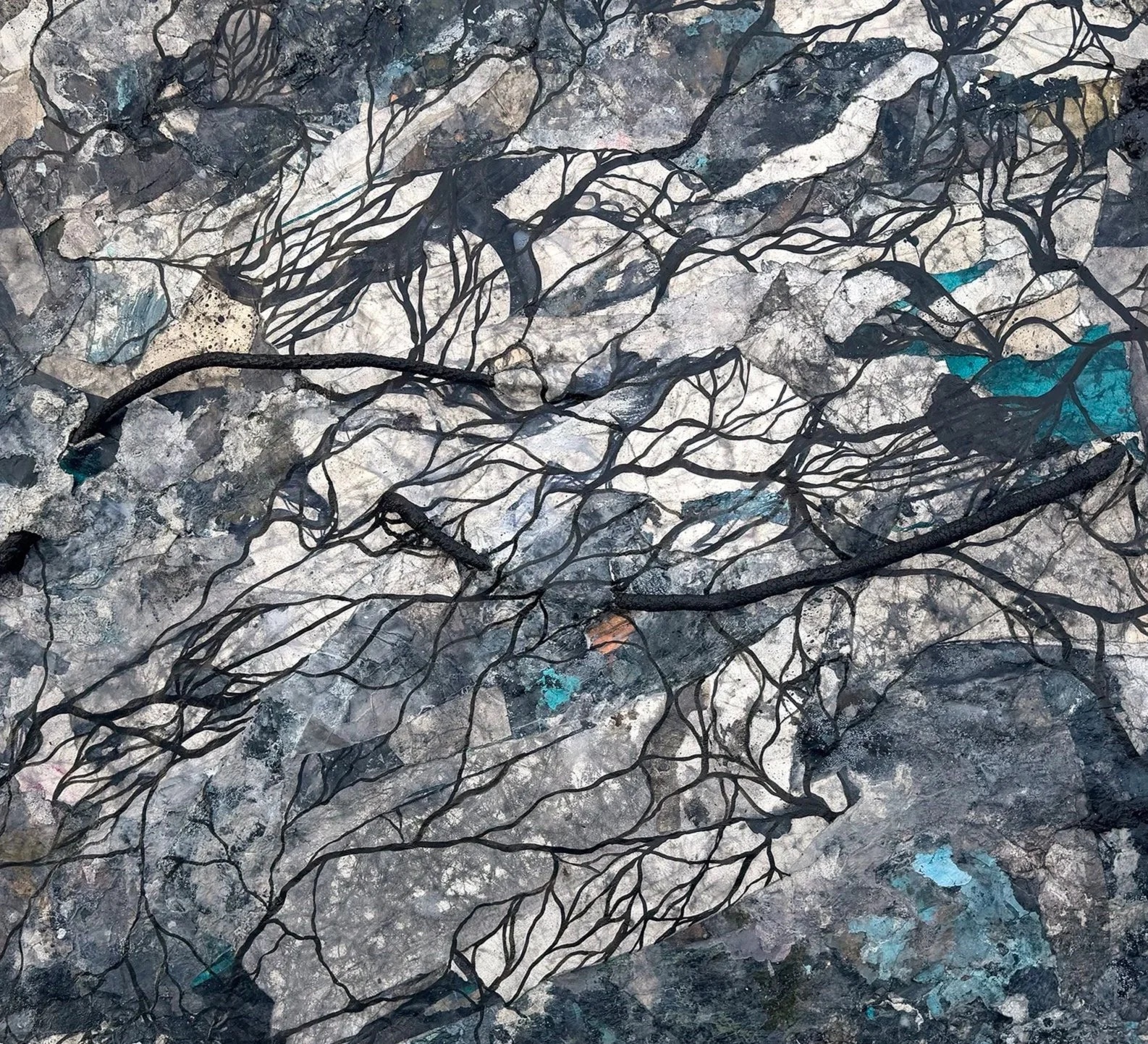
The later canvases make that relationship tangible. Bark and branches enter the work itself. Mica, ground stone and sculpted paper complicate the surface. Burial adds another maker of marks: a period of contact with the land that she cannot reproduce simply by deciding where to place the next stroke.
Consider Into the Woods We Go, a 2026 work on earth-marked canvas. Its surface spent approximately a year buried before returning to the studio. Greens, blues, charcoal tones, violet and translucent white interact with the existing impressions. The dimensions are modest enough for close looking, but the time embedded in the support stretches far beyond a single studio session.
Burn Scar (No. 2), reproduced here, brings ink, paper, branches, bark and stucco together. The materials interrupt any temptation to treat the painting as a smooth window onto somewhere else. There is something to look at on the surface, and something to think about in how that surface came to exist.
The title Counting Stars sounds upward-looking; its 2026 materials list brings us back to the ground: ink, acrylic, earth pigments, earth, ash and embers on buried canvas. That meeting of a distant image with immediate matter runs through her recent practice. A title opens a space for association. The materials keep a physical foothold.
Her ambition, expressed in her current statement, concerns how a place stores memory and how remnants become evidence. Seen this way, the buried canvas is both a working method and an inquiry. What survives contact? Which marks become legible? What can a person add while allowing an earlier record to remain?
The work comes back into the room
The career has continued to widen. The Nature of Things ran at Be Seen Gallery’s Neon Exchange pop-up in Gilroy from May to July 2025. Her subsequent exhibition record includes the Monterey Museum of Art Biennial and appearances at art fairs, while her 2026 announcements brought further museum and fair commitments.
In April 2026, she announced that A Wing and a Prayer had been selected for the Triton Museum of Art’s Salon. The exhibition chose 117 works from more than 2,500 statewide submissions. It opened in May and ran through August. Another April announcement paired her with Barbara Brenner at the San Francisco Art Fair; the two had also exhibited together in Atlanta.
Her continuing connection to commercial design is visible in a different room: the Communicator Awards lists her among its jurors. Articulate Solutions now identifies her as Founder. The historical executive titles belong to a substantial earlier chapter, while the current painting practice has its own momentum.
There is no need to tidy those chapters into a single lesson. They offer a more interesting picture left side by side: a founder who learned to give other people’s messages shape, an artist who took time to share her own, and a painter willing to wait while a surface changes out of sight. Eventually she returns, retrieves the canvas and begins deciding what to do with what is there.
Follow the lines
Explore the work, the conversations and the places it has taken her.