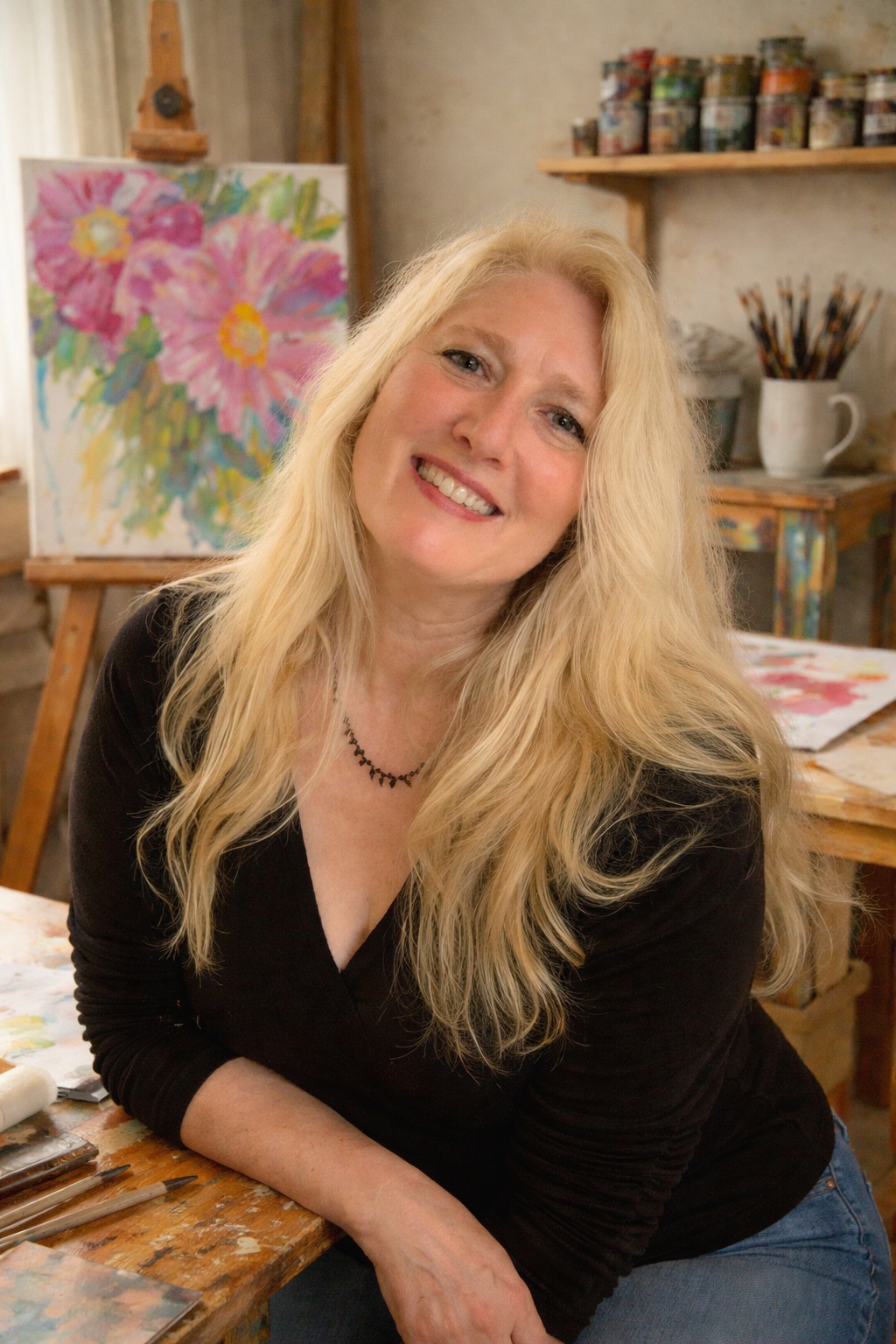
The revealing customer in Michelle S. Burt’s early art business was the one who came back. She first exhibited at Sawdust’s Winter Fantasy in 2013. At the next summer show, some buyers sought her out and bought again. A festival booth had become a place people remembered. For a painter selling individual objects, that second visit is an intriguing event: the first canvas has already left, yet the relationship remains.
- The work: originals, fine-art prints, and commissions, from coastal scenes to figures with handwritten language.
- The invitation: collect a painting or learn to make one in an artist-led class.
- The business lesson: give an interested person a reason, and a way, to return.
Today, the business bearing her name sits between a fine-art studio, an online shop, and a classroom. Its customers include collectors choosing work for their homes, adults trying painting, and organizers booking creative events. Those audiences overlap. In Burt’s own account, a former student returned for classes, commissioned a large dining-room painting, then bought another piece. The customer had changed roles without leaving the artist’s orbit.
A coastline, edited
Burt’s coastal paintings begin with observation. She has worked from sketches, small paintings, and photographs made around Laguna Beach, including Heisler Park and Crystal Cove. Back in the studio, the reference becomes a starting point. A value study establishes the arrangement of light and dark; the finished painting gives her room to choose what matters.
“I just try to paint a feeling. That’s my job.”
Michelle S. Burt
Her tools include oils, acrylics, ink, fabric, and found objects. She keeps a limited palette, mixing extra colors rather than continually adding tubes. John Eagle and Mark Kirchoff helped shape that approach. The constraint is useful to another painter: simplify the available colors, establish the values, then develop the picture. It offers a process to try without requiring anyone to borrow her subjects.
There is design training behind the looseness. Burt studied at FIDM and earned a BFA at California State University, Long Beach, with an emphasis in interior architecture. In 2012, she moved to Laguna Beach and pursued painting. Weekly classes helped; a freely painted lake reflection became a turning point in how she felt about her own work.
When the canvas acquired a voice
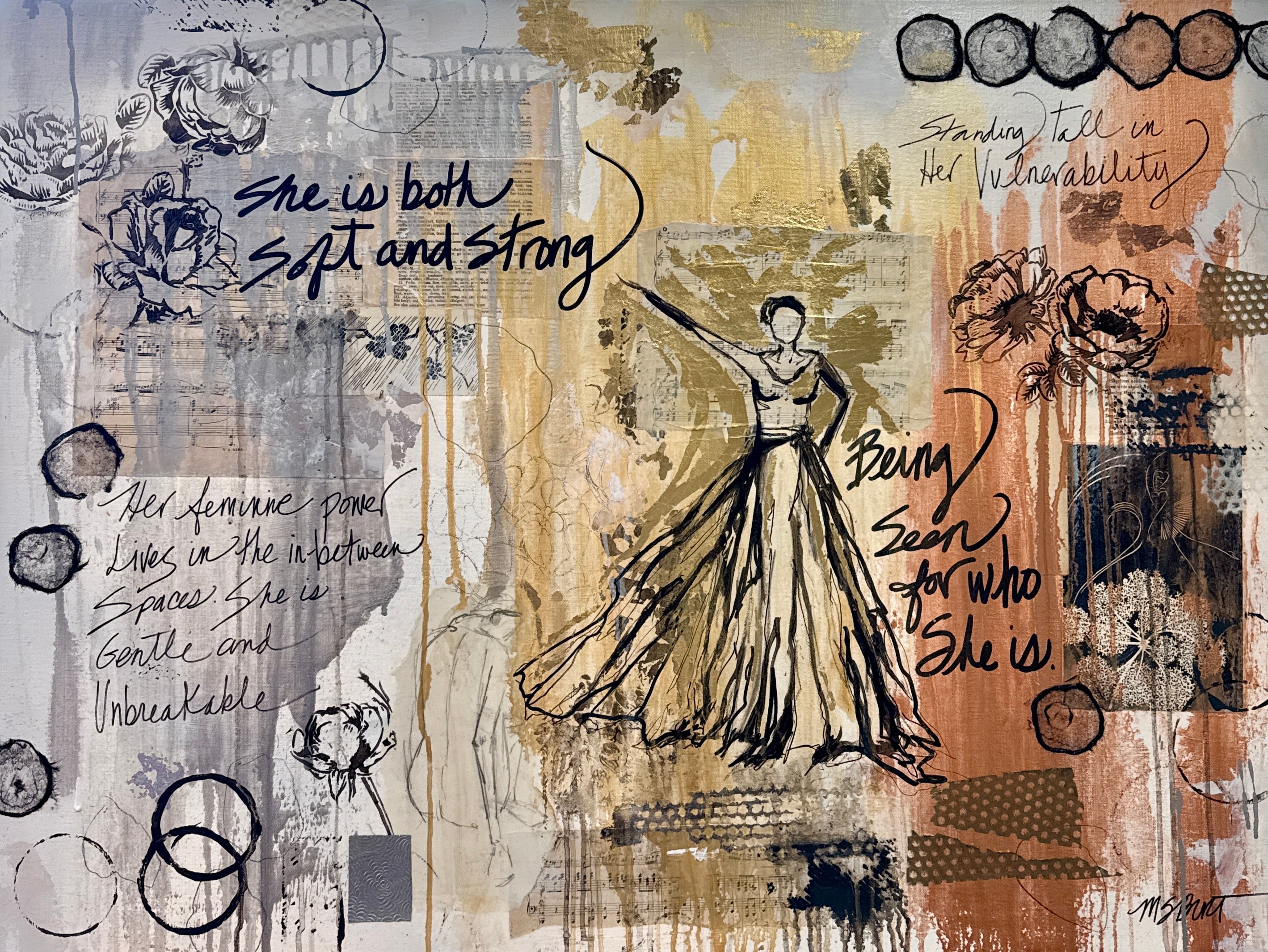
The work expanded into dancers, figures, and abstractions. Poetry entered the paintings, eventually including her own words. Her women-focused mixed-media work developed further in response to the Me Too movement. Here, language becomes something encountered on the canvas alongside a figure, a patch of color, or a visible layer.
Both Soft and Strong makes that relationship easy to see. A drawn woman stands among floral motifs, fragments of printed material, gold tones, and handwriting. The figure gives the eye a place to settle; the words invite it to wander again. For a buyer who wants a painting to carry an explicit personal sentiment, that combination provides something a purely decorative color field does differently.
The studio’s history also contains a pleasingly unromantic episode. In March 2020, Burt described retrieving a painting from a gallery with wear and tear. She began working on it and ended up repainting the entire piece, changing the design and spending days adding glaze. The damaged surface prompted another decision about the picture. Anyone who makes things can copy that willingness to revise; the revision still has to earn its place.
Three doors into the studio
The shop gives that practice several commercial forms. An original is a particular physical work. A reproduction lets another customer own the image in a chosen size and finish. A class sells time, materials, and instruction. Each answers a different question: which painting do I want, what fits my budget, or could I make something myself?
8 × 10 paper print
Both Soft and Strong
30 × 30 canvas
Bold Strokes class
36 × 48 canvas
Mixed-media class
Listed USD prices checked October 7, 2026. Different products, rather than a scale of artistic value.
The print listing offers an unframed 8-by-10-inch paper version of Both Soft and Strong for $50. Canvas and floater-frame options cost more. It specifies archival inks, includes U.S. shipping, and asks customers to allow two to three weeks. A reproduction serves someone who likes the image but needs a different format. Buyers should choose it with that distinction clearly in mind.
Bold Strokes lists a $298 class with a 30-by-30-inch canvas and materials included. The larger mixed-media class lists $498 for a 36-by-48-inch canvas, working with acrylics, inks, papers, and textured layers. Both welcome exploration. The proposition is rather charming: the person shopping for something above the sofa might become the person who paints it.
The conversation before the commission
For collectors, commissions begin with a discussion of vision, scale, and intention. Once details are agreed and a deposit secured, Burt orders the canvas and reserves a place in her schedule. Subjects may include waves, seascapes, dancers, figures, and abstracts. The process suits buyers who want her interpretation of their brief and are comfortable letting a painting develop.
That fit matters. Someone expecting rigid control over every mark should settle expectations before paying a deposit. A workshop has its own practical boundaries: the FAQ specifies adult-oriented classes, four participants as the minimum for a private group, and advance notice for cancellation credit. Participant cancellations receive credit rather than cash refunds. A pleasurable afternoon still benefits from reading the rules.
The customer can change roles
In her account of 2019, Burt reported joining Studio 7 Gallery, adding giclée prints, teaching more, and achieving a personal record sales year. The interesting detail is the combination. Exhibitions introduce the work; editions create another purchase option; teaching lets people spend time with the maker. Corporate and private events extend that participation to groups.
Sawdust lists an abstract class for October 10, 2026. The invitation remains practical: show up and work on a canvas. For another small creative business, Burt’s history suggests a useful experiment. Offer an adjacent experience your existing craft can support. Keep talking to the people who enjoy it. Give them something worth coming back for.