At five in the morning, Karla Borland had two problems competing for her attention. A food delivery had failed to reach the warehouse. At home, her young children were making their own demands, including the urgent matter of a missing Batman car. Two market managers waited in vans for stock. There is a peculiar equality to these situations: neither a customer’s breakfast nor a three-year-old’s toy can be postponed by explaining your job title.
By then, Borland was running Morsl, the workplace food business she founded in 2018. Its customers could shop without a cashier. Its founder had rather less freedom from interruptions. That early-morning collision captures the work underneath an apparently simple proposition: put food where people work, make it available when they need it, and let them pay for it themselves.
The office was the first clue
Before the fridges and checkout kiosks came a career in finance. Borland joined Investec Private Advisers in 2003 and became its head of research in 2008. Her work included developing a quantitative approach to selecting funds across asset classes. In 2010, Credit Suisse recruited her as a vice president in fund advisory and analysis. Two years later, she moved from Australia to Singapore to lead its Asian mutual funds business, covering mutual funds and exchange-traded funds.
Those appointments show a career built around examining choices: what was available, how it should be assessed, and what might deserve a place in a portfolio. They also give the later career change some texture. Borland had worked inside established organisations before she had to establish one. A role can come with responsibility and still come with a salary, colleagues and an existing system to hold it up.
Across 17 years in banking, with work taking her through Sydney, Singapore and Zurich, another problem kept presenting itself. Getting food during an office day was more awkward than it needed to be. The vending machine was close. Alternatives required going elsewhere. She began considering whether the shop could come to the employee.
There was no need to invent lunch. There was a reason to reconsider its address. The practical attraction of Borland’s idea was its familiarity: shelves, refrigeration and a checkout, installed inside a workplace. Customers would understand the transaction immediately. The unusual part was where it happened and the hours it could keep.
“I wanted to break the old model apart.”
Karla Borland
By February 2020, her ambitions were still closely associated with corporate Australia. Morsl was serving locations including Channel 7 and Employsure. Officeworks had also called after a café serving warehouse shift workers closed. The company sold products directly to staff, with employers able to subsidise purchases. Borland wanted the surroundings to feel like a café, rather than a reluctant stop beside a machine.
One warehouse kept the lights on
Then the working day changed. In 2020, six of Morsl’s seven sites closed. The location still operating was an Officeworks dispatch warehouse. For a founder, that is a brutal little set of numbers. It is also a clue: the business had reached a workplace whose need continued when the office locations fell away.
The remaining location: Officeworks dispatch warehouse.
Borland shifted attention toward industrial workplaces. The distinction mattered because the food problem there involved more than deciding which nearby café to visit. Warehouses could run through the night. Industrial sites could be isolated from shops. Breaks could be short. A staffed counter with conventional opening hours would leave part of that working population looking at a closed service.
Morsl’s format could remain available across shifts. It also allowed staff to pick up an item and look at it before buying. Food ranges could rotate and stock volumes could change with employee numbers. These were useful operating characteristics for a customer base whose working pattern did not resemble the CBD lunch rush.
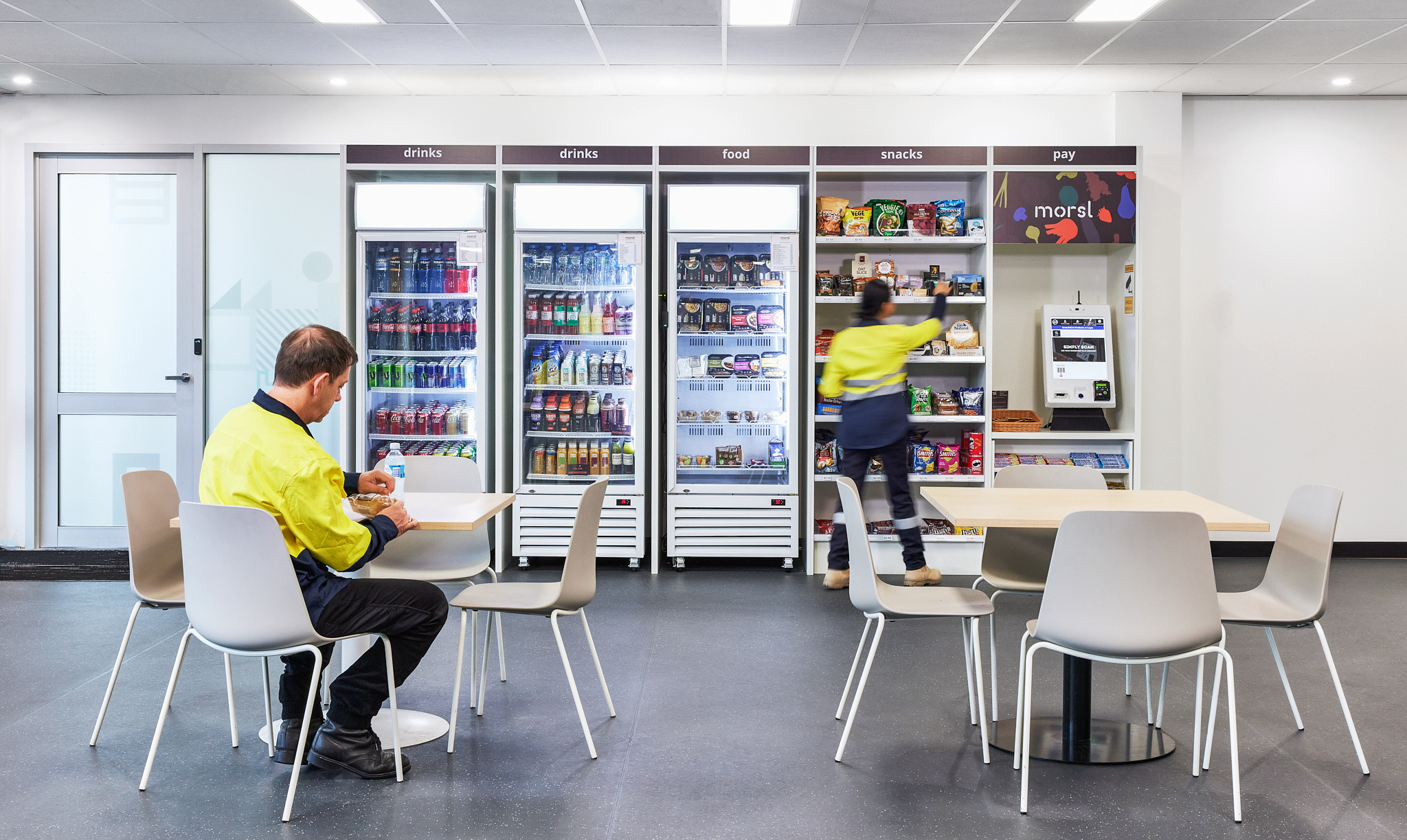
The warehouse made the question more precise. Who needs this service when the usual food businesses have shut? That question helps explain the move from an office convenience to an industrial workplace operation. It places the customer’s schedule at the centre of the business. Location alone cannot solve an access problem if the door is closed at the required hour.
Unattended, with people behind it
In a Morsl market, the customer browses, scans and pays. The company manages the installation and regular servicing. Dedicated market managers restock the shelves and handle quality control; remote monitoring helps track security and inventory. The shop may be unattended at the moment of purchase, but its continued usefulness depends on a recurring sequence of human tasks.
This gives Borland’s role a practical edge. A self-service checkout is only convenient if it works, and a fridge is only a retail offer if it contains something worth buying. The early-morning delivery problem belongs to the same business as the polished installation photograph. One is the promise. The other is the work needed to keep it.
- 01 / BrowseOpen shelves and fridges
- 02 / PaySelf-service scan and checkout
- 03 / ReplenishMarket managers return with stock
The first two steps happen in the break. The third keeps tomorrow’s break possible.
The business has extended into coffee, pantry procurement, catering and workplace events. These services sit beside the original market rather than requiring every food purchase to fit a single format. A workplace contains several occasions for food, from an individual break to a group gathering. Serving those occasions means dealing with the employer as well as the person standing at the shelf.
At Amazon’s BWU2 fulfilment centre, Morsl’s operation placed the model inside a large logistics environment. The setting brings the proposition into focus: a food service needs to function within the working patterns of a building devoted to moving goods. The machinery of convenience has to include the people doing that work.
Another installation made the issue almost absurdly clear. In March 2024, Morsl opened at Ampol’s Lytton refinery in Brisbane, replacing an existing canteen. The refinery team numbered 800. The old canteen closed at two in the afternoon. The site operated around the clock. The difference between those two timetables was an opening for Borland’s business, expressed in hours rather than a marketing slogan.
A late shift should not require a different food strategy simply because the counter has stopped serving. At Lytton, the self-service market changed the hours in which staff could buy something on site. For Borland, it was another application of the question that the warehouse had brought into view: what happens to the employee whose working day continues after the conventional service ends?
A salary, and then a larger cheque
For Borland, one early achievement was being paid. In April 2021, she announced that Morsl’s board had approved a salary for her. Her account ended with plans to buy new sneakers. It is an appealingly ordinary purchase to attach to a business milestone. Founders can spend so much time describing future scale that the first affordable personal treat gets edited out of the story.
The distinction between a founder’s pay and a funding round matters. A salary makes the business part of the household’s working arithmetic. Investment supports plans that still have to be carried out. Both can be celebrated, but they answer different questions. One concerns whether the operation can support its founder; the other concerns what it might be able to build next.
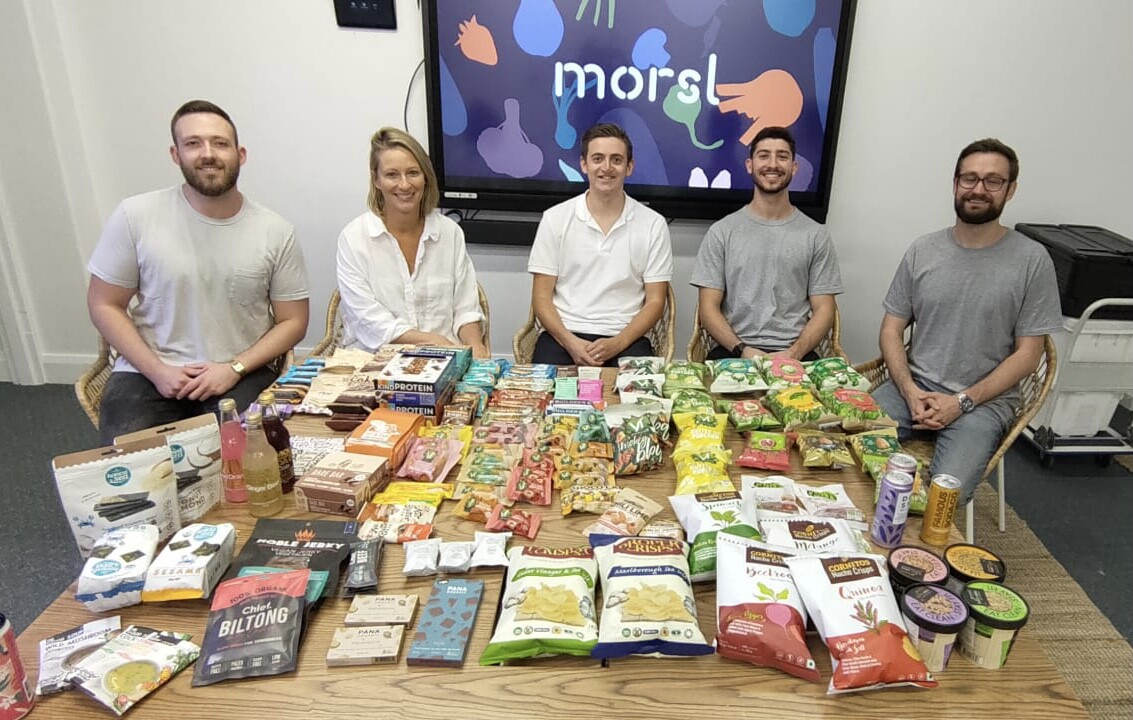
In January 2023, Morsl announced an AUD 5 million Series A. The Chapman Group contributed the AUD 4.3 million cornerstone investment. The post-money company valuation was AUD 14.4 million. At that point, Morsl had 13 established sites in New South Wales and Victoria and supported more than 5,000 employees.
Historical figures at the funding announcement.
The intended uses were specific: execute a pipeline of more than 20 new sites, expand nationally and add management capacity. A new office and warehouse lease in Marrickville made the physical side of that expansion visible. Fridges, stock and delivery routes require space. So do the people organising them.
The customer’s working day keeps moving
At the end of 2024, Borland reported a team of 38 across New South Wales, Victoria and Queensland, more than 30 new markets during the year, and over 20,000 daily customers. Her message gave the team credit for the growth. That emphasis fits a company whose service has to be renewed every time someone replenishes a market.
In May 2025, she announced a national Australia Post partnership covering eight major processing centres. Later that year, Morsl published its collaboration with ESR Australia & NZ and Richard Crookes Constructions at Moorebank Intermodal Precinct. The mobile market took the self-service format onto a construction site. A business originally imagined for offices was adapting to another kind of workplace, with another kind of timetable.
There is a personal history beneath the operating figures. Borland attended PLC Sydney from 1990 to 1995, studied commerce at the University of Sydney and began at PwC as a tax consultant. She also DJs as a hobby. Her school memories include dressing as Michael Jackson and impersonating a maths teacher who wore sandals with socks. The career in numbers evidently did not eliminate an appetite for a good costume.
Asked what she would tell her younger self, she offered a compact piece of advice: “Take more notice of the opportunities you thrive in.” Her own career gives that sentence something to work with. The banking years, the first office markets and the surviving warehouse were different settings for noticing what might come next.
Borland’s business still returns to a small, repeatable event. Someone finishes a task, takes a break and goes looking for something to eat. For the customer, success can be as ordinary as a stocked fridge and a working checkout. For the founder, achieving that ordinary result across more workplaces is the continuing job.