Before Kambi sold risk management, its founders argued over Risk. Kristian Nylén remembers a fiery dispute with Anders Ström during the board game. The detail is almost too convenient: two friends interested in probabilities, each convinced he understood the position better. Years later, they would build a company whose job was to help other people price uncertainty.
- Kambi supplies the technology behind licensed betting brands.
- Operators can buy a managed sportsbook or plug in its odds.
- The advantage is shared expertise. The tension is control.
The interesting question is why a bookmaker would hand that job to somebody else. A betting brand is supposed to know sport. Surely calculating odds belongs at its centre? Kambi’s answer starts with something less glamorous than a clever prediction: the cost of keeping the entire operation running while the match is still being played.
Every goal creates more work
Live betting turns a sporting event into a moving production line. Prices need updating. Markets open and close. Bets must be checked, accepted and eventually settled. Multiply that by sports, leagues, languages and regulatory jurisdictions, and a bookmaker needs considerably more than a website with a bet button.
Kambi emerged from Unibet’s sportsbook operation in 2010. Nylén and Ström’s proposition was to share that expensive machinery across operators. Paf signed first and launched in 2011. But the next partner took two years to arrive. Potential customers questioned the independence of a supplier connected to a rival. The early bottleneck was trust.
“I recall Anders and I got into a fiery argument over a game of Risk”Kristian Nylén / co-founder
The 2014 public listing helped establish Kambi as a standalone business. It also sharpened the proposition: customers could compete for bettors while buying important infrastructure from the same specialist. Shared plumbing was acceptable, provided nobody believed another customer controlled the taps.

The brand stays out front
Today, Kambi’s buyers include casinos, lotteries and online gambling operators. Its reported network exceeds 70 turnkey and odds partners across six continents. Names include Rush Street Interactive, BetPlay, Bally’s and Ontario Lottery and Gaming Corporation. The consumer usually encounters the operator’s name; Kambi works underneath it.
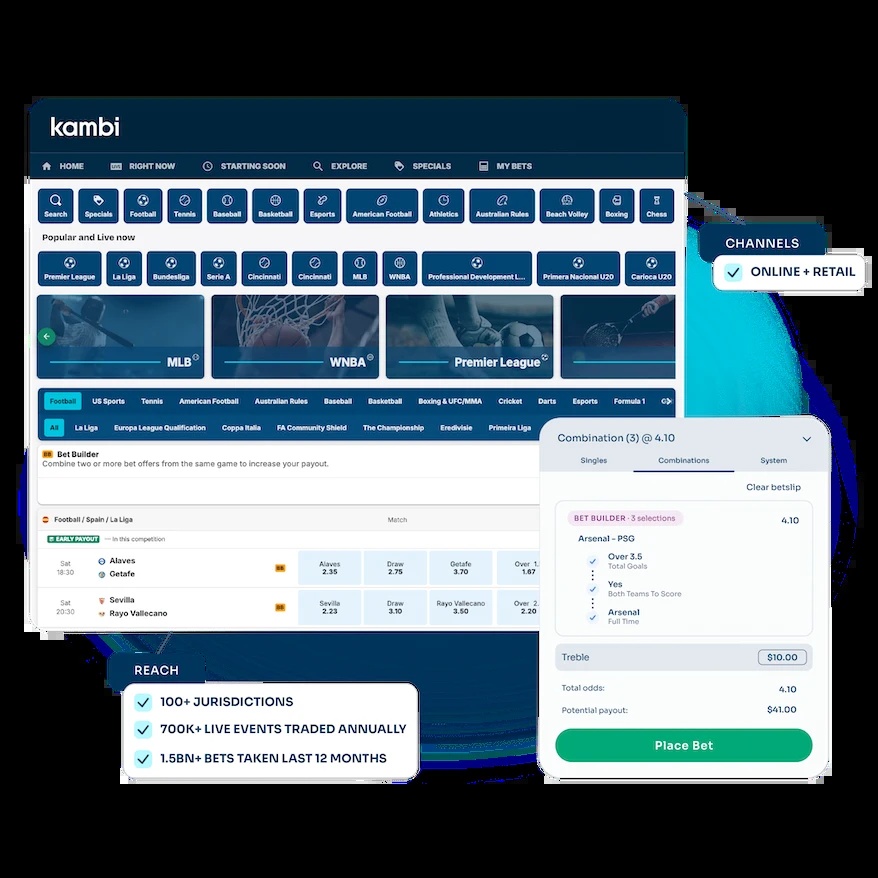
Turnkey Sportsbook bundles the betting platform with pricing, trading and risk capabilities. It supports online and retail betting, customisable interfaces, promotional tools and Bet Builder, which lets players combine selections. An operator can concentrate more effort on its brand, distribution and customer relationships while Kambi supplies specialised sportsbook work.
The customer
Sportsbook engine
Network activity → pricing insight → updated offers
Kambi argues that activity across the network improves pricing and risk decisions. That is its distinctive sales argument: experience accumulates across customers. It is also a claim worth examining rather than accepting automatically. Shared intelligence is useful only if it produces reliable, relevant products for an individual operator’s market.
There are alternatives. OpenBet sells sportsbook technology and trading tools. Sportradar offers ORAKO and managed trading services. A sufficiently ambitious operator can develop proprietary systems. Kambi sits between a software vendor and an outsourced operating team, with expertise that spans mathematical models, live trading, integration and regulated-market delivery.
The customer who learns to leave
Here is the awkward part. A supplier can help a customer grow until that customer wants more control. DraftKings migrated away from Kambi. PENN subsequently agreed to move its online sportsbook to proprietary technology. These departures exposed a limit of the model: the same infrastructure that accelerates entry can eventually feel like a constraint.
PENN’s agreement made the switching effort unusually visible. It provided for $12.5 million in early termination fees and $15 million for transition services, alongside revenue sharing while services continued. That $27.5 million was a negotiated exit arrangement, not a standard Kambi price. Moving a sportsbook meant moving an operating system, not merely changing its paint.
Buying more capability was expensive too. Kambi paid €38.5 million upfront for front-end specialist Shape Games in 2022, with additional performance payments possible. The rationale was sensible: shared betting infrastructure still needed distinctive customer experiences. Yet Kambi later acknowledged that Shape Games’ revenue contribution in 2023 had fallen below expectations.
Sell the part they still need
The response has been to widen the ways customers can buy. Introduced in 2024, Odds Feed+ delivers configurable odds packages through one API. An operator with its own platform can buy pricing without adopting the entire sportsbook. Kambi can now approach companies whose answer to a full outsourcing proposal would be no.
This expansion did not erase commercial pressure. Revenue fell from €176.4 million in 2024 to €162 million in 2025. The following year brought improvement: second-quarter 2026 revenue reached €45.9 million, up 13.5% year on year. Kambi also acknowledged customer credits associated with operational issues in April. Scale does not remove the obligation to keep the service working.
Revenue received by Kambi, not the value of bets placed.
What is worth owning?
Kambi’s underlying commercial model links its fortunes to its customers through negotiated revenue-sharing arrangements. That alignment also exposes it to their performance, regulatory changes and departures. For a smaller operator, pooling specialist costs can be attractive. For a large operator with engineering resources and unusual requirements, owning more of the stack may make sense.
For an operator choosing a supplier, the useful questions are concrete. Can its team integrate the product with existing accounts and payments? Does the offering fit local rules and customer tastes? Who handles incidents during a major match? Shared infrastructure pays off when those answers fit the business. A long feature list alone cannot settle the decision.
The practical lesson travels beyond betting: identify which work benefits from being shared, and which work makes a customer different. Kambi has gradually made that boundary more negotiable. Its October 2026 agreement with QuinnBet paired Kambi’s sportsbook with Pragmatic Solutions’ player account platform. The machinery can be shared. The decision about what to own remains the customer’s.