A small business does not experience cash flow as a tidy line on a quarterly report. It experiences cash flow as Tuesday. The invoice is good, the customer will pay, and the new equipment is plainly useful. Unfortunately, payroll is Friday and the supplier has developed an urgent affection for being paid now. Justin Leto built his second career around this small tyranny of timing.
His first career had juries, depositions and a different sort of suspense. Leto earned a business degree from the University of Arizona, graduated from the University of Miami School of Law in 2003, and became a Florida trial lawyer. By 2011 he was running his own practice when he met Larry Bassuk, another attorney working on the same floor. Proximity did what networking breakfasts labor to accomplish: the two began talking.
The conversations became a law firm, Leto | Bassuk, and then an insurance idea grounded in the peculiar economics of contingency litigation. Plaintiff lawyers routinely advance the costs of a case. Experts, depositions, records and trial preparation consume money long before a verdict, and a loss may erase the investment. Leto and Bassuk asked why that downside could not be insured. In 2016, they brought Level Insurance to market to do just that.
The conference room era
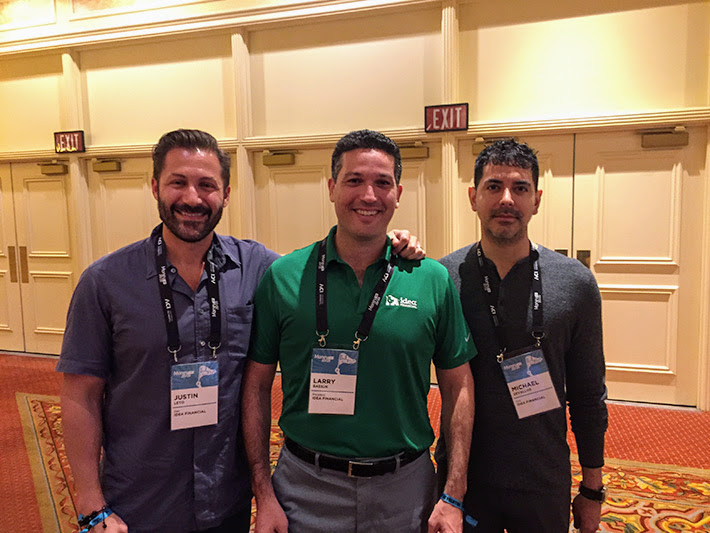
Insurance led the partners toward insurtech, which led toward fintech. An adviser from European banking helped with the insurance venture and opened a broader discussion: plenty of established businesses could qualify for conventional credit but valued the speed and efficiency of an online lender. In March 2017, Leto and Bassuk founded Idea Financial around that group. They did not begin in a gleaming innovation lab. They used their law firm's conference room.
For much of the first year, the room held the work of inventing a lender: strategy, hiring, technology and credit models. Idea Financial made its first loan in January 2018. Leto later offered a bracingly honest description of the early system. The customer experience appeared seamless; behind it, the team's process remained intensely manual. People were the integration layer.
This was less a fake-it-until-you-make-it trick than an operator's bargain. The front end had to respect a business owner's time. The back end had to respect credit risk. Until software could do both reliably, careful humans closed the gap. Over the next two years, the company developed its underwriting system, data-science capability and customer portal. Automation arrived after the team understood what deserved automating.
A lawyer's useful baggage
Leto did not pretend that courtroom work supplied a ready-made lending résumé. He and Bassuk were outsiders to banking and alternative finance. But they carried useful baggage. Trial practice trains a person to examine claims, prepare for adverse outcomes and make consequential decisions with incomplete information. Running a boutique firm also teaches the intimate indignities of ownership: revenue can be healthy while cash arrives late, and a theoretically available bank loan is useless if the opportunity expires first.
Idea Financial's niche was precise. Leto described its customers as otherwise bankable merchants who wanted fintech speed. He also said the aim was to help them grow without saddling them with unsustainable debt. Those two statements belong together. Faster credit is useful only if speed does not become an excuse to ignore whether the borrower can carry it.
The product design followed the jobs money needed to do. A revolving line of credit suits recurring uncertainty: inventory, repairs, seasonal gaps or the excellent contract that arrives before its first payment. A term loan suits a known project with a price tag. Leto spoke in 2019 about offering the two side by side so a merchant could fund a large project without sacrificing flexible working capital. The observation is usefully mundane. Financing should fit the expense, not merely appear at the right moment wearing a persuasive rate.
Money for the lender
A lending company must raise capital before it can offer capital. Here the milestones show Idea Financial gradually earning institutional confidence. The business was initially backed with $20 million from Poland's Idea Bank. In 2019 it closed a $70 million warehouse facility with Cross River Bank. By that August, Idea Financial had funded $50 million to nearly 600 businesses.
In 2021, Synovus Bank Specialty Finance and Hudson Cove Capital Management provided an $84 million warehouse facility. The agreement supported the core small-business credit line and an expansion into legal finance. LevelEsq brought the founders' career full circle: technology and underwriting built for Main Street could now finance plaintiff firms whose case costs had inspired their first insurance venture.
The numbers kept widening. Idea Financial said it passed $1 billion in total funding originated by 2025. In January 2026, EverBank provided a $20 million corporate term loan for expansion in small-business and legal lending. That spring, MA Asset Management and Pinnacle Financial Partners announced a $175 million asset-backed facility to support further growth. The facilities are not personal wealth and should not be mistaken for it. They are the plumbing of a lender: capacity, covenants, confidence and an obligation to keep underwriting sober.
Rules, risk and a ringing telephone
Leto's public comments resist the easy caricature of fintech as cheerful software racing dusty banks. In 2019, he named regulation, debt stacking and macroeconomics as the sector's largest challenges. Stacking, in which a business takes loans from several lenders, can push debt beyond what operations can sustain. On regulation, he was blunt: rules for the industry could be a good thing.
That instinct comes from a career spent around downside. It also explains why Idea Financial's promise mixes technology with human support. A quick decision matters. So does the ability to reach someone when a payment schedule, fresh draw or cash-flow surprise needs explanation. Software can remove waiting. It cannot make a difficult obligation disappear, and a good interface is not permission to stop asking hard questions.
Leto has been equally direct about the work itself. Fintech, he said, means long hours, high stress and considerable competition. His counterweight is the team: people who arrive wanting to leave the company better than they found it the night before. He has described watching Idea Financial grow as a defining experience in his professional career. The pleasure seems to reside in the building, not merely in the milestone.
The other counterweight is Bassuk. Their partnership has outlasted the law firm that first gave it a room, moved through insurance and lending, and survived the uncomfortable freedom of being outsiders. In 2019, Leto recalled that Idea Bank had supplied two newcomers with capital and few strict covenants. The founders had room to make their own rules. Their answer was not a solo mythology. Bassuk publicly credited a team whose members brought experience from several countries and argued for diversity of thought. Leto emphasized a culture in which colleagues genuinely enjoyed one another. Institutional partners then became part of the operating story: Idea Bank, Cross River, Synovus, Hudson Cove, EverBank, MA Asset Management and Pinnacle. For a company selling access to capital, its own history is a long demonstration that access still depends on trust between people.
Read your book
One personal detail makes the operator less abstract. Leto has read Deepak Chopra's The Seven Spiritual Laws of Success at least 20 times. He has given it to other people. When his wife senses he is unbalanced, she tells him, “Read your book.” The phrase is affectionate, efficient and faintly managerial. Every founder needs a reset protocol; his happens to fit on a shelf.
He has also recommended Phil Knight's Shoe Dog and Earl Nightingale's Lead the Field. Outside work, Idea Financial's biography places him with his wife, children and two American bulldogs, or rooting for the New York Mets. Supporting the Mets is its own recurring seminar in uncertainty, though no underwriting model has yet been disclosed.
From 2022 through 2024, Leto and Bassuk made some of their working philosophy public in 19 episodes of Trials & Tribulations. Their subjects included preparation, partnership, bank insecurity, the human element of risk, marketing for law firms and whether Miami could become a financial capital. The series connected the courtroom and boardroom rather than treating one as a discarded life.
That may be the cleanest reading of Leto's career. He did not flee law for software. He carried forward the problems law had taught him to see: delayed proceeds, expensive preparation, uncertain outcomes and small organizations that must keep operating while larger systems deliberate. Idea Financial turned those lessons toward established businesses. LevelEsq returned them to lawyers. The industries changed; the clock kept ticking.
In a founder culture devoted to disruption, Leto's story is more practical. Notice where capable people are made to wait. Understand what the delay costs them. Build the operational machinery carefully enough that speed remains a service rather than a hazard. Then, when Tuesday inevitably arrives, answer the phone.