Julius Lim’s early customers supplied an education that neither Wharton nor a consulting career could quite provide. He had been accustomed to corporate executives. Now he was trying to sell used computers through small independent shops. The distance between those worlds was measured in much more than the size of the premises. A business plan had to become a transaction someone else actually wanted.
There is a pleasing awkwardness to that beginning. Lim arrived with credentials, experience and a plausible opportunity. The market reserved the right to be unimpressed. His subsequent work at CompAsia can be read as a long response to that first encounter: keep the useful problem, revise the way of solving it, and pay attention to the person expected to hand over money.
The diploma meets the shop floor
Before CompAsia, Lim worked at Boston Consulting Group and MCSB Systems. His studies combined electrical engineering and economics at Johns Hopkins University, followed by an MBA at Wharton. Those disciplines sit comfortably beside his eventual business: hardware has to work, and the price has to work for somebody.
Education gives this story context without supplying its explanation. Knowing how a device functions is different from persuading an owner to surrender it. Understanding a market is different from having inventory someone will buy. Lim’s career brought both questions into the same working day.
CompAsia was established in 2012, with a year of preparation before its early trading. Lim initially pursued used corporate computers. Selling refurbished machines online proved slow, and independent dealers became another route to customers. The company later entered used mobile phones in 2015. The first product had given the business a starting point; it did not dictate the rest of its life.
The change leaves an instructive gap between having an idea and operating a company. A seller needs a route to a buyer. A buyer needs a reason to choose this particular seller. In used equipment, the condition of the object complicates both jobs. A degree makes a handsome frame for a wall. It cannot inspect the stock.
Johns Hopkins: electrical engineering and economics.
Wharton: MBA.
Then came the practical examination: finding a buyer.
A smaller object, a different business
CompAsia’s own account of its development centres on Lim noticing faster turnover in smartphones than laptops. Moving toward phones meant working with a different rhythm of replacement and resale. The company began buying smartphones from large organisations and directing them toward markets with demand.
That move is worth lingering over because a change of product changes the questions an operator must answer. How quickly can stock move? Where should it go? What does a prospective owner need to know before agreeing to a price? The company’s published story describes further device lifecycle services growing out of that initial change.
Lim’s contribution was to keep investigating the transaction around the object. The phone itself was already familiar. The business opportunity lay in organising what happened when one owner was finished with it. There is room for invention in that unceremonious moment, even if nobody holds a launch event for the second sale.
“We believe in giving devices a second life.”
Julius Lim, 2018
By October 2018, Lim was discussing the potential of used phones in a radio interview. The subject placed him in a part of the electronics trade where usefulness survives the excitement of a new model. A device can stop being someone’s latest purchase well before it stops being useful to another person.
You cannot resell a phone you never collect
For Lim, finding supply became a continuing concern. In 2022 he described demand for pre-owned devices as established, while collecting enough devices remained a constraint. CompAsia had been moving further into collection, including buyback and leasing programmes. Returns at the end of a lease offered another route for hardware to come back.
That turns the usual retail question around. Before asking how to sell the stock, a resale operator has to persuade someone to part with it. A collection process that feels inconvenient can interrupt the business before a prospective second owner ever sees a listing. The supply chain starts with a human decision.
It also helps explain why Lim’s work extends into relationships. In 2019, he discussed the role of MDEC’s GAIN programme in connecting CompAsia with investors, potential partners and app developers. Access to other Malaysian companies with experience abroad offered another way to learn about regional expansion.
Introductions may sound less exciting than an expansion announcement. They are often where the practical questions become answerable. Who understands the local market? Who can supply a missing capability? Which assumptions will travel well? A regional company needs more than a map with several countries coloured in.
- 01CollectTrade-ins and buybacks
- 02PrepareAssess condition and wipe data
- 03PlaceResale and ownership plans
The partner network widened beyond the obvious phone businesses. In March 2025, CompAsia and Sime Motors announced a collaboration covering Malaysia, Thailand, Singapore and Indonesia. Employees and customers could exchange used devices for cash or discounts through a trade-in programme.
A motor distributor is an interesting place for that conversation to begin. The connection puts device collection within another organisation’s relationships with people. For Lim’s company, the partnership offers a practical illustration of a wider point: access to used equipment need not begin inside an electronics shop.
The photograph with a shop behind it
In August 2023, CompAsia announced a Series A led by Gobi Partners. The amount was undisclosed. The photograph marking the investment put Lim alongside colleagues and investors at the company’s Sunway Pyramid flagship store. Behind the customary line of smiling executives was a very literal shopfront.
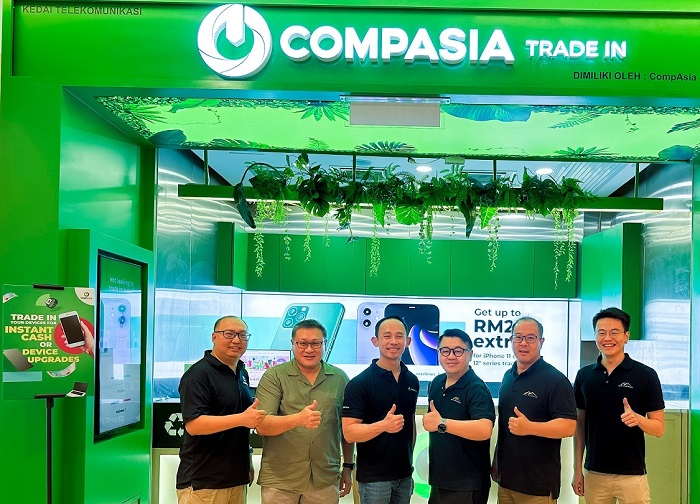
The round backed a business already combining device transactions with financing options. Its plans included deeper regional reach. Lim’s stated ambitions connected affordable devices with reducing electronic waste, putting the buyer’s budget and the life of the hardware in the same conversation.
In a later company account of the funding, CompAsia described spending on people, training, operations and digital assets. Those categories are a useful antidote to the glamour of the announcement. Investment becomes consequential when it turns into capabilities: someone trained to do the work, systems that support them, and a customer who receives what was promised.
That account also described plans for more physical branches. The storefront in the photograph was part of an operating direction, rather than merely a convenient backdrop. Capital and counters were beginning to appear in the same chapter of Lim’s story.
The internet acquires a front door
By July 2026, Lim’s radio conversation about CompAsia included an 85-store retail footprint. The discussion covered how physical locations could acquire customers and source devices alongside the online business. A company whose early attempts included selling online was giving people more doors to walk through.
The apparent reversal becomes easier to understand when the object is secondhand. Buyers may want to examine the particular unit they are considering. Sellers may want someone to explain an assessment. Physical retail gives those conversations a location. It also gives the operator the continuing task of making the location earn its keep.
CompAsia’s description of that interview emphasised AI grading, automated diagnostics and certified data wiping. These are tools for addressing questions specific to used hardware. What condition is it in? Does it work? What has happened to the previous owner’s information?
A store cannot answer those questions through lighting and signage alone. Consistent assessment has to support the conversation at the counter. For Lim, the retail expansion places the visible business and its less visible processes close together. A customer can judge both during the same visit.
The footprint discussed in Lim’s July 2026 interview. A dated snapshot of CompAsia’s retail expansion.
A listing belongs in the future tense
Lim’s next proposed milestone is a Main Market IPO on Bursa Malaysia in the first half of 2027. In March 2026, he outlined a fundraising target of RM400 million to RM500 million. Working capital, the ReNewNGo ownership programme and the connection between online and physical retail were among the stated uses.
The target has a history behind it. Back in 2020, Lim had already deferred earlier listing ambitions while continuing to build the company. Public markets have occupied a place in his plans for years. That makes it sensible to keep the latest proposed date attached to the proposal.
The more revealing question is what capital would allow the company to do. Stock must be obtained before another owner can buy it. Payment programmes extend the relationship beyond the day a device changes hands. Stores create obligations that continue after the opening photographs. Growth makes those ordinary details more consequential.
Lim’s story began with the discovery that a reasonable plan could still be difficult to sell. It now reaches a stage where selling the plan involves bankers as well as customers. Between those audiences sits the work that has followed him from the beginning: making a used device worth buying again.
The first version of CompAsia needed revising. Lim kept the business open to revision. For someone whose working life revolves around second uses, it is an appropriately practical habit.
Keep the conversation going
- Julius Lim on LinkedIn
- CompAsia’s website · Newsroom
- Listen: Lim on the used-phone opportunity, October 2018
- Listen: the 85-store decision, July 2026
- The early CompAsia story, November 2018
- Lim’s proposed IPO and retail plans, March 2026
- Watch CompAsia’s videos on YouTube
- Company channels: LinkedIn · Instagram · Facebook
Company channels are listed separately from Julius Lim’s personal profile.
The second owner matters