A smartphone spends its first life being photographed, financed and fussed over. Its second life often begins in a less glamorous place: the back of a drawer, beside an expired passport and a cable for a camera nobody owns. CompAsia has built a regional company around that pause. The Singapore-headquartered business takes devices that owners, companies and retailers no longer need, works out what they are worth, clears the data, checks the hardware and sends each one toward another user.
That sounds like a used-phone store, but the shop window is only the visible end. Behind it sits a reverse supply chain that runs in the opposite direction from conventional electronics retail. Stock does not arrive in uniform cartons from a factory. It arrives one phone at a time, with different scratches, batteries, passwords, parts and stories. CompAsia's job is to make those mismatched objects legible enough to price, safe enough to circulate and predictable enough for someone else to buy.
Its customers stand on every side of the transaction. A consumer wants cash for an old handset. Another wants an iPhone without the new-iPhone bill. A telco or manufacturer wants a trade-in offer that nudges an upgrade. A retailer wants the same, without building a valuation and collection operation. A company wants hundreds of retired work phones securely wiped and monetised. A wholesaler wants graded stock in volume. CompAsia connects those needs, then tries to keep the margin created by moving a device from one context to another.
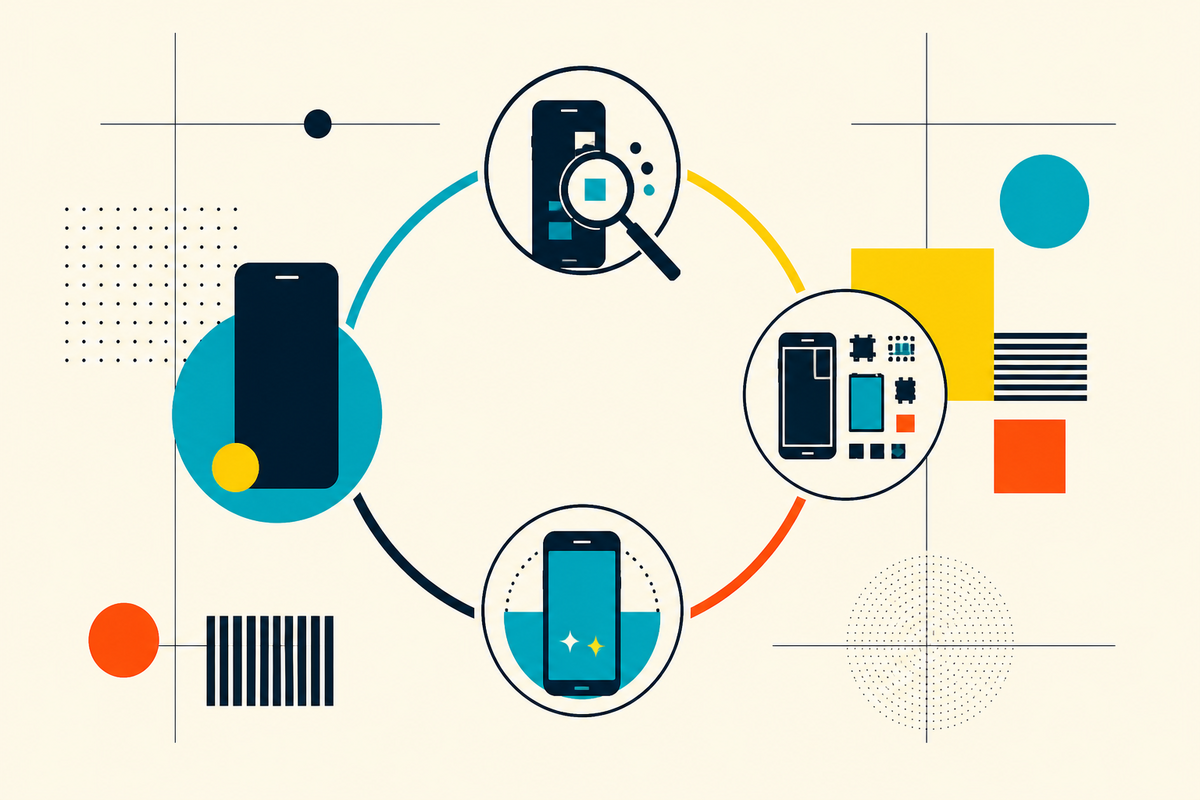
The product is certainty
Second-hand electronics have always been sold. What changes at scale is the amount of doubt that must be removed. Will the camera focus? Has the screen been replaced? Is the battery exhausted? Will the former owner's data survive the handoff? Does “good condition” mean a hairline scratch or a crater? A marketplace can introduce buyer and seller, but it generally leaves those questions between them. CompAsia inserts an operating process in the middle.
For consumer resale, the company advertises a 32-step quality check. Devices are tested for function, assigned a cosmetic grade and cleaned; its shopping sites say saleable units are fully functional and carry at least 80 percent battery health. Warranty and extended-cover options turn a one-off object into something closer to ordinary retail merchandise. None of these measures makes a used phone new. They make its imperfections describable, which is the more important commercial trick.
“We're here to transform how people view and interact with tech.”CompAsia's statement of intent
The same logic applies on the intake side. CompAsia offers trade-in through stores, websites and an app. The phone performs automated diagnostics, receives a quotation and enters a collection process. For corporate fleets, the language shifts from convenience to compliance: on-site service, certified data erasure, grading reports and residual-value recovery. A handset that looks like clutter to an IT manager becomes inventory once it has a verified identity, condition and clean data state.
More exits make better economics
Refurbishment is only useful if every device has somewhere sensible to go. CompAsia operates several exits. The cleanest consumer stock appears in country-specific e-commerce stores or physical shops across Malaysia, Singapore, Thailand and the Philippines. Businesses can acquire second-life fleets of smartphones, tablets and laptops. Tested and graded lots go to wholesale buyers, while lower-certainty “as is” inventory can be sold with the option to test functions or parts authenticity.
This range matters because used inventory is stubbornly nonstandard. Repairing every phone to the same cosmetic condition would waste money on some units and destroy the economics of others. Multiple channels let CompAsia match the cost of intervention to the likely value at the end. A pristine recent model can bear a warranty and retail margin. A scarred but functional handset may suit an enterprise deployment. A device with uncertain repair economics can move as a wholesale lot. The system is less a conveyor belt than an air-traffic controller.
The partner network makes the intake pipes wider. CompAsia names Apple and Samsung among brand relationships, telcos including Maxis and CelcomDigi, and retailers including Machines and Senheng. Samsung's Malaysian trade-in terms identify CompAsia as the party assessing value. Maxis has said its relationship began in 2021, with traded-in devices refurbished and reused or repurposed. To the customer, the trade-in may feel like part of the new-phone purchase. CompAsia is the machinery behind the button.
From ownership to access
Selling a device twice is a transaction. Keeping it in circulation through several owners starts to look like a platform. CompAsia's ReNewNGo plan, launched in 2024, adds that recurring layer. Customers make monthly payments and, after 12 payments, can upgrade, downgrade or return the device; ownership comes after 36 payments. The older ReNew+ offer spreads payments across 12 or 24 months without requiring a credit card, subject to local eligibility.
The appeal is financial, but the strategic value is control of the return path. A conventional sale loses sight of the handset until its owner decides what to do years later. A subscription creates a scheduled decision point and a possible stream of known devices coming back. That can improve supply visibility - the scarce ingredient in recommerce - while giving customers a lower monthly path to technology. In April 2026, CompAsia said ReNewNGo had about 20,000 subscribers and set a target of 50,000 by year-end.
Financing second-life hardware also reaches customers whom premium smartphones normally exclude. The company talks about affordability and e-waste in the same sentence because the two problems share a solution: extend the useful life of hardware whose largest environmental cost has already been incurred during manufacturing. The climate claim is not that delivery vans or repairs disappear. It is that another year of useful service can defer the demand for another newly manufactured unit.
A digital company opens the door
CompAsia's recent expansion has a decidedly physical shape. Founder and CEO Julius Lim said in April 2026 that the company had grown from five or six Malaysian shops in the prior year to roughly 70, with a target of 150 by the end of 2026. For a company that can quote a phone through an app, rows of stores might look like regression. In recommerce, they solve a specific problem: people like to see the exact used object they are buying, and many prefer another human to explain why the offered trade-in value changed after inspection.
Stores can collapse several moments into one visit: inspect an old phone, establish its value, apply that value against another device and attach a payment or protection plan. The company calls the strategy omnichannel. Less elegantly, it is a way to manage awkward conversations near the hardware. Those conversations are where trust is won or lost, especially when every scratch changes the price.
Three million transactions create a practical library of failure rates, resale prices, grading disputes, repair choices and channel demand. CompAsia's advantage is the judgment encoded in that operating history.
Where CompAsia sits
CompAsia occupies the space between classifieds and the manufacturers. Carousell and Facebook Marketplace offer breadth and direct exchange, but buyers often carry more of the inspection risk. Device makers and telcos can create compelling upgrade programs, but many do not want to operate every collection, diagnosis, wipe and resale route themselves. Traditional IT asset disposition firms understand secure corporate recovery, while repair shops understand hardware. CompAsia's proposition is that one regional operator can combine those capabilities and send inventory across consumer, enterprise and wholesale channels.
That breadth adds complexity. The company must forecast resale values while new models push old prices down, finance inventory while devices wait for buyers, manage fraud and data risk, and deliver consistent grades across markets. Warranties convert uncertain hardware into a continuing obligation. Physical stores add rent and staff. Subscription makes devices more accessible but increases exposure to credit, returns and residual values. Vertical integration captures more of the economics precisely because it accepts more of the operational headache.
The company reported about RM180 million in 2025 revenue from Malaysia and RM20 million in pre-tax profit, up from RM12 million the year before. It has floated a Bursa Malaysia Main Market listing in the first half of 2027, with a goal of raising RM400 million to RM500 million at an indicated valuation near RM2 billion. Those are ambitions, not completed outcomes. The planned uses - working capital, ReNewNGo and the physical-digital retail network - reveal the business's demands. Phones must often be bought before they are sold, and circulation consumes cash.
The most useful way to understand CompAsia is not as a destination for cheap phones. It is an attempt to make the second life of hardware behave more like the first: priced, warrantied, financed, distributed and supported through recognizable channels. The difference is that every unit begins as a small mystery. Solve enough of those mysteries, and the phone sleeping in a drawer stops being waste. It becomes supply.