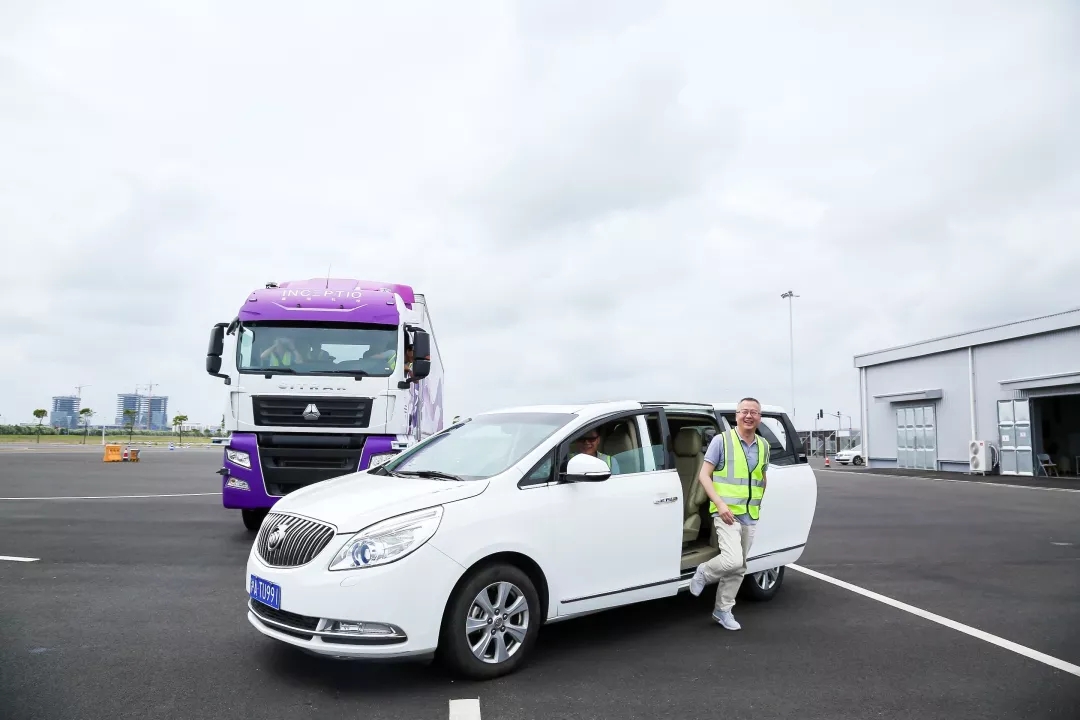
Julian Ma was in the small car. Behind it was the autonomous truck his company had brought to CES Asia in 2019. The car cut into the truck’s path; the truck detected the danger and applied its emergency brakes. Ma and Inceptio’s chief financial officer, Jielong Zhang, had taken seats in the car to demonstrate their confidence in the system. A founder can put his name on a presentation. This one put himself in the traffic.
The photograph from the demonstration has a pleasing lack of ceremony. Ma stands beside an open car door in a fluorescent vest, with a purple-and-white truck behind him. There is asphalt, an industrial building and plenty of sky. The future, on this occasion, has dressed for a warehouse visit.
The episode is a useful entrance to Ma’s work because it puts the abstract promise of autonomous driving into an unusually concrete arrangement. The software has to notice. The hardware has to respond. The vehicle has to stop. Confidence in any one of those things is insufficient when the others are absent.
A career before the company
Ma founded Inceptio in 2018 after a career that included Motorola, management consultancy, Tencent and the fleet technology business G7. He had already spent decades working across technology and corporate management, moving between China and the United States. He brought a substantial professional past to a company whose product still needed a future.
His training combined electrical engineering at Shanghai Jiao Tong University with an MBA at IMD in Switzerland. At Tencent, he became a corporate vice president with responsibilities spanning strategy, location-based services, search and autonomous driving. He also served on the boards of NIO, NavInfo and Zoox. That is a career with several routes into the automobile, including maps, software and the companies building the vehicles themselves.
By the time he started Inceptio, Ma had experience managing large research and development teams. That matters to the shape of the enterprise: an autonomous truck requires people who understand a machine, people who understand software and people who can make the two agree repeatedly. A good algorithm cannot negotiate every organizational disagreement on their behalf.
In a 2021 interview, Ma described experience as a way to recognize opportunities sooner. He also advised aspiring entrepreneurs to follow their interests and pay attention to people. Read alongside his career, the advice has a practical quality. Years spent inside established businesses can become preparation for choosing which problem deserves a business of its own.
The customer has a calculator
Ma’s early public explanations of Inceptio returned to the arithmetic of trucking. In a 2019 conversation with Robin.ly, he broke operating costs into fuel, drivers and depreciation, then described where automation could make a difference. His pitch attached autonomous driving to recurring expenses. Every journey supplied another occasion for the customer to check whether the promise held up.
There is an appealing severity to that customer. A logistics operator must move cargo, meet schedules and keep vehicles working. The purchase has to make sense after the launch event, when someone else is paying for diesel. Novelty enjoys a brief reception; the invoice has considerably more staying power.
At CES Asia, Ma discussed network effects alongside labor and fuel savings. He was interested in what happened when the technology spread through freight operations. A truck performs a journey, but a logistics business coordinates many journeys. The commercial ambition therefore reached beyond an individual vehicle’s ability to stay in its lane.
His company’s stated mission is to make line-haul logistics safer and more efficient, with a longer-term ambition to operate an autonomous freight service network. That ambition explains the choice of partners. Vehicle manufacturers and logistics operators have to participate because the invention must enter a production line and then earn its place on a route.
“an accelerating evolution”Julian Ma on L4 autonomy, 2025
A truck brings its own physics
Ma’s explanation of the engineering problem is refreshingly specific. In a January 2026 interview, he described how a truck’s changing weight, tractor-trailer connection and slower response complicate control. He also pointed out that traffic behaves differently around a heavy truck than around a passenger car. Lessons collected from one vehicle do not automatically describe the other.
That observation gives his work an awkward, productive constraint. The physical world refuses to become convenient merely because a software team has a deadline. A vehicle carrying a different load is still the same customer’s truck, yet controlling it may require a different response. The system must accommodate the variation without asking the freight business to stop being a freight business.
Inceptio’s technology includes long-range perception, planning and control, and fuel-saving algorithms. Its published specifications describe three-dimensional perception out to 400 meters and control designed around variable loads and the flexible connection between tractor and trailer. These are stated capabilities of the system, rather than a promise that every journey will be uneventful.
The product also includes emergency braking, lane control, speed and following-distance adjustment, and navigation-guided highway entry and exit. Redundancy extends to steering, braking and power supply. The list is useful because it reveals how much of autonomous driving is careful coordination. A truck needs several things to work together, and provision for what happens when something fails.
Commercial operations supply examples for further development. Diagram of the approach described by Inceptio.
From a demonstration to a delivery
Inceptio released its Xuanyuan autonomous driving system in March 2021 and reached series production of Level 3 trucks late that year. In 2022, it received a Chinese permit for public-road testing of driverless heavy-duty trucks. These milestones describe different steps: a production vehicle, a testing permission and the ongoing work of deployment.
For Ma, manufacturing is part of the strategy rather than a task postponed until the software is finished. Inceptio develops its system in cooperation with truck makers so it can be installed in production vehicles. The business depends on repeatability. One demonstration truck can command attention; a production program has to survive purchasing, assembly and the customer’s next order.
At the Next Truck conference in Berlin in 2025, Ma presented the company’s two-track approach: use commercial deployment to generate data while developing higher levels of autonomy. Inceptio reported more than 4,000 L2+/L3 trucks and over 400 million commercial kilometers at the time. It also reported typical customer payback periods of 10 to 24 months.
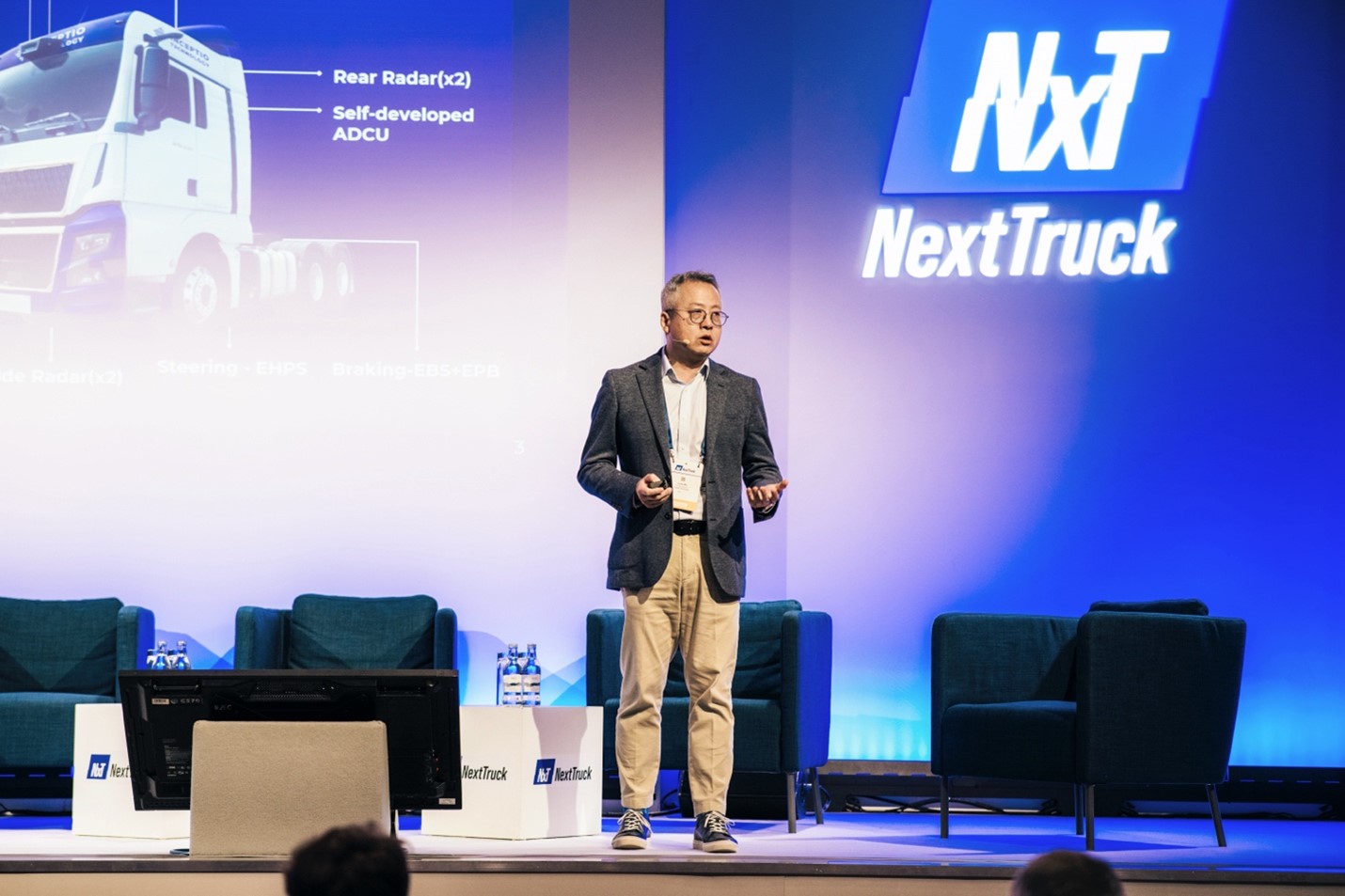
Those figures are company-reported operating results. Their significance to Ma’s argument is the connection between use and learning. Customers receive a product they can deploy, and the resulting journeys provide material for development. The route carrying today’s shipment can also help the engineers understand tomorrow’s difficult situation.
The distance between launch and habit
The conversation gets bigger
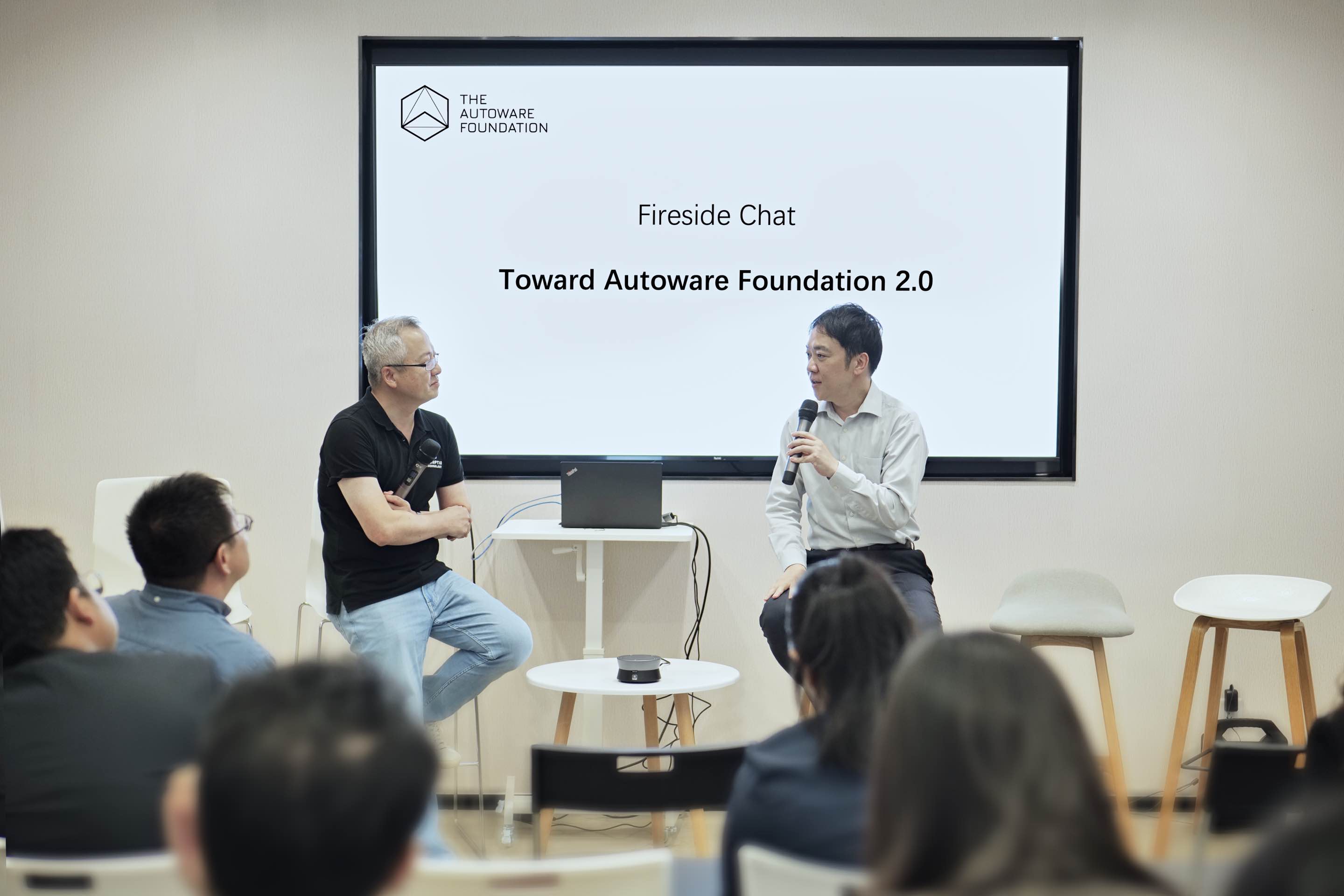
In June 2025, Ma hosted the Autoware Foundation’s China meetup at Inceptio’s Shanghai headquarters. More than 60 participants from 40 companies attended. He discussed integrating Inceptio’s system with the foundation’s open-source platform and joined Autoware founder Shinpei Kato for a conversation about international talent, regional development hubs and relationships with vehicle manufacturers.
The scene offers another view of the founder. Six years after the fluorescent vest and the braking demonstration, there are microphones, chairs and a room of collaborators. Ma’s work now includes connecting an established commercial program with a wider development community. The partnerships have become part of the product’s path into other markets.
By September 2026, Inceptio announced that its system had exceeded one billion kilometers of commercial autonomous driving. It also described work with JD Logistics on heavy-duty Level 4 demonstrations carrying commercial cargo, and public-road driverless light-duty pilots with SF Express. The company reported selection for a pilot at the Port of Antwerp-Bruges, extending the story into European freight.
The geography adds obligations as well as opportunities. Inceptio has described international work in Europe, Japan and the Middle East, where the technology must be validated for local roads, rules and operating conditions. A system’s accumulated experience is valuable, but a new market asks questions in its own accent.
The ambition is a routine journey
A September 2026 account of a TV Tokyo report followed a truck driver on an approximately 800-kilometer trip from Shandong to Shanghai. The driver said the system handled more than 90 percent of the route. He remained responsible for supervision. It is a useful picture of the present: a commercial journey, substantial automated driving and a person still in charge of watching.
Inceptio’s future plans include commercial operations without a driver in the cab around 2028. That remains a target. The company’s existing commercial mileage includes assisted and conditional automation; the billion-kilometer figure should be read with that distinction intact. Ma’s approach depends on using today’s operations to develop a further capability.
The change from the 2019 demonstration is therefore both large and unfinished. A test once needed the founder sitting in the car ahead. Now, shipments provide the repeated examination. For Ma, the next achievement will have to pass through manufacturing, regulation and the decisions of customers who need their goods delivered.
There is a modest-looking destination inside that considerable ambition. The truck arrives. The cargo is unloaded. Someone schedules the next trip. The scene is ordinary enough to escape attention, which may be the most demanding outcome Ma has chosen: technology that earns its keep after everyone has stopped gathering to watch it.