Julia Hasenzahl used to send her husband photographs of server racks. As each rack filled, another picture went out. She and her business partner, Trevor Allen, had invested so much money and feeling in ProSearch that the equipment became a family joke: these were their children. Some founders preserve their first dollar. Hers came with a power supply.
The anecdote has a companion worth keeping. Asked what advice she would give her earlier self, Hasenzahl answered, “Let people help you more.” Affection for a business can become an expensive reason to carry everything yourself. She acknowledged that she and Allen might have taken more opportunities if they had shared the load.
An operator before she was a founder
Hasenzahl’s route to the chief executive’s chair passed through the machinery of other organizations. During nine years at Ernst & Young, she held practice and client support roles, including national responsibility for an enterprise-wide shared service function. These are jobs concerned with how a large institution actually runs, a subject seldom improved by a glamorous title.
She subsequently became chief operating officer of BMC Group, which provided legal and compliance support services. Joining while it was still a startup, she built service delivery teams and processes as the business grew. BMC appeared on the Inc. 500 following its growth in 2003. Her later responsibilities at ProSearch would combine long-term direction with day-to-day operations. The distance between a strategy and its execution was already familiar territory.
The invoice becomes part of the design
Hasenzahl co-founded ProSearch with Trevor Allen. In 2009, they introduced a fixed-fee managed service for corporate discovery portfolios. That choice mattered to the work itself: technology and services could be applied across matters without selling each intervention separately. An annual arrangement made room for a continuing relationship with a corporate legal team.
The arrangement required shared risk. Hasenzahl described years when twice the expected data arrived, and others when the volume was lower. Clients and provider could examine experience across several years. Predictability did not arrive by wishing uncertainty away; it required a willingness to manage it together.
That operational thinking also reached data reuse. Records about collection and handling helped establish whether material could be used again with confidence. It is a pleasantly unromantic idea: yesterday’s careful record keeping can spare tomorrow’s repeated work. The commercial model and the process supported each other. A useful improvement could become part of the service rather than another item awaiting permission.
AI enters through the working door
By January 2019, ProSearch had announced a partnership with NexLP to add artificial intelligence to its analytics portfolio. The intended applications included early case assessment, fraud investigations, compliance, and information governance. Hasenzahl paired the technology announcement with an emphasis on the people applying it: human expertise belonged in the same sentence as software.
This provides a useful date in her story. AI was already part of the company’s work years before the current generative AI conversation. The practical questions had recognizable shapes: what can a team learn from the data, where should it look, and how does that help a client? The vocabulary would change. Those purposes would remain legible.
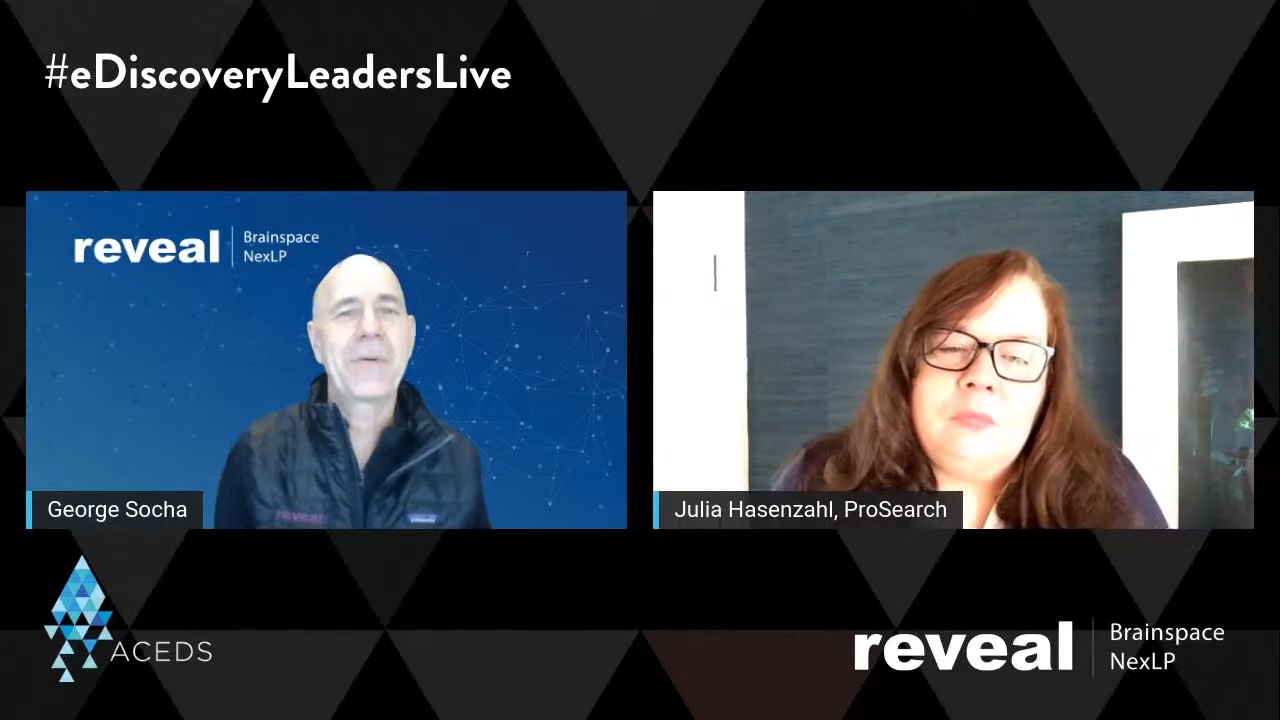 ▶ Watch the conversation
A weekly question with room for an honest answer
In 2016, ProSearch began a weekly employee happiness survey. Hasenzahl said the proposal was sufficiently unlike her usual personality to surprise the organization. The questions reached into satisfaction with work and opportunities for creativity; anonymous responses could be examined at team level.
The aim was to understand conditions and respond where possible. A perfect participation rate or universal happiness would have missed the point. Her willingness to adopt an unfamiliar management tool gives the server-rack story a second meaning. Building the company also meant learning how the people inside it experienced their work.
An entrepreneur joins the conversation
In May 2022, Hasenzahl was listed among the speakers for the Women in eDiscovery conference’s entrepreneur session in San Diego. The TED-style talk brought her together with Ariana J. Tadler of Tadler Law and Amy Juers of Edge Marketing. The program gave entrepreneurship its own place alongside the conference’s technical education.
Her public participation also extends to questions of who gets to advance. On LinkedIn, she shared plans to speak at SOLID East about changing how diversity is measured, and at another SOLID gathering about reframing the future of work. These are questions a growing services company eventually has to answer in practice: whose contribution becomes visible, and what does a useful career look like when the work changes?
“Let people help you more.”
Julia Hasenzahl / advice to her earlier self
A new shareholder, and a larger to-do list
In October 2023, Consello Capital acquired a majority stake in ProSearch. The transaction was the private equity firm’s first investment. ProSearch then had more than 200 employees and operations in the United States, Ireland, and India. Financial terms were undisclosed.
Hasenzahl’s stated ambition for the partnership was specific: grow the company and rethink discovery and review using generative AI. She pointed to Consello’s corporate connections and experience as reasons for the choice. The founder who once photographed each additional rack was discussing the next stage with an institutional partner.
The following June, ProSearch announced Chris Dahl as chief revenue officer, alongside expanded responsibilities for company veterans Matt Davidson in client partnerships and Kenneth Spencer in client services. Hasenzahl described the changes as adding breadth and depth to the leadership team. Growth was acquiring an organizational shape, with client relationships and delivery each receiving explicit attention.
Her answer to the AI skills question: read the data
Hasenzahl is a founding member of the Legal Data Intelligence project, an initiative that places legal data work in a broader professional frame. Her involvement connects the company she built with an effort involving practitioners across the industry. The audience for her operational experience now stretches beyond her own organization.
At Relativity Fest London in June 2024, her contribution to a panel on the model returned to data literacy. She discussed the ability to read data, turn it into information, and then evaluate and analyze that information before acting. Her formulation keeps a demanding human task at the center of an increasingly automated workplace.
It is a useful distinction in a room full of new tools. Access to an answer is only part of the job. Someone still has to decide whether the answer is meaningful, what it leaves out, and what to do next. Hasenzahl’s emphasis puts responsibility squarely with the person making that decision. The software demonstration ends; the judgment continues.
- ReadUnderstand the data.
- EvaluateQuestion the information.
- ActApply professional judgment.
A curriculum for work that keeps changing
In September 2024, Hasenzahl and Ashley Christakis were scheduled to present a SOLID New York session on meta-skills and the move from current practice to what comes next. By December, the pair had joined Jeremiah Weasenforth for David Cowen’s Legal Data Intelligence podcast. Its subjects included adaptability, strategic thinking, problem-spotting, and the value of experience.
The conversation treated professional development as a design problem of its own. Existing processes need improvement while new uses of legal data demand different ways of thinking. For a leader whose career began in service operations, that is a recognizable tension: keep today’s work dependable while preparing people for assignments that have yet to settle into job descriptions.
At Legalweek in March 2025, she joined a panel on ten essential skill sets for corporate legal departments, with participants from Nextdoor, UL Solutions, Edward Jones, and FedEx. In June she moderated an ACEDS webinar on the same theme. The advertised territory included analytics, AI, strategic thinking, and collaboration across functions. Her calendar was giving the skills argument repeated, practical outings.
The new tools still have old obligations
ProSearch’s March 2025 product updates put that discussion beside concrete changes in delivery. WorkStream expanded support for modern collaboration data, including Microsoft Copilot material. Data Insights combined generative AI, analytics, and data science. Essential Review applied AI workflows and automation to document review, with RelativityOne supporting the broader offering.
The list describes several kinds of work, rather than a single miraculous button. Conversations, attachments, patterns, review decisions, and platform operations present different demands. Hasenzahl’s announcement emphasized collaboration and client trust. The product names were new; the dependence on an organized service around them was familiar.
In October 2025, ProSearch announced its Relativity aiR for Privilege competency, adding to earlier competencies in aiR for Review and Data Migration. Privilege review is an exacting application for any efficiency claim: sensitive material has to be handled with care. Hasenzahl framed the recognition in terms of identifying that content and reducing client risk. Automation was being discussed against a particular responsibility, with a particular kind of consequence.
2019NexLP AI partnership
2026Expanded Relativity aiR investment
Another investment, the same practical question
In September 2026, ProSearch announced an expanded agreement with Relativity and increased investment in Relativity aiR. Hasenzahl’s explanation concentrated on practical uses: reaching facts sooner, working more efficiently, and giving clients better command of their legal data. Cloud technology and AI workflows occupied the center of the company’s stated strategy.
By October, The ProSearch Pulse was carrying her invitation to join the conversation about current developments in legal technology. Her public work continued to sit close to the friction between emerging tools and everyday professional obligations.
There is a straight line here, though it passes through some decidedly unglamorous places: shared services, delivery teams, pricing arrangements, data records, and skills discussions. Hasenzahl’s career gives those subjects their due. The racks in the early photographs held equipment. The business that grew around them depends on people who can decide what all that equipment should accomplish.