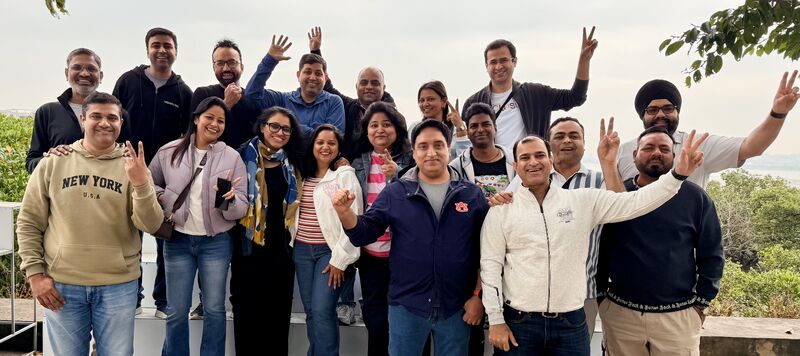
Mandeep Baweja took the leadership team to Vietnam. There were four days away, conversations over coffee, and photographs in which the usual corporate dress code had sensibly surrendered. In one, colleagues crowd into a boat wearing orange life jackets. In another, the group poses outside beneath the trees. A strategic plan rarely has such agreeable scenery.
When he described the trip in January 2026, Baweja made the connection to work himself. Listening, challenging one another, and agreeing on priorities were the business of the offsite. The setting supplied a change of perspective. His account was cheerful enough to include a joke about discovering that strategy could survive outside a conference room. One imagines the conference room took the news with dignity.
The episode offers a useful entrance to Baweja, co-founder and CEO of Trexo Global. He works in intellectual property technology and services, where the vocabulary can become technical before the coffee has cooled. Yet his account of building a company begins with people getting comfortable enough to think together. For a business selling improvements to how work gets done, that is an apt place to begin.
Before the founder’s title
Baweja came to entrepreneurship with a substantial operating career behind him. His earlier employers included Daksh, IBM, and WNS. People management, business strategy, and operations occupied the first stretch of that career; intellectual property became the focus of the next. He has described work involving business turnarounds and international expansion. The recurring responsibility was making organisations function across teams and markets.
At CPA Global, he served as managing director for India and global head of IP filing and prosecution services. The role put him close to the machinery supporting law firms and corporate departments: the people and procedures that help move an intellectual property matter forward. His official Trexo biography credits him with helping build a large international filing and prosecution support operation.
This history gives his present work a particular texture. Baweja had managed the service side of the problem before becoming a founder selling technology into it. A workflow diagram represents a familiar working environment for him. Behind its arrows sit assignments, reviews, handovers, and colleagues whose day becomes longer when the arrows lead nowhere useful.
- Daksh · IBM · WNSPeople, strategy, operations
- CPA GlobalIndia leadership and global IP services
- Trexo GlobalCo-founder and CEO
An argument he was making in 2018
In May 2018, while leading CPA Global in India, Baweja spoke about the conditions innovation needs to become commercially useful. He saw an increasingly entrepreneurial generation of technically educated Indians. Graduates who once aspired to join an established technology company might now want to build a company themselves. Intellectual property, in his account, had a role in helping those ideas earn their way in the world.
His optimism came with a practical requirement: an environment that supported the creation and enforcement of IP. He pointed to lessons India could draw from other countries. The ambition extended beyond filing more paperwork. It concerned the ability of people with ideas to protect and commercialise them, including outside their home market.
Read beside his later work, the argument has a clear continuity. Innovation needs an operating system around it: institutions, processes, and people capable of carrying an idea through formal requirements. Baweja’s career has stayed close to that supporting work. The invention may attract the applause; someone still has to make sure the documents reach the right place.
The small task is a serious business
At Trexo, that concern takes the form of software and professional support for IP teams. The company’s products are organised around individual jobs. Its modular approach allows customers to address selected processes alongside their existing systems. For a founder with an operations background, this is a legible proposition: find the recurring difficulty, then give the people doing the work a better way through it.
Baweja publicly introduced JUNE in January 2025. Its current capabilities include verifying patent and trademark information, preparing documents, retrieving records, and helping with references. Some of its tasks are gloriously specific. Generating forms in bulk may lack the glamour of a product launch photograph, but glamour has never been especially good at completing forms.
The specificity matters. A professional can recognise a task they do every week and ask whether the software handles it well. That makes the promise open to inspection. In Baweja’s business, usefulness has to survive contact with an actual case file, an actual user, and an ordinary working afternoon. The product name can be memorable; the output still needs checking.
A second look, built into the work
Data Risk Manager addresses another part of that afternoon: checking the information on which the next action depends. Trexo describes the product as automated quality control for IP data and says it uses more than 65 proprietary algorithms to identify possible errors. That figure describes the company’s checking tools. It does not tell a customer how many errors their own records contain.
For Baweja, the appeal of this territory is consistent with the service operation he previously helped build. Filing and prosecution support depend on details moving reliably between people and systems. A product that flags a questionable entry intervenes in that chain. The commercial question becomes wonderfully concrete: what did the check catch, and what does a person need to do next?
There is room here for a measured kind of ambition. Better checking is a less theatrical claim than reinventing an entire profession. It also gives a founder something specific to discuss with the people who use the tool. Trexo’s combination of software and specialist services keeps both parts of that conversation within the same business.
The company keeps hiring people
Baweja’s public activity supplies a useful companion to the product announcements: recruitment. In July 2026, he shared an expansion of Trexo’s IP operations team. The accompanying company notice advertised 50 openings in Noida, covering patent and trademark docketing, paralegal work, and proofreading. The number was a hiring target, rather than a statement that 50 people had already joined.
Those job descriptions make the work tangible. Docketing, proofreading, and paralegal support are named disciplines with their own experience requirements. They also show the human work being recruited alongside the company’s automation products. Anyone trying to understand Baweja’s approach should keep the recruitment notice beside the software brochure. Each explains part of the operation.
An earlier appeal sought a recruiter with connections beyond job portals, including campuses and professional networks. Baweja was asking for someone able to find people through conversations and relationships. That is a revealing detail for a CEO whose company deals in process improvement. Even a carefully designed process needs someone good enough to recognise the person it ought to bring in.
A place at the table for the numbers
By August 2026, another hiring appeal turned to financial planning and analysis. Baweja said Trexo was being built for scale and wanted a commercially minded finance leader who could help shape growth. His emphasis fell on interpreting numbers and challenging decisions. The company’s advertisement placed the role in Noida and sought an experienced chartered accountant.
A finance vacancy is rarely treated as a character sketch. It can nevertheless say something about what a founder wants around him. In this case, Baweja explicitly invited a prospective colleague to question the thinking behind the business. The invitation was for participation in decisions, with reporting serving that larger purpose.
The next phase of a company often appears first in such ordinary documents. A job description has to say who is needed and why. Baweja’s public search puts financial judgment alongside the technical and operational skills already associated with Trexo. Ambition, it seems, will have to bring a spreadsheet. The spreadsheet may even be allowed an opinion.
Recognition, with the team in the picture
In March 2026, Baweja announced that Trexo had received an award for Excellence in Global IP Transformation at the ET NOW Business Conclave. He congratulated Bikram Sethi and Ankur Srivastava, who received it for the organisation. In explaining its significance, he put human involvement alongside AI, specialist knowledge, and data.
Sethi, Trexo’s co-founder and chief operating officer, and Srivastava, its co-founder and chief product officer, recur in Baweja’s public updates. Christopher Burger, the commercial leader on the team, also appears in those conversations. These are the colleagues around whom the company’s operating, product, and customer responsibilities are organised.
The award is a milestone in the company’s public account of itself. Baweja’s response also brings the story back to the group photographs from Vietnam. Both place colleagues in the frame. A founder’s title is singular; the work described around it plainly involves a number of people, with different responsibilities and plenty to discuss.

A gardener with a global diary
There is a less formal portrait of Baweja in his PeopleBOT biography. Alongside his experience leading teams and business transformation, it describes a father who enjoys gardening, loves dogs, and travels to unwind. Those details give the professional itinerary some domestic company. A garden has a useful way of interrupting the belief that every living thing will respond to an urgent email.
His education includes the Indian Institute of Management Calcutta and the Swedish Institute in Stockholm. His professional profile places him in the New York City metropolitan area, while Trexo’s operations and recruitment connect him closely with India. Travel belongs to both the work and the leisure sides of his biography, though the reasons for packing presumably differ.
None of these details requires turning a hobby into a management theory. Gardening can simply be gardening. Dogs can be enjoyed without being recruited as metaphors for loyalty. They make room for an ordinary person around the executive role, which is often where a profile becomes more interesting.
“The customer is the hero of our story.”Mandeep Baweja
The customer gets the starring part
Baweja has expressed his leadership priorities with an unusually useful allocation of attention: “The customer is the hero of our story.” His stated principles include clear communication, following through, accepting feedback, and recognising other people’s contributions. The ambition for Trexo is broad support across the IP lifecycle. The everyday test remains whether that support helps a customer finish the work.
The result is a portrait built from fairly concrete things: an international operating career, software for recognisable tasks, colleagues recruited into named roles, and four days away to talk about where the company should go. Baweja’s version of ambition has room for the people who carry it out. It also appears to have room for coffee with a view. That seems a civilised concession to make on the way to the next deadline.