A patent portfolio has an awkward relationship with the people who create it. An inventor wants to invent. A finance chief wants a budget. An attorney wants a defensible claim. Somewhere between them sits a disclosure form, waiting for someone to fill it in. D. Bommi Bommannan has spent much of his career moving between those desks. In 2004, he founded MaxVal to help companies manage what happens after an idea begins its journey into intellectual property.
His route into that business began on the inventor’s side. As a graduate student, he encountered patents through his own work. He went on to become a research scientist, a patent agent and a patent attorney. Each role put the same object in a different light: an invention could be a technical result, a legal claim, a commercial asset or an administrative responsibility. Bommannan’s eventual company would work across those boundaries.
There is a pleasing complication in this career. Someone with a doctorate and a Stanford law degree might reasonably be expected to make things more elaborate. Bommannan’s published argument for better patent operations runs in the other direction. Give people clear goals. Make the routine work easier. Ask for less information when less will do. The paperwork, apparently, need not enjoy the same educational advantages as its designer.
First, he was on the other side of the form
Bommannan studied chemical engineering at Anna University and the Indian Institute of Technology, Kanpur. In 1990, he completed a doctorate in the joint bioengineering program at the University of California, San Francisco and the University of California, Berkeley. His legal education followed at Stanford, where he earned his J.D. in 1998 and belonged to the Order of the Coif.
His working life included research and management positions at Merck, Cygnus and Alza. Patent practice took him through Bay Area firms including Morrison Foerster, Cooley Godward and Thelen Reid & Priest, as well as in-house work. Before MaxVal, he co-founded NTERO Surgical with backing from Menlo Ventures and served as its CEO. That earlier venture brought the practical duties of raising capital, assembling a team and developing products.
By the time he started MaxVal, he had accumulated experience of invention, representation and company building. The progression matters because a patent system has several customers within one organization. A researcher submitting an idea and an executive deciding where to spend money may need answers from the same underlying information. Their questions, however, are rather different.
MaxVal began with the aim of improving patent lifecycle management and realizing value from patents. The combination of services and software gave Bommannan a business in which the legal work and the machinery around it could be considered together. It also gave his varied background a common destination: making a portfolio useful to the organization that owns it.
The inventor who would rather be inventing
In a 2020 essay on patent portfolio development, Bommannan addressed a problem that will sound familiar to anyone who has ever postponed an internal form. Inventors may need encouragement to submit disclosures. His proposed remedies included measurable goals, incentives and a submission process requiring very few clicks and only essential information. Administrative enthusiasm was not a prerequisite.
He allowed room for rewards as varied as money, merchandise and recognition on an online portal. Even bragging rights had a place. It is an unusually human detail in a discussion of intellectual property operations: a system can accommodate the simple pleasure of having colleagues see your name. The software may be technical; participation still involves people.
“The easier the submission process is, the more often inventors will submit inventions.”
D. Bommi Bommannan, 2020
That observation helps explain his interest in the mechanics surrounding an invention. A disclosure process stands between work already done and decisions still to come. Removing unnecessary steps gives the person with the idea fewer reasons to delay. Bommannan’s prescription starts with the behavior a company wants, then asks whether its process makes that behavior convenient.
He also argued that patent priorities should be established with business executives and the general counsel. Goals would guide budgets, and measurements would show whether work was progressing. The approach gives the patent department a conversation it can have with the rest of the company. How much has been spent? What has been accomplished? Does the portfolio reflect the business? These are questions an executive can use.
A dashboard needs something worth counting
Bommannan’s essay was specific about the measurements. Departments could track the time needed to process disclosures, applications filed, patents issued and performance against budget. Outside counsel could be assessed on work quality and billing. A useful metric, in his account, should connect to a goal and suggest what to do when the result departs from the target.
That last requirement gives the argument its bite. A number displayed attractively can still leave its audience stranded. Bommannan wanted measurements that supported decisions about people, processes and resources. He also made room for changing priorities: when a business shifts direction, the measures used to assess its patent activity should shift with it.
The distinction is especially relevant to a founder selling technology to professional users. A feature list can demonstrate what a product contains. It takes a closer understanding of the work to explain why a feature belongs there. Bommannan’s writing provides that operational context, down to the reluctance of an inventor faced with another request for information.
In 2016, the pieces acquired a name
MaxVal publicly launched SymphonyIAM in September 2016. Its scope included invention management, docketing, portfolios, workflows, annuities, forecasting, analytics and reporting. A data synchronization component gathered information from public and private sources, including patent prosecution records. The product brought activities that could otherwise be handled separately into a shared platform.
Bommannan described three intended outcomes at launch: users should understand the assets they held, have ways to analyze and manage them, and produce reports for stakeholders. The sequence is sensible. Before a portfolio can support a decision, someone needs a dependable view of what is in it. Software has its work cut out before it gets to the impressive charts.
The 2018 Symphony 1.5 release made that practical ambition more concrete. Built on Salesforce’s Lightning platform, it added configurable invention review tools, committee scheduling, data checks, cost projections and expanded analytics. Those details connect the product to the situations Bommannan later described in his essay: reviewing an idea, allocating resources and checking whether expenditure follows the plan.
The client across the table becomes a partner
In January 2022, MaxVal announced a partnership with Baker McKenzie to extend Symphony’s capabilities for law firms. The expansion included support for different client arrangements, client-specific workflows, billing and time-management integrations, dashboards and access controls. A platform serving corporate owners of intellectual property was being adapted for the professionals serving many such owners at once.
It was a move with a recognizable connection to Bommannan’s own career. He had worked inside companies and at law firms; the partnership addressed the relationship between those environments. The requirements were more intricate than simply putting another customer’s name on an account. Different clients could require different processes, while a firm still needed to run its own operations coherently.
Ben Allgrove, Baker McKenzie’s partner and chief innovation officer, described MaxVal as understanding the firm’s goals. For Bommannan, the partnership offered a way to develop Symphony with a law firm’s needs in view. His earlier experience on both sides of the relationship had become relevant to the direction of the product.
A business with more than one time zone
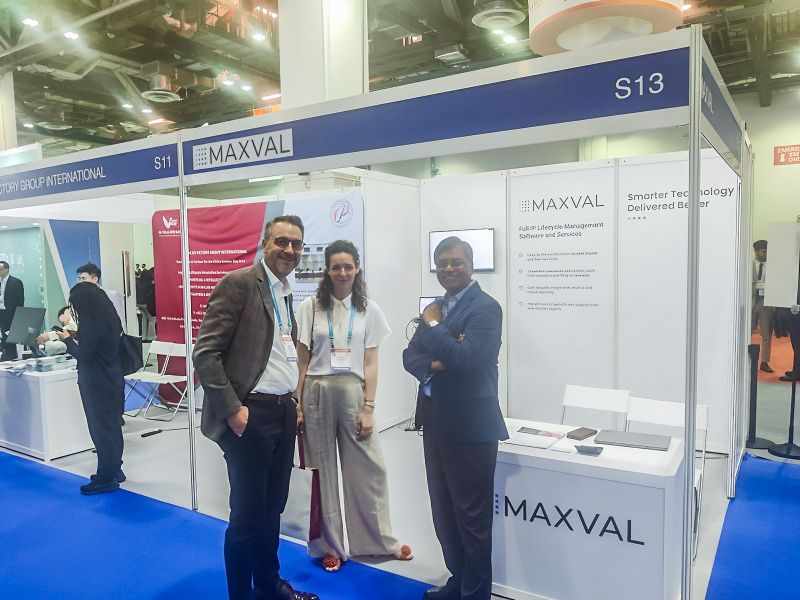
The company’s expansion also required people and places. In March 2022, MaxVal announced an office in Noida, its fourth Indian location after Bengaluru, Chennai and Coimbatore. At that point, the company reported more than 400 employees worldwide and more than 600 customers. These are figures from that announcement, a dated snapshot of the business Bommannan had started in 2004.
He explained the Noida choice in terms of available intellectual property expertise and the ability to support customers globally. Geography entered the story as a practical resource. The work needed people who understood it, and the office gave the company access to another pool of them. Expansion followed the same concern with matching resources to requirements that appeared in his writing.
In November 2023, Bommannan opened MaxVal’s first virtual user conference with a company update. The two-day program included product feedback, customer discussions and sessions on services and patent trends. It put users into the conversation about the systems they relied on. For a company developing professional software, that conversation is part of the work.
The next idea still has to get through
By May 2025, MaxVal had integrated Relecura’s NoveltyAI and ClassifierAI into Symphony for patent research and classification. That month also brought Victoria Friedman and Shawn Duckworth to the affiliated Convergence IP Law, where Bommannan serves as CEO and patent attorney. The developments extended the mix of software, analysis and legal expertise around his original business.
His own professional reach includes chairing Relecura’s board. In September 2026, MaxVal added Michael Flannery as chief revenue officer, with responsibility for global sales and customer relationships. The organization continues to develop around a founder whose career began with an inventor’s encounter with patents and expanded into the systems used to manage them.
For all the changes in tools and titles, the small disclosure form remains a useful way into Bommannan’s story. Someone has an idea. Someone else must evaluate it, fund it, protect it or explain its value. His career follows those handoffs. The modest ambition of making them easier has given him a considerable amount of work.