The name was easier than the problem. Chai, Joshua Meier explained during a 2026 conversation, stands for chemistry and AI. The office also has a taste for the beverage. There are chai-themed things around, he said, with the faint pleasure of a founder who knows a joke has survived contact with a serious company. The field around him tends to favor names that sound like complicated molecules. He wanted something people could say without pausing to breathe.
By then, the company had announced work with some of the world’s largest drugmakers. Its models were being used to design molecules on computers, and its founders were talking less about the possibility of the science than about whether the tools would keep working for partners. That sounds like a routine change in a startup’s life. For Meier, it was the point of a long route through labs, model research and a company he had once decided it was too early to build.
He had been interested in biology since his teens, when his high school had a stem cell lab. At Harvard, he studied computer science and chemistry. He met Jack Dent in CS125, a demanding computer science class. Dent would go on to Stripe; Meier would go toward AI research. Their eventual partnership was built from two different kinds of fluency: one in models and molecules, the other in software products and company building.
A language with no dictionary
Meier joined OpenAI in 2018, during its nonprofit years. Language models were beginning to show how much they could learn from large collections of text. If a model could absorb patterns in English or another human language, he wondered, could it do the same with the strings that describe proteins? Those strings are sequences of amino acids. Their order helps determine what a protein does and how it folds. The analogy to language was useful, if imperfect: life had accumulated an immense archive of examples, but no tidy grammar book.
He moved to Facebook AI Research, later part of Meta’s FAIR organization, to work on the question. A team including Meier trained a model on 250 million protein sequences. Their paper, published in 2021, reported that the model learned information connected to protein structure and function from sequence data alone. The number is striking. More interesting is what the work suggested: a machine could extract regularities from biological examples without being handed a separate rule for every one.
A research result is an invitation, not an industrial process. Meier later became chief AI officer at Absci, an AI biotechnology company. The years mattered because the problem he wanted to solve kept changing. Models got better at predicting structures. Generative methods became more capable. A system that could tell a scientist something about a protein began to look, cautiously, like a system that might help propose a new one.
There was also a conversation that did not immediately become a company. After Meier left OpenAI, Sam Altman contacted Dent about the possibility of working with Meier on a proteomics venture. Dent was interested. Meier judged that the technology was not ready. It is tempting to make every founder’s origin story a lightning strike. This one includes the less cinematic skill of waiting.
The meeting at Matt’s house
In a later interview, Meier recalled an early discussion at Matthew McPartlon’s house. McPartlon was showing results on predicting the structure of antibodies and the targets they bind. For a long time, researchers had considered that task particularly difficult. If a system could not predict what an antibody looked like in context, Meier asked, how could it design one? The results suggested an answer might be getting closer.
In 2024, Meier, Dent, McPartlon and Jacques Boitreaud founded Chai Discovery. The company began in San Francisco, working for a time from OpenAI’s offices. Their roles combined model research, applied science, product and commercial experience. The timing was a judgment about the science. Meier had watched the methods move from interesting prediction toward possible design; now a company might build a useful tool around them.
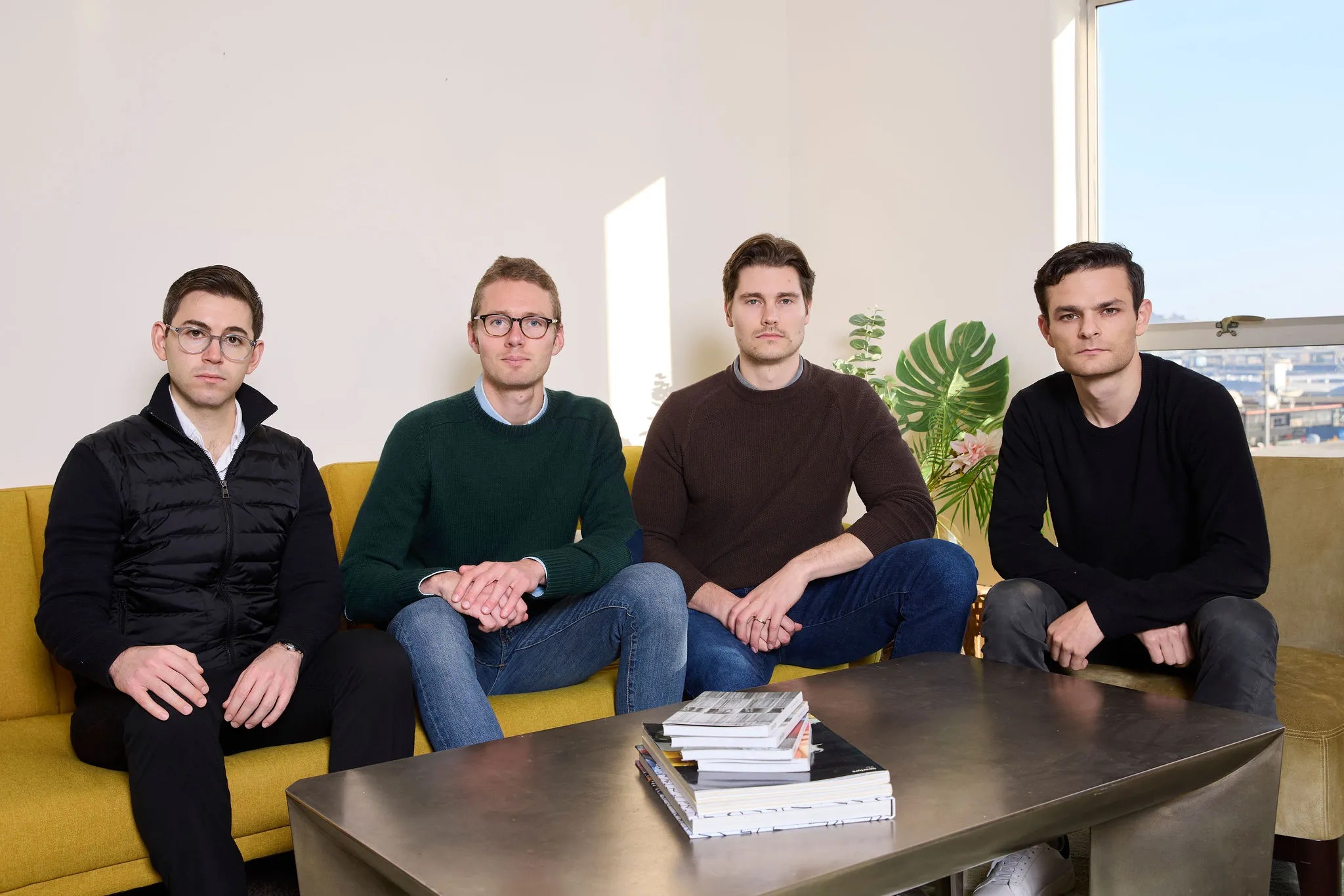
Chai’s first public model, Chai-1, arrived in 2024. Chai-2 followed in 2025 with reported double-digit success rates for designing antibodies from scratch against tested targets. In a 2026 conversation with Sequoia Capital, Meier and McPartlon described a shift from a hit rate below one tenth of one percent to 16 percent. These figures describe measured binding in the reported experiments. They are not a count of finished medicines, and Meier’s own explanation keeps the laboratory at the center of the process: a model proposes; experiments verify.
The appeal of the method is easy to grasp. Conventional discovery often begins by screening a vast collection of candidates and hoping that something sticks. Meier wants a scientist to describe the desired molecule, let the model produce candidates and use laboratory work to test them. This would move more of the search onto a computer, where designs can be revised quickly. The lab would still settle the argument. A computer can draw a key; a lock remains stubbornly physical.
“The lab is an important part to verify that what you’re doing is correct.”Joshua Meier, on the role of experiments
When the customer is waiting
The first two years of Chai were full of visible milestones. In 2025, the company raised a Series A and then a $130 million Series B. In 2026, it announced collaborations or licensing arrangements involving Eli Lilly, Pfizer, Novartis, argenx and Bristol Myers Squibb. A $400 million Series C followed in July. Money and logos make a clean graphic. They do not explain the daily work of being responsible for a tool another organization has begun to use.
Meier has been unusually plain about that work. In the Sequoia interview, he said a new model generation must avoid bugs and regressions. The codebase has to remain usable as the team grows. Chai’s partners rely on the systems, and a promising result in a paper is no comfort if an updated product breaks a real workflow. He described the satisfying side of the job as seeing results return from the lab or a feature make a customer’s work easier. The difficult side is making that happen again tomorrow.
Asked elsewhere about the hardest part of building Chai, he chose a single word: “Focus.” There are many directions the company could pursue, and he said it takes discipline to reject some of them. That observation carries more weight in a field where almost every new model opens another tempting experiment. A startup cannot chase every branch of a science at once, however beautiful the branches look.
His cofounders bring different habits to this problem. McPartlon, who leads research, has talked about simplifying model architecture so the team can learn from each iteration. Dent, who met Meier at Harvard and later helped build products at Stripe, has argued for the patient engineering that lets a company move faster over time. Boitreaud leads applied science. Together they are trying to make a research organization answer to the needs of working scientists.
The dates behind the bet
The dates show a founder who did not appear from nowhere in the model boom. The high school lab, the Harvard classes, OpenAI, Meta and Absci each supplied a different piece of the work. A good question can travel with a person for years, changing form as the available tools change. Meier’s question moved from whether a model could understand a protein sequence to whether a scientist could use a model to design a molecule with a specified purpose.
He has said the company is pragmatic about the route. Sequence methods or structure methods are means to an end; a useful system will likely need both. He is also careful about measurement. Lab readings can be noisy, he has noted, so a small improvement on a chart may mean little. The standard is whether a result holds up broadly enough to become part of a product. That is a stern way to talk about a field whose presentations often favor grand futures.
In the months ahead, Meier has said he is most excited by deployments: what partners do with the models after the agreement is signed. That is where the long wait pays off, or does not. Chai’s name may be simple, but its test is exacting. Scientists will ask for something specific; the software will offer a design; the lab will answer. The tea can wait until the results come back.