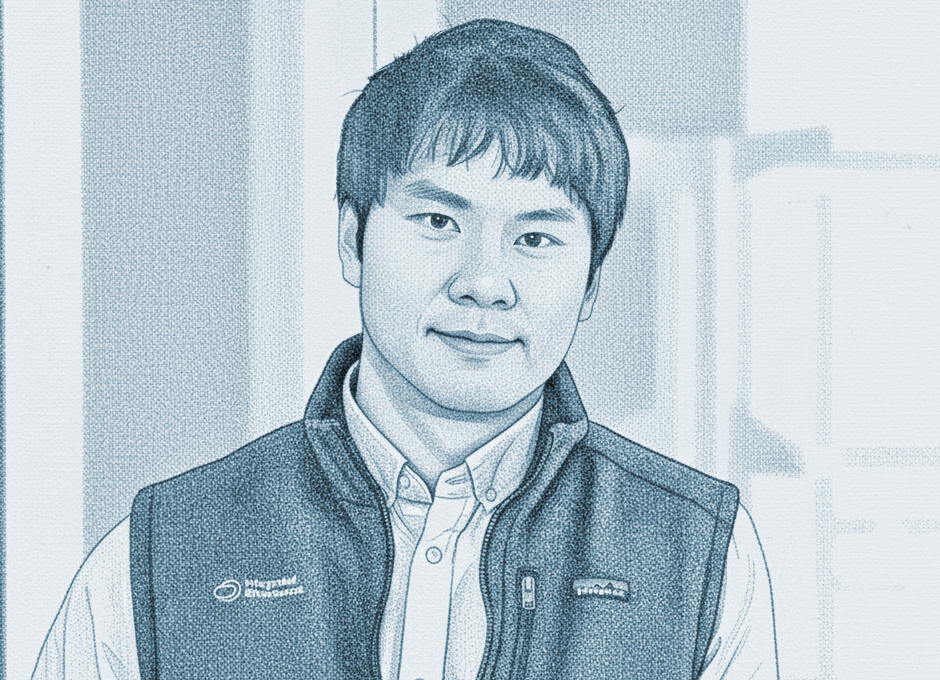
A physicist who decided the medicine cabinet was running out of ideas
Most antibiotics in your pharmacy were discovered before the moon landing. Felix Wong looked at that fact and treated it as a math problem.
Wong runs Integrated Biosciences, the Redwood City company he co-founded in September 2022 with the optogenetics specialist Max Wilson. The pitch is unreasonable on purpose: use synthetic biology, light-controlled cells, and artificial intelligence to discover small-molecule drugs for the diseases that arrive with age. Where most biotechs chase a single target, Wong wants the machinery of aging itself - the cellular stress responses that fray as the years pass.
He came to biology sideways. Wong is a physicist and mathematician by training, with degrees from Harvard in applied physics, computer science, and mathematics, capped by a 2019 PhD in applied physics. People with that resume usually end up modeling galaxies or pricing derivatives. Wong went looking for the equations hiding inside living cells - how they are built, how drugs break them, how infections spread through them.
The hinge of the story is a postdoc in the MIT lab of James J. Collins, a giant of synthetic biology who now chairs Integrated's scientific advisory board. Funded by an NIH career-development award, Wong became fluent in a strange dialect: part microbiology, part machine learning, part statistical physics. Then he and Collins did something the field had mostly given up on. They went hunting for a brand-new antibiotic.
"We think that senescence is only a piece of the bigger puzzle."
The catch with using AI to find drugs has always been trust. A neural network can rank a million molecules and never tell you why. Wong's team built one that could. Their model didn't just point to a promising compound - it highlighted the specific chemical substructures driving its prediction. That is the difference between a tip and a reason. The team, 21 researchers strong, virtually screened more than 12 million candidate compounds and surfaced a genuinely new structural class of antibiotics, lethal to MRSA and other hardened pathogens.
When the work landed in Nature in December 2023, the headline number was the rare part: a new structural class of antibiotic is something the world has seen only a handful of times in roughly six decades. The method was the bigger deal. Explainable deep learning, Wong argued, could change not just which drugs we find but how efficiently we find anything at all.
Cells in virtual reality, switched on with light
If the antibiotic was the proof, aging is the obsession.
Integrated's platform leans on optogenetics - the trick of using light to control what happens inside a cell. By flipping cellular stress responses on and off like a switch, Wong's team can place cells in something close to a controlled virtual reality, generating clean data about the integrated stress response, a hallmark of aging that most drug screens can't isolate. Feed that data to the AI, and the machine starts proposing molecules that nudge the biology back toward youth.
That approach produced the company's second headline: the first AI-driven discovery of senolytics, a class of investigational anti-aging compounds. The models generated candidates with efficacy comparable to known senolytics but better medicinal-chemistry properties - the unglamorous traits that decide whether a molecule ever becomes a drug. In 2025, the team published "Optogenetics-enabled discovery of integrated stress response modulators" in Cell, extending the playbook beyond senescence.
Selected venues from a 30+ publication record. Heights are illustrative of profile, not citation counts.
"We would want any model to predict chemical scaffolds it has not previously seen - and positively identify those as new senolytics."
A first-time CEO, learning the second job
Discovering a drug and running a company are different sports, and Wong took on both at once - a first-time chief executive at 31. In October 2024 he closed a $17.2 million seed round led by Sutter Hill Ventures, with capital earmarked for two things at once: scaling the synthetic-biology-and-AI engine, and pushing the small-molecule portfolio toward the clinic. The same year he turned up on the Forbes 30 Under 30 in Healthcare. Then came a strategic research partnership with LVMH Recherche - the luxury house's science arm taking an interest in the biology of aging.
The leadership bench fills in around him: Max Wilson on the technology, a chief scientific officer with two decades in drug discovery, a chief business officer who came out of big pharma. Collins anchors the science from the advisory board. The shape of the thing is a research lab that decided to grow up into a drug company without losing the habit of publishing what it learns.
What makes Wong unusual isn't the credentials, which are abundant. It's the insistence that an AI in drug discovery should be able to argue its case. In a field crowded with confident black boxes, he built one that explains itself, and then trusted it enough to start a company on the answer. The bet underneath all of it is simple to state and hard to win: that aging is not a fate but a problem, and problems can be engineered.
The Long GamePublishing a company into existence
There's an old tension in biotech between secrecy and science. Drug companies guard their data; researchers publish it. Integrated tries to do both. Since its founding the company has reported its drug-discovery engine in a steady run of peer-reviewed work - Nature, Nature Aging, Cell, Cell Systems - rather than hiding behind a stealth banner. For a founder who spent years in academia, the choice reads less like marketing and more like temperament. Wong's whole argument is that the method is reproducible and that the reasons hold up. The fastest way to prove that is to show the work.
The two-pillar strategy - antibiotics and aging - isn't a hedge so much as a thesis. Both problems come down to the same wager: that vast chemical space, screened intelligently, still hides molecules medicine has never tried. The antibiotic proved the engine could find something nobody had seen against an urgent target. The senolytics and stress-response work points it at the slower, deeper target of how bodies wear out. One is a sprint against resistant bacteria. The other is a marathon against time. Same machine, different finish lines.
It helps that Wong did not build the lab alone. Max Wilson, his co-founder, brought the optogenetics expertise that turns light into a research instrument. James Collins, whose MIT group launched the antibiotic project, lends the scientific gravity of one of synthetic biology's founding figures. Around them sits a leadership team with decades of pharma experience in the seats - drug discovery, business development - the people who know how a promising molecule survives the long walk from a screen to a patient. The structure is deliberate: a discovery culture wrapped in the discipline of a company that intends to ship.
For now, Wong sits at the front of a young company with a rare opening result and a great deal still to prove. The clinic is where biology stops being a paper and starts being a product, and that journey is measured in years, not press releases. But the shape of the ambition is clear. He took the tools of a physicist - models, light, the patience to screen millions of possibilities - and aimed them at two of medicine's most stubborn frontiers. Whether or not the aging bet pays off, he has already done the thing that matters most in science. He found something nobody else could see, and he could tell you exactly why it was there.