Josh Phifer knew the journey before he started looking for a way to eliminate it. On ranches in Wyoming and Nebraska, checking distant assets meant going out to look. A water tank could be perfectly full and still require a drive to establish that reassuring fact. Years later, after flying fighter jets and studying business, he would build a company around the possibility of staying where you were.
He has described spending four hours a day driving around a ranch to check tank levels. That is a substantial portion of a working day devoted to acquiring an answer. The tank, meanwhile, has contributed little to the conversation. It sits there, withholding information until someone arrives.
Phifer became founder and CEO of Barn Owl Tech, a Colorado Springs business making cellular camera systems for places where plugging in a conventional security system is inconvenient or impossible. The appealing version of his biography would let a fighter pilot return to ranch country with the answer already worked out. His actual route involved changing the answer.
An aerospace ambition, a water-tank business
In 2015, arriving at Wharton, Phifer still expected to build something in aerospace. He came with a bachelor’s degree in operations research from the U.S. Air Force Academy and a master’s in aeronautical science from Embry-Riddle. His military jobs included F-22 instructor and evaluator pilot, operational test pilot, and division commander for operational test and evaluation. Starting a company in that neighborhood of experience would have been understandable.
He also had an unshowy view of how to introduce himself. Asked about business-school applications, he urged applicants to treat the exercise as a “personal inventory.” The advice favored an honest account over an elaborate performance. It makes a useful starting point for reading his later business: experience mattered, but it did not guarantee that the first design would work.
By May 2016, Phifer was presenting Barn Owl Systems as a finalist in Wharton’s business-plan competition. Fellow MBA student Vincent Kuchar brought experience with drones and wireless sensor networks. Their proposed system combined aerial imagery, water monitoring and livestock-location data. The pitch gathered several capabilities around the same practical difficulty: ranches contained too much ground for easy inspection.
The venture joined the Fall 2016 VIP-X accelerator cohort. On December 6 that year, Phifer and Kuchar won a $10,000 prize at the Greater Philadelphia Veterans Network’s Veteran Shark Tank. Kuchar had served as an Army Ranger; Phifer came from the Air Force. Together they were taking familiar military technologies toward a civilian problem.
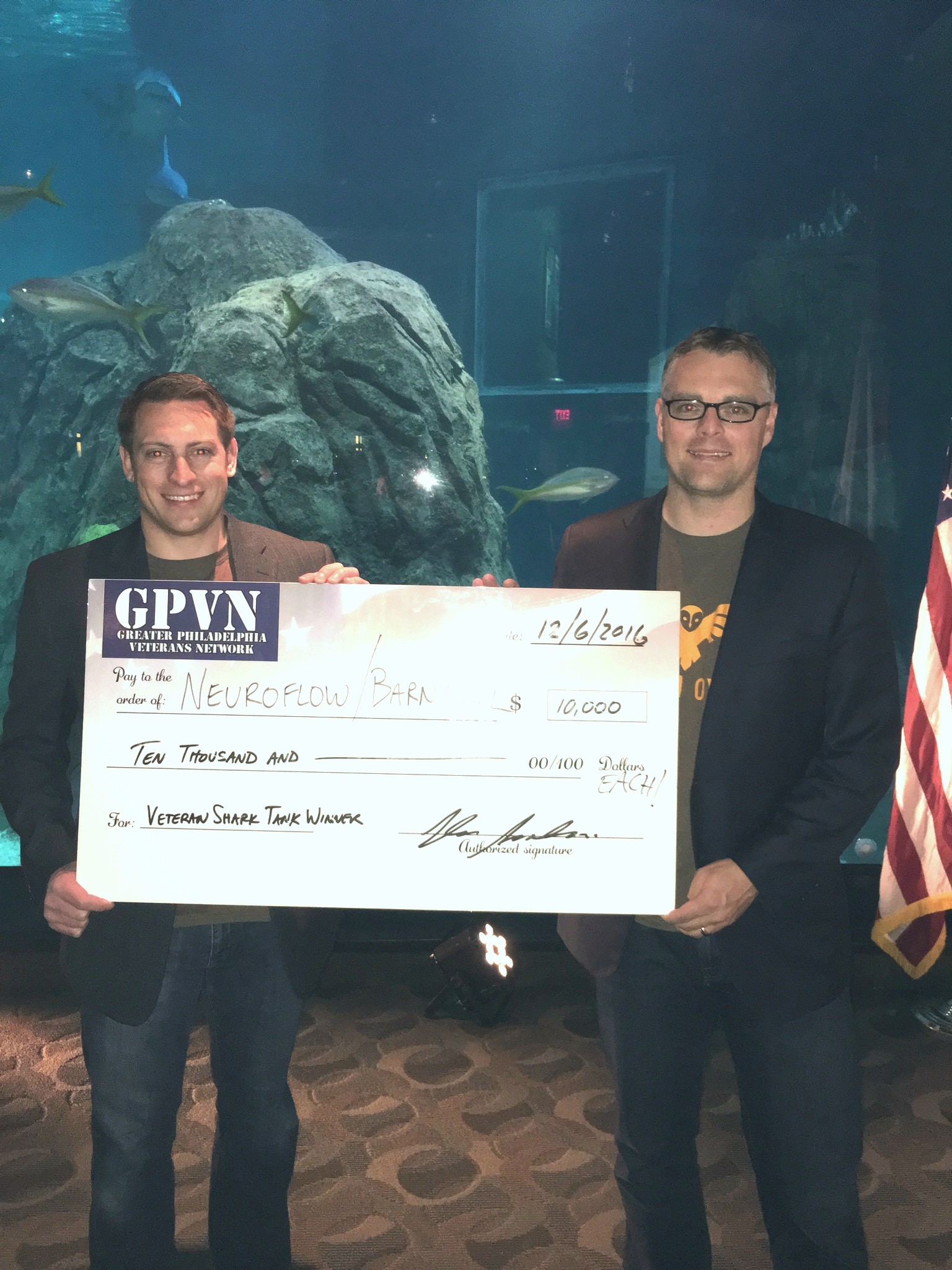
The photograph preserves the satisfying part: two founders, one oversized check. The company’s subsequent direction was still unsettled. An award gives a venture money and attention. Customers bring their own requirements, and they seldom arrive carrying ceremonial stationery.
The customer asks for a picture
The early drone concept proved too complex and expensive to make business sense. Phifer and his team turned toward remote sensors, including a system for checking liquid levels. Water was an obvious place to begin. The same equipment could also address tanks holding fuel or fertilizer.
Testing supplied a more useful answer than enthusiasm alone. Farmers and ranchers could appreciate the sensor while preferring a different product. Phifer recalled their verdict: “We like it. We’d rather just have cameras out there.” Barn Owl shifted into cellular cameras at the end of 2017.
“We like it. We’d rather just have cameras out there.”The ranchers’ feedback, as recalled by Josh Phifer
The distinction matters. A sensor offers a measurement of something selected in advance. A photograph lets the person looking bring their own knowledge to the scene. A tank, a windmill, a gate and the ground around them can each mean something to an operator who knows the property. The choice of what deserves attention need not be settled entirely by the product designer.
That helps explain why the camera business could extend beyond water. A device useful for a tank could also watch an entrance or equipment. Phifer described customers with one or two cameras as well as operations deploying dozens. The task could vary while the basic transaction stayed familiar: look first, then decide whether to go.
A pilot without a pause button
Phifer’s aviation background offers a tempting supply of dramatic metaphors. His own account of its business value was more practical. Military work taught him to make decisions with limited time and resources, communicate clearly, and keep a team moving. Of flying a jet, he observed that “there is no way to hit the pause button.”
For the camera venture, the immediate constraint was software. In 2019 he explained that Barn Owl had used Bubble because custom application development exceeded its resources. The early interface displayed incoming pictures, then accommodated multiple cameras and additional controls. The point was to have something customers could use and revise.
That choice is revealing precisely because it lacks much cockpit glamour. A founder’s previous occupation can make the biography memorable. A working interface still has to show someone the right photograph. Prestige is of limited assistance when the screen is empty.
His public recommendations of former colleagues offer another view of what he notices at work. In writing about technical teammates, he has praised troubleshooting ability alongside kindness and collaboration. Those are descriptions of particular people rather than a personality test for their boss. Still, they show him choosing to acknowledge the human qualities involved in getting difficult systems to behave.
- 01DronesEarly ranch-monitoring concept
- 02SensorsRemote liquid-level checks
- 03CamerasPictures customers asked for
The ranch gate meets the perimeter fence
By November 2019, the company had received a $240,000 grant through Colorado’s advanced-industries accelerator program. The planned work involved using artificial intelligence to monitor remote and mobile assets. Phifer said Barn Owl already had nearly 600 customers and was operating at a profit.
Those numbers belong to that moment. They show a business reaching beyond its earliest experiments, with a new set of institutional expectations coming into view. The grant was intended to help develop a camera for government agencies and small and midsized businesses. Rural surveillance was becoming a route into a broader market.
A federal award gives a particularly concrete marker of that expansion. In 2020, Barn Owl received a $50,000 Air Force SBIR Phase I contract for rapidly deployable surveillance for Security Forces. Phifer was listed as principal investigator. The project described cameras, connectivity, monitoring software, artificial intelligence and an interface for integrating data with other systems.
A documented research award, with Phifer named principal investigator.
The connection to his old profession had become a customer problem of its own. Ranch operators and military installations have different responsibilities, but both can need visibility across places where conventional infrastructure is awkward to install. For Phifer, the relevant experience ran in both directions: knowing what surveillance could do and knowing the inconvenience of going without it.
Money, with experience attached
In June 2024, Cypress Growth Capital announced an investment in Barn Owl. Its description of the customer base included ranchers, construction companies, municipalities, wildlife preserves, government agencies and military bases. The money was intended for sales and marketing work and product improvements.
Phifer’s explanation of the partnership emphasized experienced guidance as well as financing. He wanted people who had led and built industrial technology companies. Cypress also cited his work as a director at the Air Force-MIT AI Accelerator. By then, his career connected ranch operations, aviation, software and applied artificial intelligence.
The mix is interesting because each setting asks different questions of the same product. A technical capability must survive the journey into installation, daily use and support. Someone buying a camera for a remote site has a problem at that site. They need the combined system to function there, however many disciplines were required to assemble it.
Wharton’s Spring/Summer 2025 profile recorded a team of 16 employees and noted Barn Owl’s veteran ownership and military discounts. The headcount offers a dated measure of how far the operation had come. It also makes the enterprise feel human in scale: a group of people maintaining a product used across much larger distances.
An owl with a longer view
The company’s name supplies its own explanation. Barn Owl points to the bird’s ability to sense things at a distance and turn that ability into practical benefit. Its published values emphasize humility, appetite for work, kindness and trust. For a business selling remote visibility, the last of those has a particularly literal job to do.
In September 2025, a company post under Phifer’s byline described RangeCam Live, extending the proposition from recorded images to a live view. The next month, another post featured Jay and Charlotte, first-generation operators building Algiere Ranch. The subjects brought the attention back to people making a working life on the land.
Phifer’s journey contains aircraft, an MBA and research contracts. Its recurring question is smaller and more persistent: what is happening over there? The first answer involved going to see. His business has spent years making another answer available, one camera at a time. Somewhere, a tank can be full and a gate can be closed without requiring an expedition to prove it.