A greenhouse is a promise you can walk into. There are rows, pipes, glass and workers. Money has acquired an address. For Jonathan Webb, that was part of the attraction: an idea about the future could become a place in Kentucky where people showed up for work. His next promise involves nuclear reactors, which make a greenhouse look almost forgiving. The question following him into that business is the same one that followed him out of agriculture. Once the thing is built, will the whole enterprise work?
Webb founded AppHarvest in 2017. Its indoor farms offered an appealing arrangement: borrow methods from the Netherlands, grow produce nearer American shoppers and put investment into Appalachia. The company went public in 2021. In July 2023, Webb was replaced as chief executive. Later that month, AppHarvest filed for bankruptcy. Those events belong together, however awkward the seating arrangement.
He is now co-founder and CEO of The Nuclear Company, a venture organized around the delivery of nuclear infrastructure. His career invites a story about reinvention. It also invites a more useful story about continuity: the same appetite for large physical projects, carrying a much less convenient understanding of what can go wrong.
Rainfall, roads and an old Kentucky friendship
Webb graduated from the University of Kentucky’s Gatton College of Business and Economics. He studied marketing and graduated in 2007. The credential suits a career spent translating technical possibilities into propositions that investors, public officials and future colleagues might find worth their time.
Before AppHarvest, he supported energy initiatives for the U.S. Army, working on privately financed projects at military installations. He worked as a contractor helping teams develop solar, storage and microgrid projects. He encountered Dutch indoor agriculture while working in sustainable project development. The idea travelled well enough to send him home.
In February 2017, Webb left Washington for Kentucky. The agricultural pitch had a geographical logic. Rain could supply the greenhouses. A central location could shorten the journey to customers. A region associated with an industry in retreat could host a new one. He was asking people to see an industrial opportunity in a place accustomed to hearing explanations for its decline.
One recruit was his friend Ramel Bradley, the former University of Kentucky basketball player. Bradley had an agriculture degree and had been pursuing work around food in Brooklyn. Webb called and urged him to put that education to use. Bradley joined AppHarvest in 2017. It is a pleasingly Kentucky detail: a future farming company reaching into an old basketball friendship to assemble its team.
- 2007University of Kentucky marketing graduate
- 2017Returns to Kentucky; founds AppHarvest
- 2020First Morehead greenhouse opens
- 2021AppHarvest becomes publicly traded
- 2023CEO change; AppHarvest files for bankruptcy
- 2024The Nuclear Company emerges publicly
- 2026Brookfield venture announced for nuclear project delivery
The part the glass could not solve
The first AppHarvest greenhouse opened in Morehead in 2020, covering about 60 acres. This was agriculture with the physical presence of an industrial complex. By the time the business was publicly traded, the structure itself could serve as an argument. Here was something you could visit, photograph and point to from a road.
The distinction between a construction accomplishment and a commercial accomplishment would become painful. A greenhouse needs crops, yields, customers and cash flow after the contractors have gone. Its opening ceremony has no authority over the next harvest. The tomato remains wonderfully indifferent to the capitalization table.
AppHarvest attracted recognizable supporters. Martha Stewart joined its board and appeared with Webb in a televised interview about the planned public listing. The promise was easy to understand: modern facilities, American produce and jobs in a region that wanted investment. The economics proved harder. Lower crop yields than expected and elevated operating costs contributed to the company’s difficulties.
In July 2023, Tony Martin took over as CEO. Webb became chief strategy officer and remained a director at that transition. On July 23, AppHarvest and its debtor affiliates filed voluntary Chapter 11 petitions. The chronology is important. The public listing had brought the company into a new arena; it had not settled the underlying operating problem.
There is no reason to sand that chapter smooth. People had committed money and work to the enterprise. Bankruptcy was a business outcome with consequences, rather than a dramatic device placed conveniently before a founder’s next entrance. Any account of Webb’s infrastructure experience needs both the facilities that were built and the company that failed.
A new industry, a familiar construction problem
The Nuclear Company emerged publicly in 2024 with a proposal centred on construction. Its approach uses established reactor technology and repeated designs, aiming to make each build less of a fresh organizational experiment. The company describes the method as designing once and building many times.
For Webb, the continuity is in assembling a system: people with experience, partners with technical knowledge and capital willing to wait for physical results. The company’s ambition is to coordinate those ingredients at the scale of nuclear fleets. A reactor design can be proven while the business of delivering another plant still contains plenty of opportunities for expensive confusion.
In April 2025, The Nuclear Company completed a Series A financing led by Eclipse and opened its primary engineering and construction office in Columbia, South Carolina. Greg Reichow, an Eclipse partner and former Tesla executive, joined the board. At the time, the company was evaluating sites for a proposed six-gigawatt fleet.
The site-evaluation ambition reported in April 2025. Gigawatts describe the scale of the plan; completion determines whether it becomes electricity.
That last distinction matters particularly in Webb’s story. A funding round is an event. A staffed office is a place. A gigawatt target is an ambition. Each can be meaningful without being interchangeable. Nuclear development has a long enough calendar to accommodate many announcements before anyone can switch on a light using the resulting power.
The paperwork gets an Iron Man suit
Webb’s present diagnosis puts considerable weight on coordination. Materials, schedules, inspection records and the availability of crews can govern what happens on a job site as surely as the engineering drawing. A missing document may look less impressive than a crane. It can still leave the crane waiting.
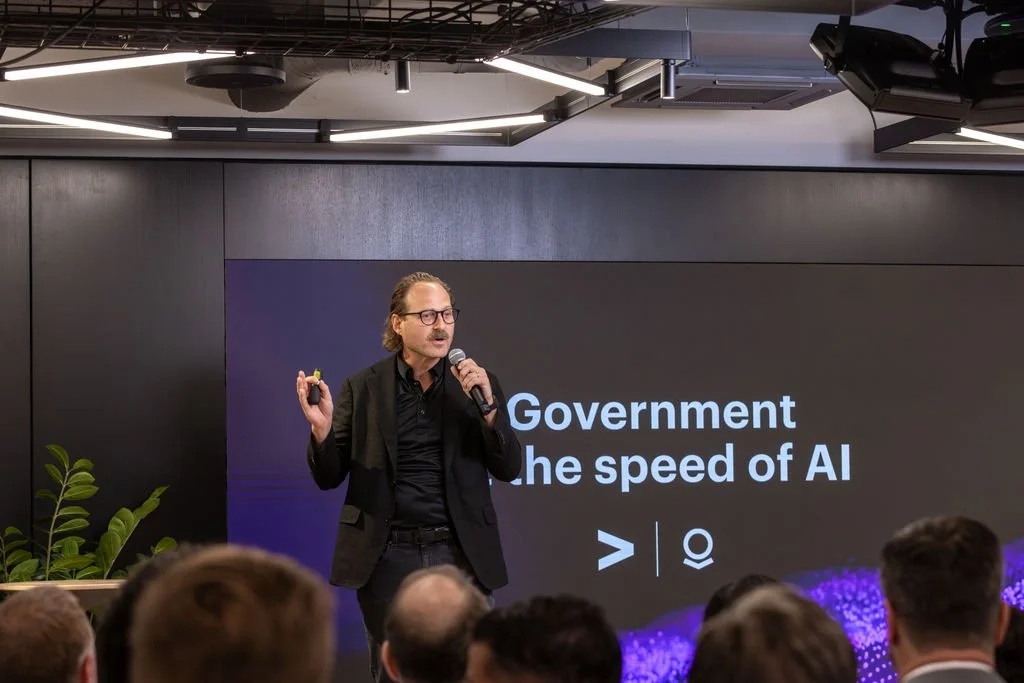
In June 2025, The Nuclear Company and Palantir announced plans to develop the Nuclear Operating System, or NOS. Built on Palantir’s Foundry platform, the proposed system connects construction decisions with information about parts, constraints and progress. Webb was scheduled to demonstrate it at Palantir AIPCon that September.
The company describes several intended uses: tracking materials, adjusting work when constraints change, comparing site progress with digital models and helping review regulatory documentation. These are proposed mechanisms for reducing mistakes and delays. Their value has to be established through work on actual projects.
In an interview about the partnership, Webb reached for the image of an Iron Man suit to explain how he wanted to equip frontline workers. It is a flamboyant comparison for a problem partly involving paperwork. There is a practical argument underneath it: the person doing the job should have the information needed to do it.
South Carolina has something to finish
The current chapter has a particularly demanding setting. In May 2026, Brookfield and The Nuclear Company announced a venture focused on project development and delivery using Westinghouse reactor technology. Brookfield selected that venture as project manager for the potential completion of V.C. Summer’s two partially constructed AP1000 units near Jenkinsville, South Carolina.
The announcement attached conditions to the work. Further evaluation, regulatory approvals and definitive agreements remained necessary. Delivery would follow if the project reached a final investment decision. Those conditions belong in the story because they describe where the undertaking stands, rather than where its participants hope it will end.
The site makes finishing an unusually literal challenge. There are already unfinished reactors. There is already a history that the new team must work within. The job involves inheriting decisions and physical structures, then determining how to move forward. An empty field offers fewer reminders.
By his September 23, 2026 appearance on the podcast Shift Key, Webb said roughly 40 to 50 people were on site. He described planning as work that begins when a team arrives on the ground, while acknowledging the formal milestones between a project decision and operation. His phrase for the obligation was blunt: “we got something to finish”.
“we got something to finish”
Jonathan Webb, September 2026
For a founder coming out of AppHarvest, that sentence carries weight beyond the reactor site. It makes an appropriate standard for the second enterprise. The result cannot be supplied by the biography, the investors or the software demonstration. It has to come from the project.
The next verdict comes from the field
Webb’s public conversation repeatedly returns to Kentucky and to the contribution of communities that powered the country. He admires the writer Wendell Berry, an interesting presence in the intellectual company of enormous greenhouses and nuclear fleets. A concern for place can coexist with an appetite for industrial scale; making them work together is the difficult part.
He has also described himself as an optimist. That is easy enough to believe about someone taking on another capital-intensive construction venture after a bankruptcy. Optimism helps explain why he starts. It cannot, by itself, explain whether the next enterprise will last.
The person who emerges from these chapters is an organizer of ambitions with physical consequences. His work reaches beyond a pitch deck into places where other people live, invest and earn their wages. Kentucky’s greenhouse experiment gives his current promises a history. South Carolina’s unfinished reactors give them an address.
There is an unfinished business in that combination. Webb has shown that he can persuade people to attempt large projects. The next measure is more exacting: whether the teams he helps assemble can deliver an enterprise that works after the opening photographs are taken. A building can be admired on its first day. Its usefulness has to turn up again the next morning.
Follow the work
Webb’s writing, conversations and the projects behind this profile.