Efficiency is a habit, not a project
Rachel Seevers spends her days inside the Office of the CEO at The Nuclear Company, the outfit that calls itself America's nuclear infrastructure platform. The pitch is unglamorous and enormous: stitch the whole nuclear lifecycle onto one operating model and one data backbone, then deliver reactor fleets on schedule and on budget. Nuclear projects are famous for doing the opposite. Seevers is there to help change the verb.
It is a strange landing spot for someone who first made headlines by studying how jellyfish waste nothing. Look closer and it is the most obvious job in the world for her.
Because the thread running through everything Seevers has built is the same stubborn question: how do you get more out of less? Less fuel. Less drag. Less wasted water, wasted time, wasted schedule. She has chased that question through wind, through ocean, and now through the grid. The Nuclear Company raised a $51.3 million Series A on the promise of standardized, repeatable nuclear builds - roughly $71 million in total funding for the idea that reactors can be delivered like products, not like one-off miracles. Seevers, sitting next to the CEO, works the strategy behind that promise.
Jellyfish appear to be lazy swimmers. But maybe it's better to think of them as energy efficient.
A Kentucky kid who kept coming back
She grew up in Lexington, Kentucky - an inquisitive child who started dance at three and moved through choir, theater and Girl Scouts before science fairs quietly took over her life. The turning point was ordinary: an 8th-grade trip to the International Science and Engineering Fair, not as a competitor but as an observer. She watched other kids present real research and decided she would be back on the other side of the table.
She was. As a student at Paul Laurence Dunbar High School she racked up district and regional wins three years running. She spent a summer at the Research Science Institute at MIT, the invitation-only program run by the Center for Excellence in Education. And she poured more than 7,000 hours into a single aeronautical engineering project - the Virtual Winglet, a novel wing design that suppresses the wingtip vortices and flow separation that quietly bleed fuel out of every aircraft. Her result: an average 21.6% improvement in lift-to-drag efficiency, patent pending.
That work traveled. It picked up recognition from NASA, the U.S. Air Force, the U.S. Navy, and the Society of Experimental Test Pilots. At the Regeneron Science Talent Search she finished eighth in the country. And her fellow finalists - the forty other best young scientists in America - voted her the Glenn T. Seaborg Award, given to the person who best inspires others with a zeal for science. That last one is not an engineering prize. It is a character reference from your toughest peers.
Two inventions, one obsession
// measured efficiency gains, self-reported at ISEF
The lazy swimmer that won everything
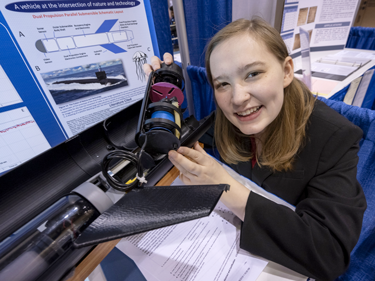
In 2019, at Intel ISEF in Phoenix, Seevers did the thing that put her name in the science press. She built an underwater propulsion device that borrowed its logic from a jellyfish - pairing a conventional propeller with a pump that cycles pulsed jets of water, the way a jellyfish flexes and glides. The payoff was a machine up to 37% more efficient than the conventional approach.
The judges gave her the $50,000 Intel Foundation Young Scientist Award and top honors in engineering mechanics. Her ambition for the device was never the trophy. It was the map. Cheaper, longer-range submersibles and underwater drones, she argued, could finally reach the roughly 95% of the ocean that humans have never seen. She framed it as a duty, not a hobby - the researcher's obligation to point at what we don't know and refuse to look away.
"Nobody can achieve success without the help of others."
"Nothing will work unless you do."
She built the door she walked through
Winning things was never the whole plan. Before she could legally vote, Seevers cofounded a girls STEM club and created STEMfems, a program that brings hands-on science workshops into underprivileged elementary schools. Her stated passion has been consistent for years: get more girls and women to see themselves in a lab coat, a cockpit, a control room.
Then came Harvard, where she studied mechanical engineering and education - a deliberately double major of a mind, half builder and half teacher. After graduating she joined Deloitte as an analyst, learning how large organizations actually move, before taking the strategy seat at The Nuclear Company. The through-line from jellyfish to reactors is not the subject. It is the method: study the system, find where energy leaks out, redesign the flow.
Smile, be nice to everyone, always stay positive and try your best.
Off the clock, she fixes pinball machines
For all the awards, the detail that sticks is domestic. Seevers unwinds by restoring vintage pinball machines with her dad - flippers, bumpers, tangled wiring, the analog cousin of everything she does professionally. It is the same instinct that drives her engineering: take a complicated old thing, understand exactly how it moves, and get it working better than it did before.
As a teenager she named an audacious long-term goal - Secretary of Defense - alongside a life of research. Whether or not that particular title ever lands, the shape of the ambition is clear. She wants to sit where engineering, service and consequence meet. Right now that seat is inside a company trying to make American nuclear power boring, in the best possible way: predictable, repeatable, on time.
It is a long way from a Phoenix convention hall and a homemade jellyfish. It is also, when you follow the logic, no distance at all.