Jonathan Azoulay announced his return with a photograph of people crowded into his home. The talent.io leaders had gathered to hear that their co-founder was coming back to the controls and to prepare the next quarter’s strategy. In the foreground, Azoulay held the camera. Behind him were colleagues, a hammock, framed pictures and the sort of cheerful compression that happens when a team tries to fit into one selfie.
It was 2023. He had spent two years away from operations. His announcement carried conviction and a joke about refusing to watch the upheaval in recruitment with a packet of popcorn. He believed in the project and wanted to participate. The photograph preserved a beginning. What followed would be considerably harder to fit into a cheerful announcement.
By 2025, talent.io had been acquired through a court-supervised sale. Today, Azoulay’s work centres on MVMT, which helps entrepreneurs take over established businesses. His career has acquired an unusual sequence: build an agency, build a platform that competes with the agency, return to that platform during a crisis, then turn towards companies that other people have spent years building.
Building his own competition
Azoulay’s first sustained education in recruitment came on the job. He worked at a large British recruitment agency before founding Urban Linker in 2009. Technology and digital businesses became his territory. This was a trade in which understanding a company’s problem mattered, but understanding a candidate’s willingness to move mattered just as much.
There was a personal connection to that work. His father was an IT developer. Azoulay helped him find a job through a recruitment agency and disliked the experience: the communication, the relationships, the fit. For a recruiter, the candidate was also Dad. An unsatisfactory placement became something more memorable than a disappointing line in a sales report.
In 2015, he co-founded talent.io with Amit Aharoni and Nicolas Meunier. Urban Linker was still part of his life; he would sell it in 2018. The new business challenged the service model of the earlier one. Azoulay had seen other markets reorganised around platforms and thought recruitment could make a similar move from a service towards a product.
That decision required a particular sort of disloyalty to the familiar. An agency teaches its founder how much effort goes into a placement. A product asks which parts of that effort can be arranged differently. Azoulay had spent years learning the first answer. He now had a financial interest in finding the second.
A job search with an appointment
The early talent.io model made a small but consequential change to the hiring ritual. It presented selected developers who were available to change jobs. Employers approached them, and candidates decided whether to continue the conversation. In an early version, new groups appeared in two-week sessions. The company was selling a more useful moment of contact.
Consider the familiar inconvenience on each side. An employer can find an impressive profile whose owner has no intention of moving. A developer can receive a flattering message that arrives months before it is useful. More contact does little to solve either problem. The platform tried to bring suitability and availability into the same window.
There was human work inside the product. Screening and conversations helped establish whether someone belonged in that window. The appeal was the preparation before the interview: a company and a candidate could arrive with some reason to believe the meeting might lead somewhere. A database can tell you who exists. Hiring requires a further question: who is ready?
Expansion followed. Azoulay announced launches in Berlin and London in 2016. A freelance offer came in 2017. The ambitions were European, with different forms of work passing through the same underlying problem of finding an appropriate match. The recruiter had built a business around a person’s next move. The founder was now making several moves of his own.
- 01Screen the profile
- 02Confirm availability
- 03Employers make contact
- 04The candidate decides
A prepared introduction, timed to a real job search.
Who gets to decide?
His interest in organisation extended beyond the marketplace. In January 2017, Azoulay wrote about company values with a title that began with the word “Bullshit”. He was concerned with the distance between a declaration of good intentions and a rule that helps someone act. Corporate posters, apparently, were going to have to earn their wall space.
The team had grown from three to 35 people in 15 months. Decisions could stall while people waited for a founder. Azoulay and his partners gathered individual feedback and developed three short values. The important work came afterwards: attaching those words to responsibilities, consultation and ways of checking progress. A colleague taking ownership of a role had to seek advice from affected people while retaining responsibility for the decision.
Take ownership. Think team. Make impact.
The three values Azoulay described in 2017
He also described dividing managerial tasks among people willing to take them on. Onboarding a new account manager could become a documented role: someone prepared the training plan, coordinated colleagues and followed the new arrival’s first two months. There was still work to organise. The experiment changed how that work was distributed, and how taking responsibility could lead to another opportunity.
Remote work brought another set of practical details. In 2021, Azoulay and talent.io market manager Margot Dumas-Danon discussed communication across locations. Written information, regular leadership updates and a rule that everyone joined remotely when one participant was remote helped make participation less dependent on a seat in the office. The meeting invitation had become part of the company’s operating design.
His views continued to change. By a 2024 conversation, he was questioning horizontal management during a crisis. That is a revealing qualification to the earlier experiment. A structure has to survive more than the circumstances in which it was first attractive. Urgency, uncertainty and difficult choices ask different things of the people sharing authority.
The return, before the result
Azoulay’s two years away also changed what he noticed. When he wrote about the break, he described recovering the ability to stay with conversations that had no direct connection to his business problems. He recontacted people who had inspired him but whom he had not properly taken the time to hear. The observation was unusually specific: attention had become another thing to relearn.
A founder can spend a working day moving among urgent decisions, each one entirely reasonable in isolation. The cumulative effect is a world whose boundaries are drawn by the company. Azoulay’s account of the pause makes the return more interesting. He came back with experience from outside that daily rhythm, as well as knowledge of the business within it.
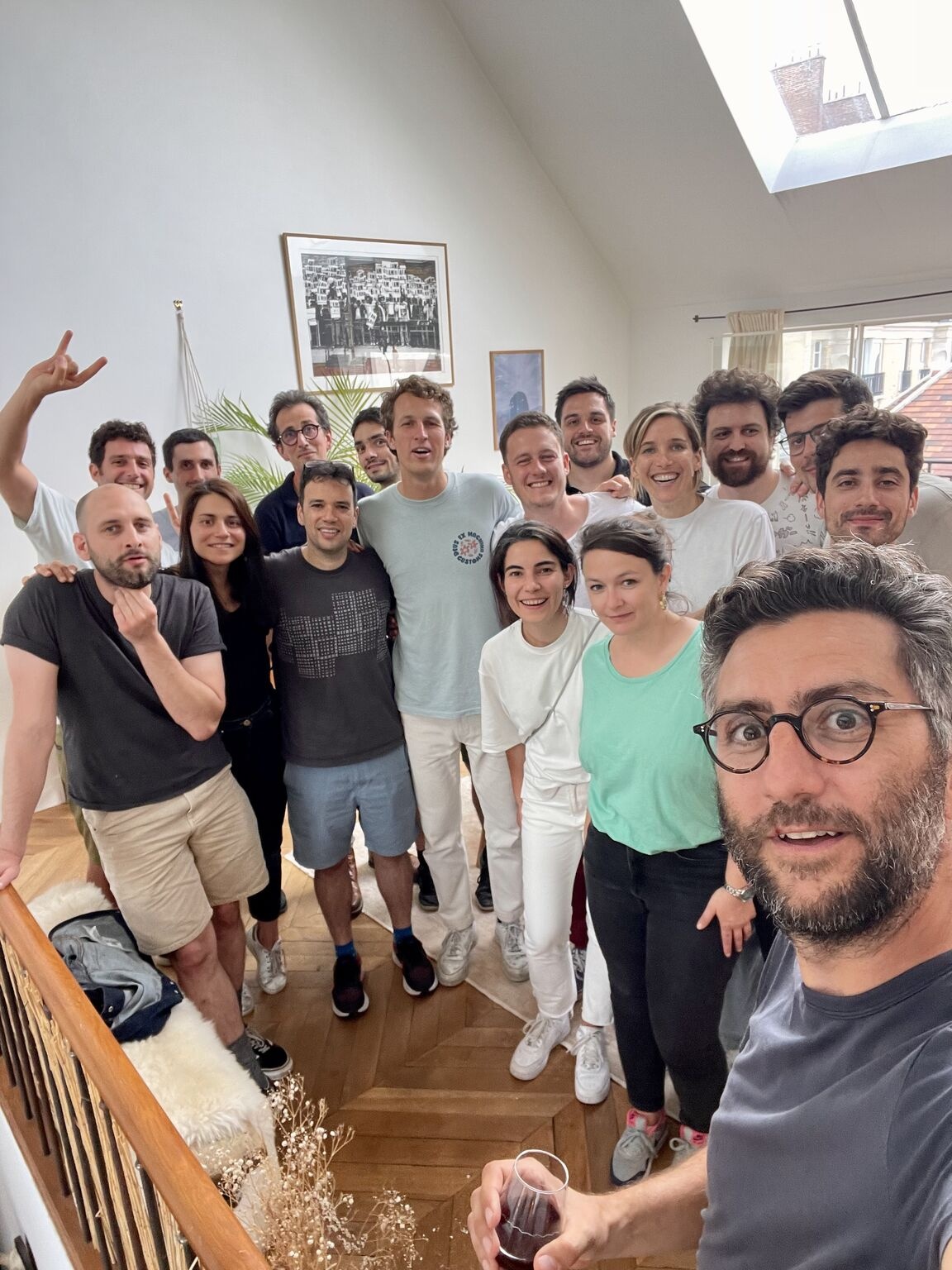
The team photograph belongs to that moment. It shows colleagues assembled for the next stage, before the outcome could be known. Read backwards from the eventual sale, a comeback can look inevitable or misplaced. At the time, it was a decision to resume responsibility. The image deserves to retain that uncertainty.
When growth changed direction
The difficulty was already in the market. Azoulay later described talent.io’s first half of 2022 as running at an annualised €15 million in revenue, with 40 per cent growth and profitability within reach. From the third quarter, activity deteriorated. Revenue fell 80 per cent in 18 months. Those figures describe his retrospective account, rather than a set of audited annual results.
Revenue index, normalised to 100. An 80% decline leaves 20% of the starting level; absolute revenue for the second point is not specified.
He returned to leadership in June 2023. The business withdrew from loss-making markets and narrowed its activity, but entered judicial reorganisation in September 2024. Davidson Consulting’s acquisition was reported in March 2025. A recruitment marketplace depends on employers making recruitment decisions. When that demand contracts, an improved introduction cannot supply the missing vacancy.
In April 2025, Azoulay and investor Audrey Soussan looked back together. He identified a company built for growth that had failed to accommodate recruitment’s cycles. He also questioned the dependence on LinkedIn and the habit of optimising the existing business while the market changed around it. The examination was about decisions within their reach, as well as forces outside it.
That makes the later account more useful than a simple tale of an unlucky market. There is a founder considering the design of his company, an investor reconsidering assumptions, and a business whose previous success did not settle the next question. The calculations that once supported expansion had to be reopened. Growth had supplied confidence; it had supplied less practice at contraction.
Someone else’s first chapter
At MVMT, Azoulay is now President and CEO. He works alongside Agathe Desplats, the firm’s COO. The venture focuses on acquiring established small and medium-sized businesses and supporting their continuation. An entrepreneur arriving through this route inherits customers, colleagues and working habits. The first task includes understanding what somebody else has already made.
For Azoulay, the setting has changed again. Recruitment asked him to understand a candidate’s next step. A platform asked him to prepare many such steps. Business succession brings an outgoing owner and an incoming operator into the picture. Experience is useful here, but the company under discussion comes with its own history and its own reasons for doing things.
There are echoes of his earlier interests: the matching of people, the organisation of responsibilities, the relationship between a decision and the moment to make it. There is also a different starting point. The new owner’s opportunity rests partly on keeping something valuable in motion. The founder who once competed with his own creation is now working on what other founders leave in someone else’s hands.
Azoulay’s story remains open at that handover. An agency was built and sold. A platform grew and encountered a market it could not overcome. Another venture is underway. The photograph from his return still catches him in front of a group of people, holding the camera, trying to get everybody into the next frame.