John Wallace went looking for help with Microsoft .NET and found someone he would build two companies with. The introduction happened through Craigslist, a place where the line between a promising opportunity and somebody else’s unfinished project can be rather fine. Bala Kandula answered. Wallace was building DataSong and, by his own cheerful admission, needed “adult supervision.”
More than 20 years later, the two are co-founders of LiftLab. Between the first reply and the second company came a business serving retailers, an acquisition, and the decision to work together again. Their partnership supplies a useful opening to Wallace’s story because it involves something his professional life keeps returning to: a proposition tested by experience.
A prospective collaborator can promise almost anything. A colleague who has already helped build and sell a company arrives with a longer record. Wallace and Kandula had one, and chose another round.
French first, statistics later
Wallace grew up in Virginia, the son of a carpenter and a teacher. Teaching ran through the extended family. He took a scholarship to Virginia Wesleyan College, studied French, worked in technology sales, and eventually completed an MBA at George Washington University in 2000.
His interest in data mining came with a family joke attached: his mother taught statistics, the subject he had wanted little to do with as a teenager. Independence sometimes takes the scenic route home.
He subsequently worked as an analytical consultant at SAS. The job put him among colleagues with substantial mathematical training and gave him access to training of his own. The career that followed grew out of learning the software, then learning what people needed to accomplish with it.
The business he gave a year
In 2003, Wallace started an analytics consulting firm as a one-person operation. He gave himself a year. Returning to employment, joining another consultancy, and growing the business were all possible outcomes. Growth won.
His original preference was to approach a customer’s problem without having to promote a particular software license. He also wanted variety in the work. A television subscription business and a retailer could present different questions, and he thought that range would keep the team interested while reducing dependence on one industry.
He later acknowledged that the broad approach had limits as a strategy for scaling. The willingness to retire an idea appears early in this account. Wallace could enjoy the intellectual variety and still concede that the business needed to change.
The firm became DataSong, working on multi-touch attribution: allocating credit among the marketing encounters along a customer’s route to a purchase. Wallace’s work included major retail brands. His earlier measurement experience also extended to Visa transaction data. Marketing became the increasingly concentrated application of an appetite that had begun more broadly.
MarketShare acquired DataSong in 2015. Wallace went on to become chief growth officer at MarketShare. For a founder who had started alone and allowed himself twelve months to see what happened, it was a considerable distance from the initial experiment.
A reunion with a different method
After the sale, Wallace considered leaving the field. He explored projects involving agriculture and taste. Former colleagues were thinking about what to build next, however, and conversations with familiar customers exposed questions that were still unresolved.
That familiarity mattered commercially. In the early LiftLab business, some customers were willing to try the new system because they knew the team’s previous work. Wallace described a proof-of-concept period in which a customer could watch the system operate on its own data before deciding how much it needed the product. Trust opened the conversation; the work still had to justify continuing it.
The conversations were extensive. In a post written as brands prepared their 2020 budgets, Wallace said he, Bala, and Mike had met nearly 100 brands over the preceding 18 months. He described teams trying to make sense of paid media while finance pressed for clear answers. Long before the later product releases, that conversation between the people buying advertising and the people approving the budget was already part of the company’s work.
There was also a reason to change the underlying approach. Wallace anticipated that privacy changes would weaken the user-level data available to attribution businesses. LiftLab, founded in 2018, would use aggregate information and deliberately designed experiments. His first instinct was to concentrate on becoming good at running those experiments.
The company would bring together advertising-spend information from platforms and revenue information from customers’ own systems. The shift moved the work away from reconstructing every individual journey and toward investigating what happened when advertising activity changed.
Then customers supplied a complication. Experiments were useful, but the surrounding media plan raised further questions. Wallace’s team debated remaining a standalone experimentation product at a lower price or undertaking more development. They chose to expand, adding marketing mix modeling.
The resulting combination joined two different jobs. A model could estimate the relationships across spending and business results. An experiment could introduce a deliberate change and provide evidence against which those estimates could be checked. Customers had encouraged the team to widen the product rather than simply polish its original boundary.
“Where’s the lift?”
John Wallace’s recurring question in customer meetings
The average has an alibi
Wallace’s recurring concern is the return from the next dollar. Advertising reports can show what a channel has delivered on average. A budget decision asks what additional spending is likely to deliver now, at this level of investment.
His explanation turns on diminishing returns. An advertiser can find useful audiences and placements, then encounter less rewarding opportunities as spending rises. The past average can remain respectable even as the marginal return deteriorates. A dashboard can keep smiling while the next purchase of media becomes harder to justify.
Wallace applies that scrutiny across the media plan. A company pursuing growth may consciously accept short-term losses; a company emphasizing profit may choose another threshold. He argues that either objective benefits from knowing the economics of the additional spend. The business chooses the trade-off. Measurement helps make the choice explicit.
He also has a way of turning an unwelcome instruction into a useful question. If a business needs to cut its advertising budget, he suggests making the reduction in a selected geographic portion of the country, then measuring the effect, rather than immediately making the same reduction everywhere.
A cut becomes an opportunity to gather evidence about what would be lost. The distinction matters in the next meeting: management can discuss the growth it is prepared to forgo, alongside the money it wants to save. A smaller bill is easy to recognize. The revenue that might have arrived requires more work.
In a July 2026 discussion, Wallace described an advertiser that had expanded a channel almost eightfold without revisiting an earlier incrementality result. LiftLab’s analysis suggested that roughly 80% of the channel’s spend could be removed with only a 1% revenue change. In Wallace’s account, the advertiser cut in stages, checking the results along the way.
The case is his caution against treating one test as a permanent permission slip. A result at one spending level cannot be carried indefinitely into another. Even a good experiment has a date and a set of conditions attached to it.
Still asking where the lift is
At LiftLab’s New York customer forum in May 2026, Wallace opened by expressing pride in the team and its customers, then made room for the things that concerned him. It was an apt combination for someone selling a way to investigate uncertainty. The occasion allowed both the work already done and the questions still open to share the stage.
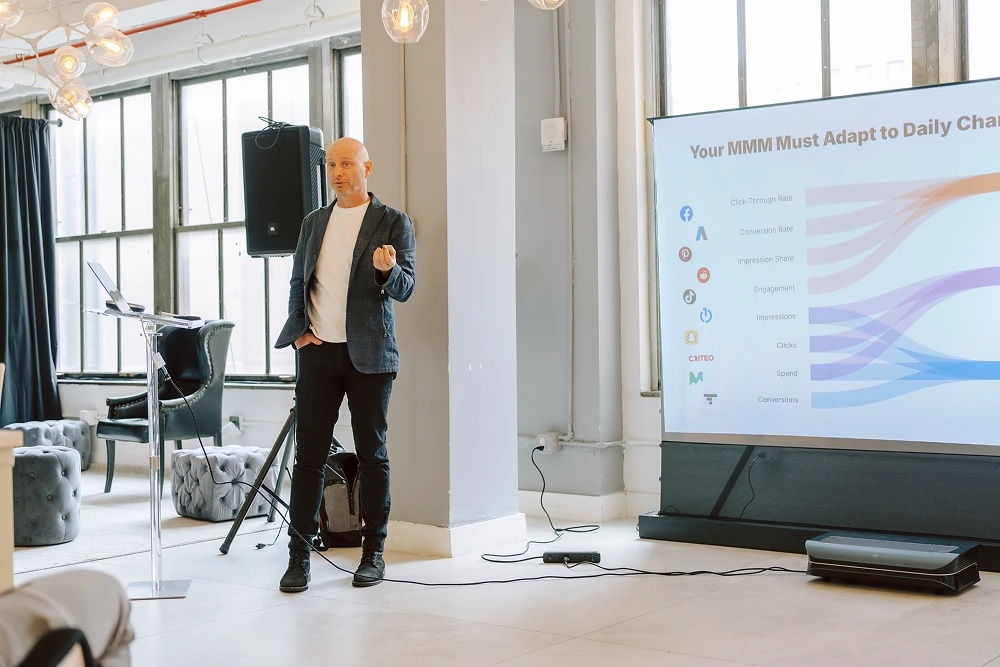
His public conversations that summer returned to specific decisions: how promotions affect performance, how margins differ between online and store sales, and how to evaluate automated advertising platforms. The questions are ordinary enough to arise in a weekly meeting. Answering them requires more than a single blended return figure.
Wallace’s August discussion of advertising algorithms offered a particularly plain explanation of incentives. An advertising platform has reasons to seek more of a customer’s budget. Expecting it to recommend moving money to a competitor is optimistic. The advertiser needs a way to evaluate the channels together, including the return from the last dollar committed to each.
The summer’s discussions also show how granular those questions become. A promotion can influence sales alongside the advertising that publicizes it. A purchase in a store can carry different margins from a purchase online. Wallace described marketers wanting to understand particular offers and acquisition objectives, rather than receiving one number that averages the business together. These details bring the analysis back to the company actually buying the media, with its own prices, sales channels, and priorities.
He gives the name LiftLab a similarly practical explanation. Lift is the improvement a marketer wants to establish. Lab stands for the willingness to take things apart, investigate them, and accept some immediate inconvenience in exchange for learning. It is a business name that obliges its owner to keep asking awkward questions.
There is a pleasing continuity in that. The one-person consultant gave himself a year to see whether a business would work. The founder found a collaborator through an unlikely channel and kept building with him. The returning entrepreneur allowed customers to change the scope of his second product.
Now the decision waiting for his customers is another experiment in allocation: where to put the next dollar, and what they can reasonably expect it to do. Wallace has spent much of his career making that small decision harder to answer casually.